Shrub · Berberidaceae
Japanese Barberry
Berberis thunbergii
Tough, thorny, and richly colored, but assess the site and the law before you plant it where it can spread.
Full sun
Every 7–14 days
USDA 4–8
3–6 ft · 0.9–1.8 m
Overview
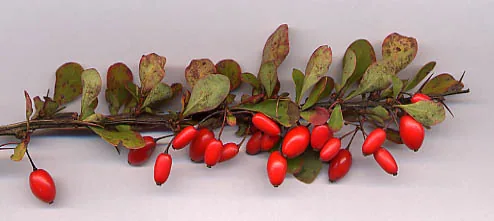
Japanese barberry is a dense, rounded deciduous shrub valued for foliage color and durability. It attains 3 to 6 feet (91 to 183 cm) in height and spreads even wider, bearing small leaves that develop red, purple, or gold tones according to cultivar. Pale yellow flowers open in late spring, and the bright red berries that follow in fall persist well into winter.
Its reliability comes from a broad tolerance for adverse conditions. It withstands drought once established, accepts poor soil and urban pollution, and escapes deer browsing because the sharp single spines at every node deter feeding. That same spination is what makes it serviceable as a low defensive hedge and a barrier beneath windows.
The significant qualification is ecological. Across much of the eastern and midwestern US the species has naturalized and become badly invasive, and its thickets are associated with higher deer-tick densities. Because several states now regulate it as a noxious weed, the first responsible step is confirming whether planting it is even permitted where you live.
Care
The short version: site it in full sun for maximum foliage color, plant it in any well-drained soil, irrigate it through establishment and then largely withhold water, and wear thick gloves for every pruning job.
Light
Give it full sun for the deepest foliage color, since light drives the pigment expression that makes the purple and gold forms worthwhile. It tolerates partial sun and even partial shade, but under reduced light the foliage reverts toward green and the habit grows looser.
Water
Water regularly through the first season while the root system develops, then reduce it, because the shrub is drought tolerant once established. Allow the top half of the soil to dry between waterings, on the order of every 7 to 14 days, and never leave the roots standing in saturated ground.
Soil
It is among the least demanding shrubs for soil, growing in dry to medium ground across nearly any texture, from clay to loam to sand. The single non-negotiable is drainage, since the roots will not tolerate waterlogging, so a free-draining site outweighs a rich one.
Temperature
It is markedly cold-hardy, functioning from roughly -29°F to 100°F (-34°C to 38°C), a span that suits a wide range of the country. Both hard winters and hot summers are within its tolerance.
Humidity
Ambient outdoor humidity is adequate, so there is no target to maintain. What matters is air movement, because a damp, congested canopy provides the leaf wetness the few foliar diseases require to establish.
Feeding
It seldom requires fertilizer and performs well in average soil unamended. Where growth is genuinely weak, a light application of balanced granular fertilizer in spring supplies what is needed.
Pruning
Keep pruning minimal unless you are maintaining a formal hedge. Cut immediately after flowering or in late winter, and renovate an overgrown specimen by cutting it back hard in late winter. Always wear thick gloves, because the stems are densely armed with spines.
Repotting
A container specimen rarely needs potting on. Move it up only when the record signs appear: roots circling the pot or emerging from the drainage holes, water passing straight through, or new growth that has stalled.
Size & spacing
A mature plant reaches 3 to 6 feet (91 to 183 cm) tall and spreads wider still, roughly 4 to 7 feet (122 to 213 cm) across. Allow each shrub that spacing so the canopy stays open and air can move through it, which limits foliar disease.
When to plant
This is a woody perennial worked on a spring-and-fall schedule rather than a seasonal crop. Set new plants out in spring or fall where planting is legal, anticipate pale yellow flowers in late spring, and expect the red berries to color in fall and persist through winter.
Northern hemisphere
Southern hemisphere
Typical months for a temperate climate: start earlier in warm zones, later where spring frosts linger.
- Plant: Spring or fall where legal to plant
- Harvest: Pale yellow flowers in late spring (April to May), followed by bright red berries in fall persisting into winter
Hardiness
USDA hardiness zones: 4–8
Temperature: down to -34°C
Troubleshooting
Japanese barberry is seldom seriously troubled, and the disorders that do appear nearly all trace to excess soil moisture or a crowded, poorly ventilated canopy. Identify the symptom below and intervene early, before the problem establishes.
Branch wilt and dieback signaling a failing plant
Waterlogging is the mechanism here: saturated soil starves the roots of oxygen and lets root rot invade, which is why this shrub, being intolerant of wet feet, declines so fast on poorly drained ground. Once the roots have turned dark and mushy their conducting tissue is gone, so no amount of watering will revive the affected stems. Correct the drainage, remove plants that are already lost, and site future plantings away from low, wet ground.
Fix:
- Improve soil drainage
- Remove severely affected plants
- Avoid planting in wet sites
Dark leaf lesions accompanied by early defoliation
The lesions point to anthracnose or a bacterial leaf spot, pathogens that need prolonged leaf wetness to infect, which is why they concentrate in the still, humid interior of a dense canopy. Remove the infected foliage and fallen debris to cut the reservoir of spores, and thin the shrub so leaves dry faster after rain. Switching to base watering keeps the foliage dry and denies the pathogen the moisture it needs.
Fix:
- Remove and dispose of infected leaves and debris
- Thin the shrub to improve air circulation
- Avoid overhead watering
Deformed shoots, sticky residue, and stem bumps
Two sap-feeders explain the symptoms. Aphids target the soft spring flush because it is easiest to pierce, and their feeding distorts the growth and leaves the sticky honeydew you notice; scale insects such as Indian wax scale settle as the hard waxy bumps fixed along the stems. Dislodge aphids with a water jet or insecticidal soap, and address scale by pruning out the worst-infested wood or coating the rest with horticultural oil.
Fix:
- Spray aphids off with water or apply insecticidal soap
- Prune out heavily scale-infested branches
- Apply horticultural oil for scale
Toxicity
Regard this shrub as mildly toxic rather than benign. The leaves, bark, and roots contain berberine, a bitter alkaloid that irritates the digestive tract when a pet, child, or animal consumes an appreciable amount. The dominant everyday risk, however, is mechanical, because the sharp spines at every node readily scratch and puncture skin, so wear gloves and keep small children away from the canopy.
Toxic to
Cats · Dogs · Horses · Rabbits · Livestock · People
Safe for
Birds
Cats Caution
The berberine concentrated in the foliage and roots acts as a gut irritant, so a cat that consumes more than a token amount may drool, vomit, or pass loose stools, though an incidental nibble does little. The thorns pose the greater practical hazard, scratching the mouth and paws.
Dogs Caution
A dog would need to chew a meaningful quantity of leaves or roots for the berberine to provoke drooling, vomiting, or loose stools, since a small taste seldom registers. The sharp spines around an investigating nose warrant more attention than the toxin.
Horses Caution
Horses generally decline the thorny stems, and the berberine amounts to no more than a mild gut irritant should any be browsed. The spines are the operative risk if a horse forces its way into the canopy.
Rabbits Caution
The dense spination normally excludes rabbits, which is fortunate, because the bitter berberine can disturb a small animal's digestion. It should not be supplied as forage.
Livestock Caution
Cattle, goats, and sheep typically avoid the thorny growth, and even where browsing occurs the berberine registers only as a mild gut irritant. Ecologically the thickets matter more as tick habitat than as a poisoning risk to stock.
People Caution
Although the berries and bark have a long history in herbal medicine, ingesting an appreciable amount of any part produces stomach cramps, nausea, and diarrhea attributable to the berberine. In practice the sharp single spines at every node account for most injuries, so wear gloves and keep children clear.
Birds None
Birds consume the bright red berries without harm and disperse the seed over long distances, a mechanism central to why the shrub becomes invasive.
Stems are densely covered with sharp single spines at each node that readily scratch or puncture skin; wear thick gloves and long sleeves when handling or pruning, and keep children and pets clear of the thorny canopy.
Helpline numbers

United States
ASPCA Animal Poison Control: (888) 426-4435 (fee applies)
Poison Control: (800) 222-1222



Canada
Poison Centres: 1-844-764-7669
Varieties
The named selections are grown chiefly for foliage color rather than flower or fruit. These are the ones most often encountered.
'Atropurpurea'
This is the reference purple-leaved selection, retaining a reddish-purple to deep burgundy pigmentation through the whole growing season.
'Crimson Pygmy' (var. atropurpurea)
A dwarf, compact selection forming a mound of deep crimson-purple foliage that suits low edging and tightly kept borders.
'Aurea'
A golden-yellow form that expresses its strongest coloration under full sun, where light drives the pigment.
How to propagate
Japanese barberry propagates with unusual ease, a trait that explains both how simply it roots in cultivation and why it has become so problematic in the wild.
Stem cuttingsEasy
Softwood cuttings in early summer or hardwood cuttings in late fall/winter · 4 to 8 weeks to root
Vegetative propagation is straightforward: take softwood cuttings during the early-summer flush or hardwood cuttings in late fall and winter when the wood has firmed, and expect rooting in 4 to 8 weeks. The same rooting readiness shows in the field, where low branches in contact with soil root spontaneously, a form of layering that lets the shrub extend itself clonally.
SeedEasy
Seed ripens in fall and is widely bird-dispersed · Germinates the following spring, often at very high rates
Seed matures in fall, is carried off by birds, and germinates the following spring at very high rates. That combination of prolific seed set and efficient dispersal is the engine of its invasiveness, so do not raise it from seed where it is prohibited.
Myths
Japanese barberry is a harmless, well-behaved shrub you can plant anywhere.
In fact it is among the worst invasive shrubs across the eastern and midwestern US, escaping cultivation by two routes: bird-dispersed seed and branch tips that root on contact with the soil. Several states now ban or restrict its sale as a noxious weed, and its dense thickets correlate with elevated black-legged tick populations. Verify your state and local regulations before planting, and favor the sterile cultivars or a native alternative.