Shrub · Berberidaceae
Oregon Grape
Mahonia aquifolium
Sited in shade and sheltered from winter wind, Oregon grape delivers yellow spring bloom and blue-black berries.
Partial shade
Every 7–14 days
USDA 5–8
3–6 ft · 0.9–1.8 m
Overview
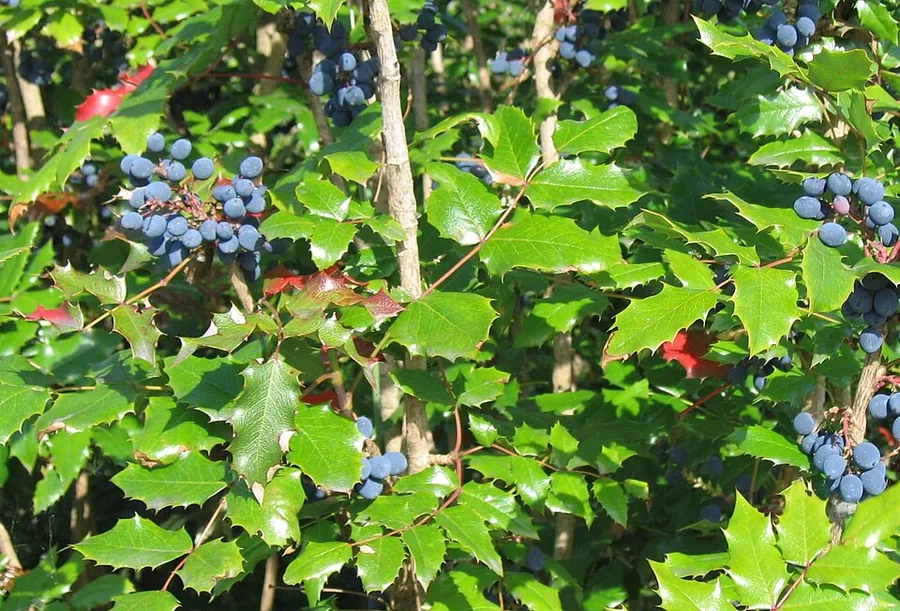
Oregon grape is a broadleaf evergreen shrub native to the Pacific Northwest, distinguished by glossy, pinnately compound, holly-like leaves that develop bronze pigmentation under cold stress and revert to deep green as temperatures rise. It sits within Berberidaceae, the barberry family, and takes its common name from the pruinose blue-black drupes that mature by late summer. Its year-round foliar interest is uncommon among hardy shrubs.
Growth is slow, with mature height reaching 3 to 6 feet tall only after several seasons. The shrub extends laterally by stolons, producing suckers that coalesce into a low, clonal colony, a habit that makes it an effective groundcover on shaded slopes provided stray shoots are removed to contain the spread.
In early spring it produces dense racemes of bright yellow flowers that supply an early nectar and pollen source for bees, followed by acidic berries taken by birds and processed by people into jelly. Cold-hardy to -20°F (-29°C), it withstands severe winters where it is protected from the desiccating wind that damages its evergreen foliage.
Care
The short version: establish it in partial shade with shelter from winter wind, in moist, acidic, well-drained soil, and irrigate consistently until the root system develops. Thereafter it requires little beyond an annual spring pruning.
Light
Oregon grape performs best in partial to full shade, where its foliage retains full pigmentation. It tolerates full sun, but exposed leaves bleach and scorch there, particularly through winter, so overhead shelter preserves foliar quality.
Water
Maintain evenly moist soil through the first season or two while the root system extends. Once established the shrub tolerates drought, so allow the top inch to dry and irrigate only every 7 to 14 days. It will not tolerate waterlogging.
Soil
Provide moist, organically rich, acidic, well-drained soil within a 5.0 to 7.0 pH window. Alkaline, compacted, or saturated soils are poorly tolerated, and liming reliably induces the chlorosis this species is prone to.
Temperature
The shrub is cold-hardy across roughly -20°F to 90°F (-29°C to 32°C). Severe winters cause no injury where it is sheltered from wind, since it is wind-driven desiccation, not low temperature itself, that scorches the leaves.
Humidity
Ambient outdoor humidity is adequate, so no target level applies. Air movement is the operative factor rather than atmospheric moisture, because stagnant air around crowded foliage favors leaf spot and rust.
Feeding
A single spring application suffices. Use a balanced or acidifying shrub fertilizer, moving to an acidic formulation if the foliage yellows from high-pH chlorosis.
Pruning
Prune after flowering to shape the plant or to renovate a leggy specimen by hard cutback. Remove dead, damaged, or winter-burned stems at the same time, and take out unwanted suckers as they emerge to restrict colonial spread.
Repotting
In the ground it requires no repotting, and containerized plants tolerate the same medium for years. Pot on only when roots circle the container or the medium dries out excessively fast.
Size & spacing
A mature specimen reaches 3 to 6 feet (91 to 183 cm) in height with a spread of 20 inches to 1.5 to 5 feet (51 to 152 cm) as the suckers infill. Allow room for the colony or plan to prune the margins annually.
When to plant
Oregon grape follows the temperate seasonal cycle. Plant in spring or fall while the soil remains workable, expect yellow flowers in early spring, and allow the blue-black berries to ripen from late summer into early fall.
Northern hemisphere
Southern hemisphere
Typical months for a temperate climate: start earlier in warm zones, later where spring frosts linger.
- Plant: Spring or fall
- Harvest: Yellow flowers in early spring; blue-black berries ripen by late summer to early fall
Hardiness
USDA hardiness zones: 5–8
Temperature: down to -29°C
Troubleshooting
The great majority of Oregon grape complaints present on the foliage, and most originate in the planting site rather than in any pest or pathogen. Diagnose from the leaves and the underlying cause usually becomes clear. Match the symptom below, then correct the growing conditions before resorting to a chemical treatment.
Brown, scorched leaf edges that worsen over winter
Brown, crisped leaf margins signal winter leaf burn, a desiccation injury rather than a disease. The evergreen foliage keeps transpiring on bright, windy winter days, yet frozen soil holds the roots from replacing that lost water, so the leaf edges dry out and die; strong summer sun on an open site produces the same water deficit. Correct it by siting the shrub in partial to full shade with wind shelter, mulching and irrigating well before the ground freezes, and removing the worst foliage in spring once new growth resumes.
Fix:
- Site in partial to full shade with shelter from strong and drying winter wind
- Mulch and keep soil evenly moist going into winter
- Prune out badly burned foliage in spring as new growth emerges
Yellow leaves with veins that stay green
Interveinal yellowing that spares the veins is classic iron chlorosis. Iron becomes chemically unavailable as soil pH rises above this shrub's preferred acidic range, so the newest leaves, which cannot mobilize iron already in the plant, pale first. Confirm the cause with a soil test, then acidify for the long term using elemental sulfur or an acidifying fertilizer, and apply chelated iron as a foliar or soil treatment when a rapid recovery is needed.
Fix:
- Test soil pH
- Lower pH and acidify with elemental sulfur or an acidifying fertilizer
- Apply chelated iron for quick correction
Spots or orange rust pustules on the foliage
Discrete lesions or orange-to-brown pustules indicate leaf spot and rust fungi. These pathogens establish where prolonged leaf wetness and stagnant, humid air on crowded plants give spores time to germinate and infect. Remove and destroy affected leaves to reduce inoculum, then thin and space the planting so the canopy dries quickly after rain or dew; reserve a labeled fungicide for outbreaks that overwhelm cultural control.
Fix:
- Remove and dispose of affected leaves
- Improve air circulation and avoid overhead watering
- Apply a labeled fungicide if infection is severe
Toxicity
This is a low-risk species in the garden, though not wholly without hazard. The cooked berries are edible, whereas the roots and stems accumulate berberine, a bitter isoquinoline alkaloid that irritates the digestive tract when a pet or person ingests it in quantity. In practice the spine-tipped leaflets cause more routine injury than the chemistry, so wear gloves during handling.
Toxic to
Cats · Dogs · Horses · Rabbits · Livestock
Safe for
People · Birds
Cats Mild
The alkaloid berberine concentrates in the roots and stems, so a cat that ingests those tissues may drool, vomit, or develop loose stools as the gut reacts. A single leaf tasting seldom delivers a meaningful dose; symptoms follow the ingestion of a substantial amount.
Dogs Mild
In dogs the same berberine irritates the digestive tract, so chewing the stems or roots can produce gastric upset and diarrhea. Severity tracks the quantity consumed, and most cases resolve without intervention.
Horses Caution
Horses generally avoid the spine-tipped foliage, yet berberine in the woody tissue can still disturb the gut if an animal grazes an appreciable quantity. Site the shrub beyond reach of pastured horses as a precaution.
Rabbits Caution
Given a rabbit's small body mass, even a modest intake of the bitter, berberine-bearing foliage can disrupt digestion. Exclude the plant from any diet offered as forage.
Livestock Caution
Cattle, goats, and sheep typically reject the prickly leaves, but consuming a quantity of stem or root tissue could induce mild gastrointestinal upset. Under normal grazing pressure they rarely select it.
Birds Safe
Frugivorous birds consume the ripe blue-black berries without ill effect and disperse the seed in the process. This endozoochory is a primary means by which the shrub colonizes new ground.
People Berries safe when cooked
Cooked into jelly or wine, the tart berries are edible, so the fruit poses no risk to people. The roots and stems are another matter, since their berberine content can provoke gastric upset if consumed in quantity.
The glossy, holly-like compound leaflets have stiff spine-tipped teeth that can prick or scratch skin; wear gloves and use care when pruning or handling.
Helpline numbers

United States
ASPCA Animal Poison Control: (888) 426-4435 (fee applies)
Poison Control: (800) 222-1222



Canada
Poison Centres: 1-844-764-7669
Varieties
The species itself predominates in cultivation, but a small number of named selections merit attention where planting space is limited or heavier flowering is wanted.
'Compacta'
A dwarf selection holding to roughly 2 to 3 feet, valued for confined plantings and for massing as a low, uniform groundcover.
'Apollo'
A low, spreading cultivar selected for its abundant yellow bloom carried over a dense, compact habit.
How to propagate
Three propagation routes are available, differing chiefly in speed. Division of the rooted suckers is the most dependable, while stem cuttings and seed both require considerable patience.
Stem cuttingsModerate
Late fall to winter, after some cold exposure · Several weeks to months to root
Collect semi-hardwood cuttings in late fall or winter after the wood has received some chilling, which primes it to root, and treat the basal cuts with rooting hormone. Insert them into a moist, free-draining medium and allow several weeks to a few months for adventitious roots to develop.
DivisionEasy
Spring or fall · One growing season
Division is the most reliable method because the plant spreads by stolons into clonal colonies. Lift an established clump in spring or fall, separate the already-rooted suckers, and replant them, each of which reestablishes over one growing season.
SeedModerate
Sow stratified seed in fall or after cold stratification · One or more years; seed is slow to germinate and reach size
Seed propagation is slow and demands a cold period to break dormancy. Clean the pulp from ripe berries and either sow in fall or apply cold stratification beforehand, since germination will not proceed without that chilling. Anticipate a year or more before seedlings attain usable size.
Myths
Oregon grape berries are poisonous because they look like holly or barberry fruit.
Superficial resemblance to holly and barberry fruit drives this misconception. The blue-black berries are astringent and unpalatable raw, yet cooking renders them edible for jelly and wine, and the species is documented as non-toxic to cats, dogs, and horses. Only the berberine-rich roots and stems warrant caution; the cooked fruit is entirely safe.