Ornamental · Asteraceae
Zinnia
Zinnia elegans
Full sun and dry foliage keep fungal disease at bay, and the zinnia flowers from summer to frost.
Full sun
Every 5–7 days
68–86°F · 20–30°C
60–70 days
Overview
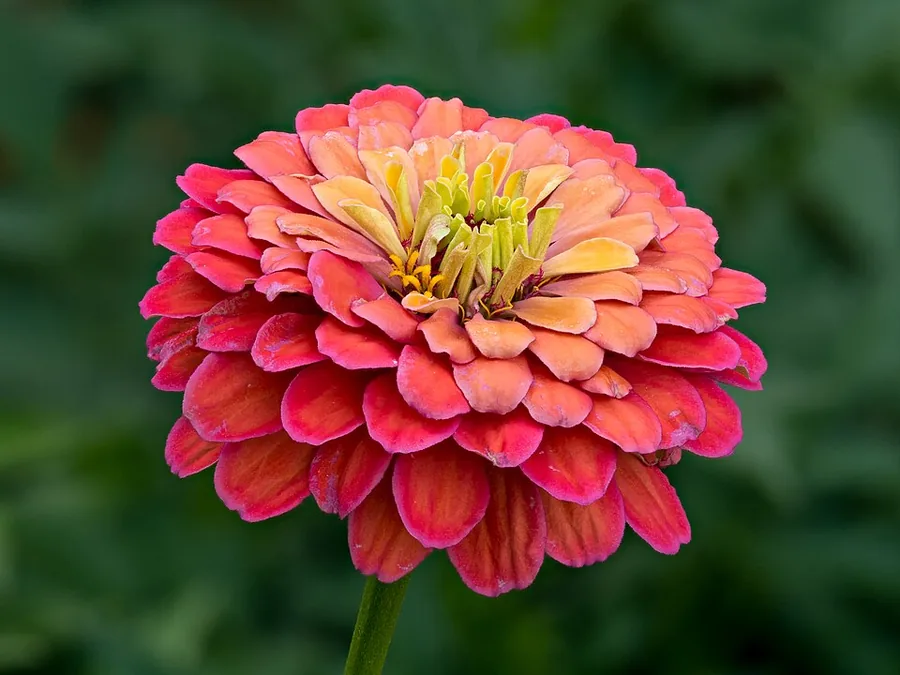
Zinnia elegans ranks among the least demanding annuals for a beginner. It sits within the Asteraceae, the daisy family, with origins in Mexico where the wild species grew before entering cultivation worldwide. As a warm-season annual, it completes its whole cycle from a single sowing between spring and the first hard frost.
Height varies widely by cultivar. Dwarf forms hold near 6 inches for bed edging, while tall cutting types extend to roughly 4 feet and supply long-stemmed flowers for arrangements. The open flower form draws bees and butterflies, and frequent cutting redirects the plant's energy into further branching and bloom.
Two cultural requirements govern success. The plant needs full sun and dry foliage, because its principal weaknesses, powdery mildew and the leaf spots, establish on crowded, wet tissue. Adequate spacing and watering at the root zone remove the leaf moisture those pathogens depend on.
Care
The short version: full sun, well-drained soil, and base watering at roughly an inch a week. Space plants for air movement, deadhead regularly, and bloom continues from summer to frost.
Light
Provide full sun, a minimum of 6 hours of direct light daily and preferably more. Strong light maintains compact, sturdy growth and sustained flowering, and it dries the foliage quickly, which is the primary cultural defense against mildew.
Water
Apply water at the base in the morning and keep the foliage dry, since surface moisture is the precondition for infection. Supply roughly an inch a week and allow the top half of the soil to dry between waterings, reducing input after establishment because zinnias tolerate heat and drought well.
Soil
Use well-drained loam. The plant accepts a pH from 5.5 to 7.5, but it is intolerant of waterlogging, so drainage outweighs fertility in importance.
Temperature
Optimal growth occurs between 68°F and 86°F (20°C to 30°C). Cold soil suppresses development and frost is lethal, which is the reason sowing waits until temperatures rise.
Humidity
The species prefers low humidity, near 40% to 60%. Saturated, stagnant air favors mildew and leaf spot, so air movement matters more to plant health than ambient moisture.
Feeding
Apply a balanced fertilizer monthly through spring and summer. Zinnias are light feeders that flower well in average soil, so excess nitrogen offers no benefit.
Pruning
Deadhead spent blooms and harvest flowers regularly to sustain branching and continued color. Pinching young plants early promotes a bushier habit and a greater number of buds.
Repotting
not_applicable
Size & spacing
Mature height ranges from 1 to 4 feet (30 to 120 cm) by cultivar. Space plants 6 to 12 inches (15 to 30 cm) apart to promote air circulation and keep foliage dry.
When to plant
Zinnias require warm soil and have no frost tolerance. Sow indoors 4 to 6 weeks before the last frost, or sow directly once soil warms, and flowering proceeds from midsummer to the first frost.
Northern hemisphere
Southern hemisphere
Typical months for a temperate climate: start earlier in warm zones, later where spring frosts linger.
- Sow: 4 to 6 weeks before the last frost
- Plant: After the last frost once soil warms to about 70°F (21°C)
- Harvest: Summer to first frost
Troubleshooting
Most zinnia disorders express on the foliage and trace to prolonged leaf wetness. Early identification lets you contain a localized infection before it moves through the planting. Match the symptom below, then intervene while control is still effective.
Enlarging reddish-brown lesions with gray-white centers
This is Alternaria leaf spot, the most damaging disease of zinnias, capable of girdling stems and wilting the entire plant. The pathogen spreads by splashing water and infected debris during warm, wet periods. Removing and destroying affected plants, watering at the base, rotating out of the same ground for two years, and hot-water seed treatment together break the disease cycle.
Fix:
- Remove and destroy infected plants and debris
- Water at the base of plants and avoid overhead irrigation
- Rotate planting sites and avoid replanting zinnias in the same spot for 2 years
- Treat seed with hot water (125°F for 30 minutes) before sowing
Grayish-white powdery growth on upper leaf surfaces
This is powdery mildew, caused by a fungus that colonizes foliage under crowding, poor air movement, and humidity. The superficial growth wipes off early, then chlorosis and tissue decline follow through late summer. Increasing spacing, restricting water to the base, and selecting resistant series such as Profusion or Zahara address both the current infection and future risk.
Fix:
- Improve spacing and air circulation
- Water at the base in the morning and avoid wetting foliage
- Remove and discard heavily infected leaves and end-of-season debris
- Choose resistant types such as the Profusion or Zahara series
Angular purplish lesions delimited by leaf veins
The angular, vein-bounded outline identifies bacterial leaf spot, since the vascular veins confine the bacterium and shape the lesion. It disperses in splashing water and persists on contaminated seed and residue, so incidence rises after rain or overhead irrigation. Keeping foliage dry, removing infected leaves, spacing for rapid drying, and starting with clean seed and resistant cultivars limit its spread.
Fix:
- Avoid overhead watering and handling wet plants
- Remove infected leaves and plant debris
- Improve spacing so foliage dries quickly
- Start with disease-free seed and resistant cultivars
Toxicity
Zinnias present no toxicity concern in a household with animals. The ASPCA classifies the plant as non-toxic to cats, dogs, and horses, and the petals are edible for people. Ingestion by a pet may produce nothing more than transient gastrointestinal upset.
Safe for
People · Cats · Dogs · Horses · Rabbits · Livestock · Birds
Cats None
Non-toxic to cats. A cat that chews foliage may show only brief, self-limiting gastric upset.
Dogs None
No toxic risk to dogs. Ingestion of foliage can cause mild, temporary loosening of the stool that resolves without treatment.
Horses Safe
Classified as non-toxic, so horses may graze near zinnias without hazard.
Rabbits Safe
Rabbits can consume the leaves and flowers safely, although an excess of any unfamiliar green can loosen the stool.
Livestock Safe
Cattle, goats, and sheep are not poisoned by zinnias, and the plants present no grazing hazard.
Birds Safe
Birds face no toxic risk, and they feed on the mature seed heads in autumn.
People Safe
The petals are edible and serve as a garnish in salads and on cakes, and no part of the plant is toxic to people.
No special handling required; ingestion of plant material may still cause mild stomach upset in some pets.
Varieties
Cultivars span 6-inch dwarfs to tall cut-flower forms, several bred specifically for disease resistance. The following are worth knowing by name.
Benary's Giant
A tall cut-flower cultivar at 36 to 42 inches, producing large, fully double, dahlia-form blooms with excellent vase life.
State Fair
A vigorous tetraploid reaching 3 to 4 feet and bearing very large flowers.
Profusion
An interspecific Zinnia x hybrida series with resistance to both leaf spot and powdery mildew.
Zahara
A Zinnia marylandica series selected for strong resistance to leaf spot and mildew.
Thumbelina
A dwarf, compact cultivar near 6 inches tall, suited to edging and container culture.
Queen Lime
A 30 to 40 inch series valued for uncommon lime-green and muted antique color blends.
How to propagate
Zinnias propagate readily, and seed is the standard and most reliable method.
SeedEasy
Spring
Zinnias germinate rapidly and reliably from seed. Direct sow after the last frost once soil reaches about 70°F (21°C), or start indoors 4 to 6 weeks earlier to advance the season. Sow at roughly a quarter inch depth, maintain 65°F to 70°F (18°C to 21°C), and expect emergence in about 5 to 7 days. Thin or space seedlings to ensure free air movement, then pinch young plants to stimulate branching and a heavier flush of bloom.
Myths
Overhead watering keeps zinnias cool and in good health.
Overhead application wets the foliage, and leaf wetness is the specific condition powdery mildew, Alternaria, and bacterial leaf spot require to infect and spread. Direct water to the base and keep the canopy dry.
All zinnias mildew equally, so cultivar selection is irrelevant.
Cultivar selection is decisive. Resistant series such as Profusion and Zahara withstand leaf spot and mildew far better than older large-flowered cultivars, which commonly deteriorate by late summer.