Houseplant · Acanthaceae
Zebra Plant
Aphelandra squarrosa
Striped foliage and a yellow bract spike, sustained only by the warm, humid air this tropical species keeps requiring.
Bright indirect
64–81°F · 18–27°C
USDA 11–12
4–6 ft · 1.2–1.8 m
Overview
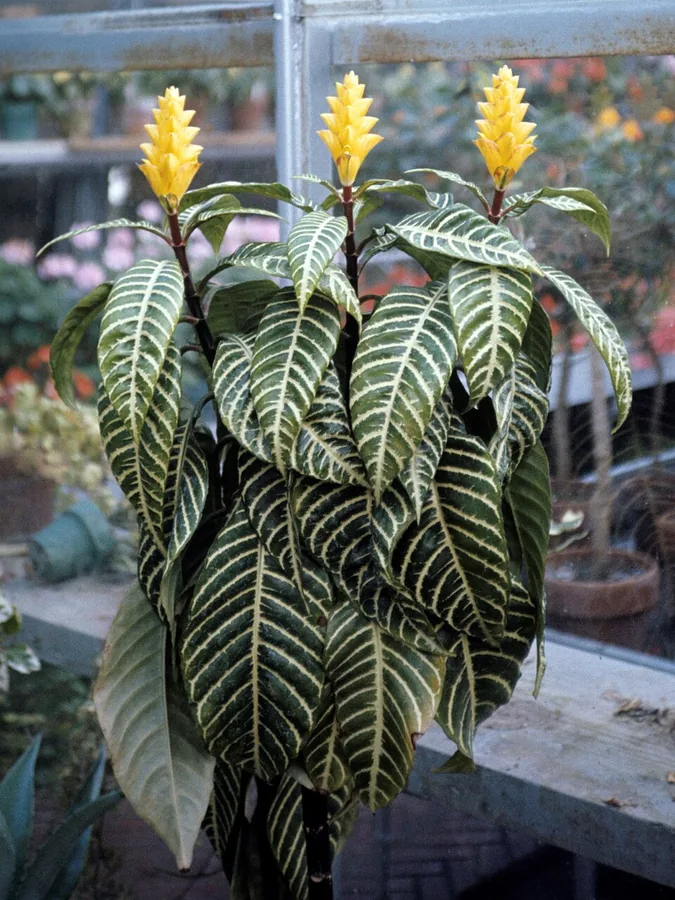
The common name records a visual trait: the dark green lamina is overlaid with prominent white veins in a zebra-like pattern, a feature that carries the plant on foliage alone. In season it produces a tall inflorescence of yellow bracts from the crown that persists for weeks.
That ornamental value comes with exacting requirements. As a species of the warm, humid Brazilian forest floor, it expects sustained high humidity indoors, and failing that single condition accounts for most losses. Dry air, or a substrate that alternates between saturated and desiccated, produces browning and drop of the lower leaves.
Supplied with its preferred conditions the plant responds well, but it is not forgiving, which is why it rates as demanding. Growth is slow and the plant is naturally short-lived. Propagating a few cuttings in advance is standard practice, maintaining a succession as the original declines.
Care
The short version: bright indirect light, sustained warmth above 65°F (18°C), and consistently high humidity. Hold the medium evenly moist year-round without saturating or drying it, and supply a light feed through the growing season.
Light
It performs best under bright indirect light, the diffuse exposure it would receive beneath a forest canopy. It tolerates partial and even full shade, but adequate soft light drives the pigment that keeps the vein pattern crisp and the plant compact rather than drawn.
Water
This species holds no drought reserve, so the growing medium must stay evenly moist year-round, neither dry nor waterlogged. Draw watering back, but do not suspend it, through the post-bloom rest. Because the roots cannot buffer swings, both saturation and desiccation express the same way, as browning and shedding of the lower leaves.
Soil
Use a peaty, free-draining medium rich in organic matter. The species favors acidity at a pH at or below 6.0, which keeps nutrients available to it, so a substrate formulated for acid-loving plants is appropriate.
Temperature
Maintain 64°F and 81°F (18°C to 27°C), and treat 65°F (18°C) as the practical floor. As a tropical understory plant it has no cold tolerance, and chilling or drafts trigger leaf drop.
Humidity
Humidity is the limiting factor indoors and the reason the species is rated difficult. It evolved in saturated forest air and needs high humidity well above a heated interior, so a wet-pebble tray or a naturally humid room such as a bathroom raises the local vapor level enough to prevent tip damage.
Feeding
Feed through the growing season from late winter with a dilute liquid fertilizer at roughly two-week intervals. Frequent weak doses match the plant's steady, slow uptake, whereas a concentrated feed risks salt injury to the roots.
Pruning
Once the yellow bract spike is spent, cut back to 12 to 18 inches (30 to 46 cm), retaining about two rows of leaves. Removing the exhausted apex releases the lower buds, which counters legginess and drives dense basal regrowth.
Repotting
Repot annually. Circling roots, a pot that dries faster between waterings, and stalled growth all indicate the root mass has filled the container and needs fresh medium and volume.
Size & spacing
Under good conditions it reaches 4 to 6 feet (122 to 183 cm) tall with a spread of 4 to 5 feet (122 to 152 cm), though its slow rate and routine pruning usually hold it well below that ceiling. Space it so air circulates around the foliage.
Troubleshooting
Most disorders in this species reduce to a single cause: ambient air that is too dry or too cold for a tropical plant. Symptoms register first in the foliage, at the leaf tips and on the lowest leaves. Identify the pattern below and correct the underlying condition before further loss.
Progressive browning and drop of the lower leaves
Low humidity is the primary driver, since a rainforest species cannot tolerate the dry air of a heated interior. Chilling and a substrate that has dried completely produce the same basal loss. Correct it by raising humidity, holding temperatures above 65°F (18°C), and rewatering before the medium dries.
Fix:
- Raise humidity by setting the pot on a tray of wet pebbles or moving it to a bathroom
- Keep temperatures above 65°F (18°C) and away from cold drafts
- Maintain consistent soil moisture without letting it fully dry or waterlog
Brown, desiccated tips on otherwise sound leaves
Tip and margin necrosis on a plant that is otherwise healthy points to insufficient atmospheric humidity. A wet-pebble tray or relocation to a humid room such as a bathroom restores the vapor level, and subsequent growth emerges undamaged.
Fix:
- Increase humidity around the plant with a pebble tray or humid room
Scorched foliage adjacent to vents or doorways
Directed hot or cold air strips moisture from the leaves faster than the plant can transpire and replace it, giving a scorched appearance. Relocating it away from vents, doorways, and drafty corners to a stable, humid position resolves the exposure.
Fix:
- Relocate away from heating/cooling drafts to a humid, stable spot
Toxicity
For animal households the profile is favorable. The ASPCA classifies the zebra plant as non-toxic to cats, dogs, and horses, and the record documents no toxins affecting other animals or people. Ingestion carries no known risk, though the plant is ornamental rather than edible.
Safe for
People · Cats · Dogs · Horses · Rabbits · Livestock · Birds
Cats None
The ASPCA classifies the zebra plant as non-toxic to cats, so an investigative bite presents no toxic hazard.
Dogs None
No toxicity to dogs is documented; the ASPCA lists the species as safe, and ingestion of the foliage produces no poisoning.
Horses None
Horses are unaffected as well, the ASPCA placing the plant on its non-toxic list for the species.
Rabbits None
The foliage contains no known toxin, so a rabbit that samples it is at no risk, though it is not a forage plant.
Livestock None
Grazing stock face no poisoning potential from this houseplant, which in any case rarely enters their environment.
Birds None
Pet birds may contact or peck the leaves with no toxic consequence.
People None
The plant carries no known toxins, so accidental tasting by a child is harmless, although it is cultivated as an ornamental rather than for consumption.
Varieties
The material sold and grown indoors is essentially the straight species, which is what reaches retail shelves.
Aphelandra squarrosa
The dark green foliage is patterned with pronounced white veins resembling zebra striping, and at flowering a persistent spike of yellow bracts is carried above the leaves.
How to propagate
Given the plant's short natural lifespan, vegetative propagation is a practical part of its culture. Conveniently, the same stems removed at pruning serve as cutting material.
Stem cuttingsModerate
Use cuttings taken from stems pruned after flowering · Several weeks to root in warm, humid conditions
The stems taken during post-flowering pruning root reliably when held in warmth and steady humidity, though establishment takes several weeks. The technique matters because the species grows slowly and is short-lived, so maintaining rooted cuttings ensures a replacement as the parent senesces.
Myths
The zebra plant requires a strict winter dormancy to survive.
No obligate dormancy exists for this species. After flowering it enters a modest rest, which in practice means reducing the watering frequency rather than ceasing it. Reduce, do not withhold, water, or the roots desiccate and the lower leaves are shed.