Ornamental · Acanthaceae
Black-eyed Susan Vine
Thunbergia alata
Provide full sun, steady water, and something to climb, and this twining annual carries flowers from summer to frost.
Full sun
Every 2–4 days
50–86°F · 10–30°C
70–100 days
Overview
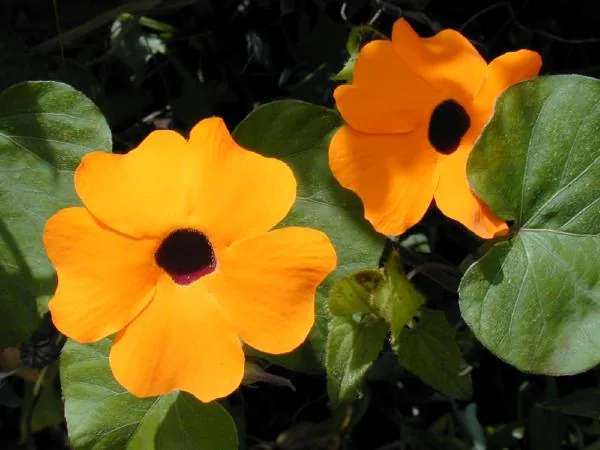
A quick, twining climber prized for its long, dependable display of cheerful flowers, the black-eyed Susan vine is a tender perennial out of East Africa. In most gardens, though, gardeners treat it as a warm season annual, training it up a trellis, fence, or hanging basket over the course of a single summer. Its bright blooms in orange, yellow, and white, the majority stamped with a dark eye, are what earned the plant its name.
Two traits make it worth the space: rapid climbing and a long flowering window. Offer it something to twine through and it will clothe an arbor or cascade from a container, reaching 3 to 8 feet (91 to 244 cm) within a season. Flowering carries from early summer all the way to frost, and the show typically peaks in late summer and fall once the harshest heat lets up.
Few plants are this forgiving. An easy plant by any measure, it requires little more than sun, water, and a structure to ascend. Keep the soil from baking dry during a heat wave and pinch the young stems for a denser vine, and it returns months of color for the effort.
Care
The short version: full sun to part shade, with afternoon shade wherever summers run hot. Keep the soil consistently moist so it never dries out, plant it in rich, well-drained ground beside a support to climb, and feed it across the growing season.
Light
Bloom in this vine is light driven, so it performs best in full sun while still accepting part shade. In regions where summers turn brutal, a measure of afternoon shade tempers the heat; deprive it of light, however, and you get a leggy plant loaded with foliage and short on flowers.
Water
Hold the soil at even moisture, watering frequently enough that it never dries out, on the order of every 2 to 4 days in warm weather. Let the root zone go dry through a hot, dry spell and the vine will shed its buds and flowers, so do not allow it to run short across summer.
Soil
Set it into rich, fertile, well-drained ground kept steadily moist, with ample organic matter incorporated. The medium needs to retain water while never turning soggy, a balance that serves garden beds and containers equally well.
Temperature
Its comfortable range runs from 50°F and 86°F (10°C to 30°C), with no capacity to withstand frost. Flowering tapers off through the peak of summer heat, then surges back as conditions cool toward late summer and fall.
Humidity
Ordinary outdoor humidity suits it, so no target figure applies. Air movement counts for more here, because stagnant, crowded growth draws in spider mites and whiteflies, particularly on plants held indoors.
Feeding
Apply a balanced, general-purpose fertilizer monthly across the spring and summer growing season. Consistent feeding keeps a rapid grower of this kind in leaf and flower, with no single nutrient falling short.
Pruning
Pinch the young stems early on to drive side branching and a denser, bushier vine. As the season runs, cut back any leggy or overgrown growth to keep the plant neat and to draw out additional flowers.
Repotting
For container culture, refresh or pot up each spring to open room for the roots and renew the medium. Look out for roots circling the pot or pushing through the drainage holes, water that drains straight through, and stalled growth, each a sign the plant has outgrown its container.
Size & spacing
Trained on a support, the vine climbs 3 to 8 feet (91 to 244 cm) tall and spreads 3 to 6 feet (91 to 183 cm) wide over a season. Allow it room along with a trellis or fence to twine up, so it always has somewhere to head.
When to plant
Warmth drives this vine, and it has no frost tolerance whatsoever. Sow the seeds indoors in early spring, transplant only after cold has fully retreated and the soil has warmed, then look for flowers from early summer until frost closes the season.
Northern hemisphere
Southern hemisphere
Typical months for a temperate climate: start earlier in warm zones, later where spring frosts linger.
- Sow: 6-8 weeks before last spring frost
- Plant: after last spring frost when soil and air have warmed
- Harvest: early summer to frost; best bloom in late summer and fall after peak heat moderates
Hardiness
USDA hardiness zones: 10–11
Temperature: down to -1°C
Troubleshooting
Nearly every problem on this vine comes down to heat, light, or pests, and the first symptoms register in either the flowers or the leaves. Catching those early cues lets you intervene before bloom drops away. Match what you observe to the entries below, then respond while action still pays off.
Bud and flower drop during a hot, dry stretch
What you are seeing is heat and drought stress rather than any pathogen, and it surfaces when the root zone dries down through a hot run of days. To conserve resources, the vine simply halts flowering, and it resumes once temperatures back off in late summer and fall. Hold the soil at even moisture with regular watering, lay mulch over the roots so they stay cooler, and shade the plant from afternoon sun in regions where summers turn fierce.
Fix:
- Water regularly to keep soil evenly moist during heat
- Provide afternoon shade in hot climates
- Mulch to conserve soil moisture and keep roots cool
Speckled, tacky leaves carrying webbing or tiny insects
Spider mites, whiteflies, aphids, or scale tend to colonize plants under stress and those grown indoors, leaving leaves stippled, sticky, or webbed. Flip a leaf to identify which pest you have, dislodge the population with a forceful jet of water, then treat the undersides with insecticidal soap or horticultural oil. Repeat the application and loosen up the air circulation, which matters most on plants kept inside.
Fix:
- Rinse foliage with a strong spray of water to dislodge mites and aphids
- Apply insecticidal soap or horticultural oil, covering leaf undersides
- Repeat treatments and improve airflow for indoor plants
Lush foliage with almost no bloom
When a vine stretches long and leafy yet declines to flower, too little sun is nearly always behind it. Bloom is driven by light, and this plant performs best in full sun, so relocate a container to a brighter position and target several hours of direct light at minimum. Supply the light it needs and the flowering follows.
Fix:
- Move container plants to a sunnier spot
- Site in full sun to part shade with at least several hours of direct sun
Toxicity
Welcome news for animal households: the black-eyed Susan vine carries no listing as toxic to pets or people. It is a safe choice for gardens shared by cats, dogs, and inquisitive children. Bear in mind that, as with any plant, a large mouthful of foliage may bring on brief stomach upset, so discouraging pets from chewing on it remains sensible.
Safe for
People · Cats · Dogs · Horses · Rabbits · Livestock · Birds
Cats Safe
Because this vine is absent from the ASPCA toxic list, an inquisitive cat may chew the foliage with no ill effect. Down a large quantity of any greenery and the worst you might see is some drooling or a hairball.
Dogs Safe
This is a safe plant to keep around dogs. At most, a nibble produces a brief spell of mild stomach upset, no different from most ornamental foliage.
Horses Safe
There is no toxicity on record for horses, so a horse grazing on a stray vine comes to no genuine harm.
Rabbits Safe
Foliage is safe for rabbits to browse. Bring in any unfamiliar green slowly, since an abrupt shift in diet can upset the gut.
Livestock Safe
No documented hazard exists for cattle, goats, or sheep, so a mouthful taken from the pasture warrants no concern.
Birds Safe
Birds face no known risk from this plant. Backyard hens are free to peck at its leaves and seeds with no trouble.
People Safe
No human poisoning has ever been recorded, and the plant is cultivated for its flowers, not for the table. Still supervise small children, who ought not to be tasting garden plants in any case.
As with any plant, ingestion of plant material may cause mild, transient stomach upset in pets.
Varieties
Black-eyed Susan vines reach the market chiefly as seed series selected for a spectrum of warm flower colors. The selections below are the ones you are most likely to encounter.
Susie series
A widely grown seed series offered in orange, yellow, and white, available with the signature dark eye or without it.
Arizona series
A vigorous group spanning warm orange, apricot, and gold tones, with every bloom accented by a dark center.
Spanish Eyes
Combines soft terracotta with apricot around a dark eye, yielding a warmer and more muted effect.
Blushing Susie
A blend of gentle apricot, rose, and ivory, frequently carrying eyes that recede rather than read sharply.
Alba
A crisp white-flowered selection that retains the typical dark purple-black eye.
How to propagate
Propagating this vine is straightforward, whether you open a fresh seed packet each spring or root cuttings to bring a favored plant safely through winter.
SeedEasy
Start indoors 6-8 weeks before last frost, or sow directly outdoors after the last frost. · Germinates in about 1-3 weeks; weeks to a few months to a flowering vine
Growing this annual vine from seed is the standard route, and an easy one at that. Sow indoors 6 to 8 weeks before your last frost, or drill it directly into warm ground after frost has cleared, and germination follows in about one to three weeks. From sprout to a climbing, flowering vine then takes anywhere from a few weeks to a couple of months.
Stem cuttingsModerate
Take cuttings in late summer for overwintering indoors. · A few weeks to root
Taking cuttings is the method for bringing a favorite plant through the cold months. Collect them in late summer, allow a few weeks for rooting, and overwinter the young plants on a warm, sunny windowsill until spring. It demands somewhat more attention than seed, but it preserves a particular variety for another season.
Myths
Black-eyed Susan vine is the same plant as the Black-eyed Susan wildflower.
A shared common name and a dark center are all the two have in common. Black-eyed Susan vine (Thunbergia alata) is a tender twining annual climber in the family Acanthaceae, native to East Africa. By contrast, the wildflower Black-eyed Susan (Rudbeckia hirta or fulgida) is an upright, daisy-like perennial or biennial belonging to the aster family. They are completely different plants that merely resemble one another at the eye of the bloom.