Houseplant · Acanthaceae
Polka Dot Plant
Hypoestes phyllostachya
In bright filtered light with steady moisture, the freckled foliage holds its strongest color.
Bright indirect
61–81°F · 16–27°C
USDA 10–11
12–30 in · 30–76 cm
Overview
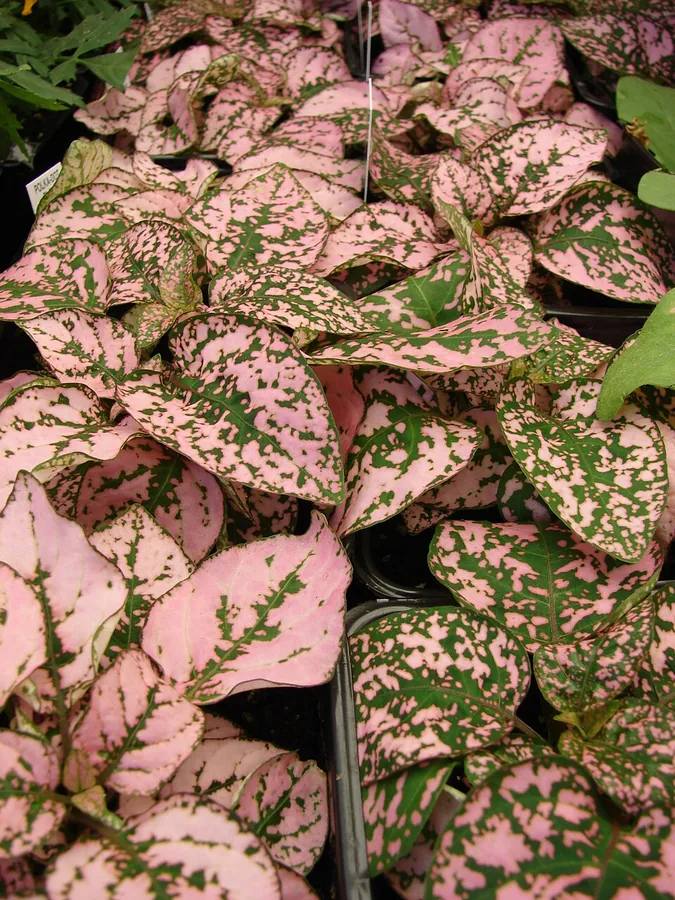
The polka dot plant, Hypoestes phyllostachya, carries leaves marked with pink, rose, or white against green, a variegation that is the plant's chief ornamental value. Native to Madagascar and placed in the Acanthaceae, it is grown almost everywhere indoors as a tender perennial. Because the small lilac flower spikes draw energy away from that foliage, growers pinch them off to keep the color coming.
Growth is fast, and the plant stays compact at 12 to 30 inches (30 to 76 cm). That vigor explains both its appeal and its short useful life. A specimen fills its pot within a season, then declines into thin, leggy stems, which is why it is commonly renewed from cuttings rather than held for years.
Rated an easy plant, it responds directly to a few conditions. Bright filtered light drives the color, even moisture supports the fast growth, and routine pinching maintains density. Where light falls short, the pigment in the spots falls with it, so light is the lever that controls the display.
Care
The short version: bright filtered light produces the strongest variegation, evenly moist but never waterlogged soil supports growth, warmth above 60°F (16°C) keeps it active, and regular pinching maintains a full habit.
Light
Provide bright, filtered light, because the pink and white pigment develops most strongly at that intensity. Direct sun overloads the leaf and bleaches or scorches it, while deep shade starves the variegation, so both extremes cost color. A bright window behind a sheer curtain sits in the correct range.
Water
Hold the soil evenly moist during active growth, watering thoroughly and letting only the surface dry before the next application. The species is drought intolerant, so it recovers from a brief dry spell but performs better with steady moisture. Consistent water sustains the rapid growth the plant is capable of.
Soil
Use a porous, organic-rich medium amended with peat moss or leaf mold, since the roots need both moisture retention and free drainage. The plant accepts a pH from 5.5 to 7.5, so reaction is not limiting as long as water does not stand around the roots.
Temperature
Hold it within 61°F to 81°F (16°C to 27°C), the range of ordinary room warmth. Metabolism and growth slow below about 60°F (16°C), so exposure to cold drafts or chilled glass checks the plant and should be avoided.
Humidity
Supply high humidity, which most interiors do not reach on their own. Grouping plants, a pebble tray, or misting through dry winter air raises local moisture at the leaf and prevents the marginal crisping that low humidity causes.
Feeding
Fertilize through spring and summer, when growth is active and demand for nutrients is highest. A dilute balanced liquid feed applied about once a month meets that demand, and feeding can stop once growth slows for the season.
Pruning
Pinch the stem tips often, since removing the apex releases the lower buds and forces the branching that keeps the plant compact and full. Remove the small flower spikes as well, which redirects energy from seed production back into the foliage.
Repotting
Repot once a year, or when roots circle and emerge from the drainage holes. Because the plant grows fast and tends to tire within a couple of years, many growers replace it from cuttings rather than repotting it long-term.
Size & spacing
Mature dimensions run 12 to 30 inches (30 to 76 cm) tall and about 9 to 30 inches (23 to 76 cm) wide. Space a planting for air movement, since still air among crowded stems favors powdery mildew.
Troubleshooting
Nearly every disorder on this plant resolves to a light, water, or pest cause, and each leaves a legible sign. Faded variegation and elongated stems are the two most common, and both indicate a specific correction. Read the symptom, identify the mechanism, and adjust before decline sets in.
Wilting with mushy basal stems or a white powdery film
Collapse at the soil line in wet soil points to root rot from overwatering or poor drainage, while a white powdery film is powdery mildew developing in still, humid air. A porous, well-drained mix and a dry surface between waterings correct the moisture fault. Improved air circulation limits the fungal spread.
Fix:
- Use a porous, well-drained mix and let the surface dry between waterings
- Improve air circulation to limit mildew
Sticky residue, distorted growth, or small insects
Sticky foliage and deformed new growth signal whiteflies, aphids, or mealybugs, the insects that most often colonize this plant indoors. Inspect the leaf undersides for clustered insects or white cottony masses, and note whiteflies that take flight when the plant is disturbed. Insecticidal soap or neem oil, repeated on schedule with the plant isolated, brings the population down.
Fix:
- Treat with insecticidal soap or neem oil
- Repeat applications as directed and isolate affected plants
Elongated, leggy stems with sparse, pale foliage
Stems that stretch toward the light and shed their lower leaves indicate insufficient light, sometimes compounded by age in a plant never pinched. Relocating it to bright, filtered light and pinching the tips restores compact branching. A plant too far gone responds best to renewal from tip cuttings.
Fix:
- Move to bright, filtered light
- Pinch back stem tips regularly to force branching
- Take and re-root tip cuttings to renew an old, leggy plant
Variegation fades or the leaves look scorched
Loss of the pink and white markings is a light imbalance at either extreme. Excess direct sun bleaches and scorches the tissue, while inadequate light suppresses pigment formation. The variegation is strongest in bright filtered light or light partial shade, so siting it there recovers the color.
Fix:
- Relocate to bright, filtered light rather than full sun or deep shade
Toxicity
For households with pets or children, the record is clear: Hypoestes phyllostachya is non-toxic. The ASPCA lists it as safe for cats, dogs, and horses, and university extension sources concur. Any effect from ingestion is limited to mild, self-limiting stomach upset caused by the plant fiber itself.
Safe for
People · Cats · Dogs · Horses · Rabbits · Livestock · Birds
Cats None
The ASPCA classifies it non-toxic to cats. Ingestion may provoke minor vomiting from the plant fiber, which resolves without intervention.
Dogs None
It is likewise non-toxic to dogs on the ASPCA listing. A chewed leaf produces at most brief, mild gastrointestinal upset.
Horses None
The ASPCA extends the non-toxic rating to horses, so a grazed mouthful carries no toxic risk.
Rabbits Safe
No toxin affects rabbits. Introduce it gradually all the same, as any abrupt dietary change can disturb their digestion.
Livestock Safe
Goats, sheep, and other grazers can browse it without harm, the plant containing no poisonous compounds.
Birds Safe
Pet birds are unaffected. The foliage holds no toxic constituents, so a sampled leaf causes no injury.
People Safe
It is harmless to people, children included. The plant is not grown for food, but a leaf taken by mouth presents no hazard.
As with any non-food plant, ingestion may cause mild, self-limiting vomiting or diarrhea simply from the plant material.
Varieties
Most stock is sold by color rather than as a named cultivar, though several selections are distinct enough to identify.
'Splash Select Pink'
A compact selection whose pink-spotted leaves stand over small purple flowers.
'Confetti Compact White'
A neat, compact form marked by white leaf-freckling instead of pink, above small purple blooms.
Pink Splash / Freckle Face types
Green foliage overlaid with rose, pink, or white spotting, in which seed-raised strains differ in spot density.
How to propagate
Propagation is straightforward by two routes. A cutting rooted in water reproduces a plant exactly, while seed produces the variable strains sold commercially.
Stem cuttingsEasy
Any time during active growth · Roots in a few weeks
Cuttings clone the plant reliably. During active growth, remove a tip roughly 4 inches (10 cm) long, strip the lower leaves, and set it in water or a moist medium, where it forms roots within a few weeks. The resulting plant is genetically identical to the parent.
SeedEasy
Sow indoors 8-10 weeks before the last frost · Germinates in as little as 4 days at about 68°F (20°C)
Seed is the commercial method and performs equally well. Sown indoors 8 to 10 weeks before the last frost and held near 68°F (20°C), seed can germinate in as little as 4 days. Because seedlings segregate for spotting, the density of the markings varies from plant to plant.
Myths
The polka dot plant is the same species as the polka dot begonia.
The two belong to separate genera and families. Hypoestes phyllostachya sits in the Acanthaceae, whereas the polka dot begonia is Begonia maculata in the Begoniaceae. Only Hypoestes is the true polka dot plant.
The polka dot plant is toxic to cats and dogs.
The ASPCA classifies Hypoestes phyllostachya as non-toxic to dogs, cats, and horses. Ingestion produces at most mild, transient stomach upset from the plant material rather than any poisoning.