Houseplant · Acanthaceae
Nerve Plant
Fittonia albivenis
Keep it warm, humid, and evenly moist, and the nerve plant answers with leaves stitched in living color.
Bright indirect
Every 3–4 days
61–75°F · 16–24°C
USDA 11–12
Overview
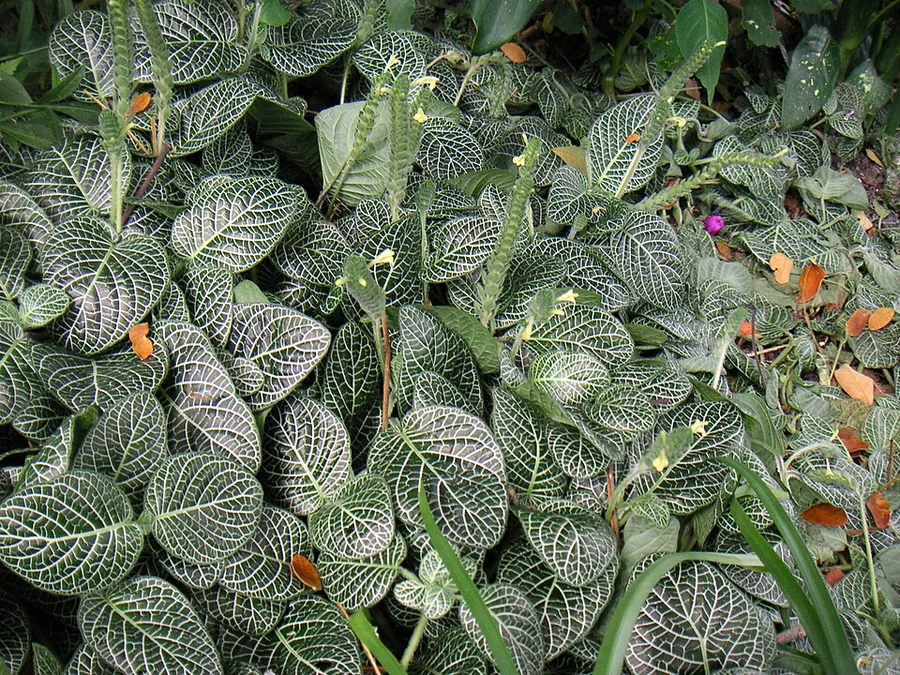
The venation gives the nerve plant its name, a fine reticulate network of white, pink, or red running over deep green laminae. It sits within the acanthus family and occurs on the rainforest understory of Colombia and Peru, an origin that dictates most of its indoor requirements. Growth stays diminutive and prostrate rather than climbing, with mature height around 3 to 8 inches (8 to 20 cm).
Its defining trait is a marked drought response. When the substrate dries beyond a threshold the leaves lose turgor and the plant faints, foliage collapsing as though spent. Rehydration typically restores it within hours with no lasting injury. That reaction makes the species instructive to grow, and it also confirms why steady moisture and humid air underpin sound culture.
The plant returns good value from a modest footprint. Its slow, low habit suits an enclosed terrarium, a humid bathroom shelf, or a grouping with other moisture-loving species. Supply appropriate light and consistent moisture and it knits into a dense, patterned carpet of foliage.
Care
The short version: provide bright indirect light, hold the substrate evenly moist yet never saturated, and maintain humid air within 16°C to 24°C (61°F to 75°F). Feed monthly through the growing season, and site it well away from direct sun and cold drafts.
Light
Site the nerve plant in bright but indirect light, such as a north- or east-facing window. It tolerates medium light and light shade, but direct sun overloads and scorches the thin leaf tissue, so keep the rays off the foliage.
Water
Hold the compost evenly moist but never waterlogged, which equates to watering about twice a week. If it faints from a dried rootzone, thorough watering restores turgor within hours. Reduce watering in winter, because saturated soil induces yellowing and root rot as growth slows.
Soil
Use a moisture-retentive yet well-drained medium, either a peaty blend or a soil-based compost. The substrate must retain water without becoming sodden, so free drainage counts for as much as water-holding capacity.
Temperature
Standard room warmth suits it, ideally 61°F to 75°F (16°C to 24°C). Hold it above that lower limit and clear of cold drafts, which it will not tolerate.
Humidity
As a rainforest species it demands high humidity, and dry air is the failing it succumbs to most readily. Group it with other plants, stand it over a pebble tray, or enclose it in a terrarium so the raised local humidity spares the leaves from desiccation.
Feeding
Apply feed monthly through spring and summer with a balanced liquid houseplant fertilizer, often at half strength. Withdraw or halt feeding over winter, since demand falls as growth slows.
Pruning
Pinch the stem tips periodically to keep the habit bushy and compact rather than leggy, redirecting growth into lateral shoots. Remove faded or damaged leaves at the same time.
Repotting
Given its slow rate, the nerve plant may remain in one container for several years before it needs moving. Repot only every few years, or sooner where roots circle the pot, growth stalls, or the substrate dries out unusually fast.
Size & spacing
Expect a low, spreading form of just 3 to 8 inches (8 to 20 cm) in height but 6 to 18 inches (15 to 46 cm) across. That prostrate habit makes it an effective groundcover beneath taller houseplants or a carpeting layer in a terrarium.
Troubleshooting
Nearly every disorder in the nerve plant reduces to a fault in water, humidity, or light. The foliage is a reliable diagnostic, so reading it usually isolates the cause quickly. Match the symptom below, then correct the underlying factor before a minor lapse escalates.
Mushy, blackened stems and roots
Dark, softened roots in a persistently saturated pot indicate root rot, the outcome of overwatering or poor drainage that keeps the rootzone anaerobic. Reduce watering and correct the drainage at once. Where the rot has advanced, repot into fresh well-drained medium and excise every mushy root so the decay cannot spread into healthy tissue.
Fix:
- Reduce watering and improve drainage
- Repot into fresh well-drained mix, trimming rotted roots
Leaves shrivel, brown at the margins, or drop
Shrivelling and marginal browning trace to low humidity, the failing this rainforest species tolerates least, because dry air pulls moisture from the leaves faster than the roots replace it. Cold drafts and direct sun compound the loss. Lift ambient moisture with a pebble tray, an enclosed terrarium, or a cluster of plants that raises local humidity, and settle it somewhere stable and out of the sun.
Fix:
- Raise humidity (terrarium, pebble tray, or grouping plants)
- Move away from drafts and direct sun
Foliage turning yellow
Yellowing points most often to overwatering: saturated soil displaces air from the pore spaces, so the roots are starved of oxygen and function poorly. Insufficient light drives a similar chlorosis. Let the medium drain, reduce watering frequency, and if the position has grown dim, return the plant to brighter indirect light so the leaves can rebuild pigment.
Fix:
- Allow soil to drain and reduce watering frequency
- Move to a brighter spot with bright indirect light
The plant collapses and faints
This sudden flop is the nerve plant's well-documented drought response: once the soil dries out, the thin-tissued leaves lose turgor fast and droop, though the plant itself is not dying. Rehydrate the rootzone thoroughly and turgor returns within hours. Shift it off any draft or direct sun during recovery, since both add stress the wilted foliage does not need.
Fix:
- Water thoroughly until evenly moist
- Move out of drafts and away from direct sun
Bleached, scorched patches on the foliage
Direct sun overloads the thin leaf tissue and scorches it, which is why the damage concentrates on the side turned toward the window. Reposition the plant into bright but indirect light at a north- or east-facing window, where diffused light reaches the foliage without the direct rays that cause the bleaching.
Fix:
- Move to bright indirect light near a north- or east-facing window
Toxicity
The record is reassuring for owners of pets and for parents. The nerve plant contains no known toxins, so it is safe to keep alongside cats, dogs, and young children. The most a persistent chewer risks is a brief, mild gastrointestinal upset from ingesting plant material.
Safe for
People · Cats · Dogs · Horses · Rabbits · Livestock · Birds
Cats None
The ASPCA classifies the nerve plant as non-toxic to cats, so an occasional nibble poses no chemical hazard. Overconsumption of any foliage can still provoke transient gastrointestinal upset unrelated to toxicity.
Dogs None
For dogs the ASPCA records no toxic constituents, which places this plant firmly in the safe category. A committed chewer risks only short-lived digestive irritation from the plant matter itself.
Horses None
The ASPCA includes horses among the species it lists as safe around Fittonia.
Rabbits None
No toxic compound in the leaves or stems threatens rabbits, and a few incidental bites carry no consequence.
Livestock None
As a small indoor specimen this plant seldom comes within reach of grazing stock, and it contains no toxin that would affect them regardless.
Birds None
Pet birds may occupy the same room or perch nearby without hazard, since the foliage holds no toxic principle.
People None
NC State tags the nerve plant as non-toxic to people, which makes it a suitable specimen for households with young children.
Varieties
The nerve plant separates into two principal groups distinguished by vein color. Identifying which you hold is chiefly a matter of the coloration you prefer.
Argyroneura Group
These cultivars carry bright white veins over deep green laminae, the character that gave rise to the silver nerve epithet.
Verschaffeltii Group
In this group the venation reads red to pink rather than white, giving the foliage its warmer coloration.
How to propagate
The nerve plant propagates readily, and its self-layering stems accomplish part of the work unaided. Both stem cuttings and division of a congested clump succeed with minimal intervention.
Stem cuttingsEasy
Spring and summer · A few weeks to root in a humid environment
Stem cuttings are the most dependable method, best taken during the spring and summer growth flush. Sever a section about 2 inches (5 cm) long immediately below a node pair, then insert it in moist compost within a humid propagator or sealed bag, where roots form over a few weeks. The creeping stems also self-layer, rooting at any node held in contact with the medium.
DivisionEasy
Spring · Establishes quickly once potted
A congested clump divides cleanly in spring. Separate the rootball into sections that retain three or more stems apiece, then pot each independently. Because each division carries established roots, the sections resume active growth quickly.
Myths
A nerve plant that has collapsed and fainted from dryness is dead and should be thrown out.
The collapse is a reversible loss of turgor from dryness, not death of the plant. Water it well and the leaves usually firm right back up within hours as cells rehydrate. Among houseplants this ranks as one of the most reliable recoveries.
Fittonia is toxic to cats and dogs like so many tropical houseplants.
Fittonia is an exception to that assumption. The ASPCA lists it as non-toxic to dogs, cats, and horses, so it is a sound selection for a household with animals.