Houseplant · Asphodelaceae
Zebra Haworthia
Haworthiopsis attenuata
Meet its two core needs, bright indirect light and a complete dry-down between waterings, and this striped succulent stays healthy with little else.
Bright indirect
Every 14–21 days
50–77°F · 10–25°C
USDA 9–11
Overview
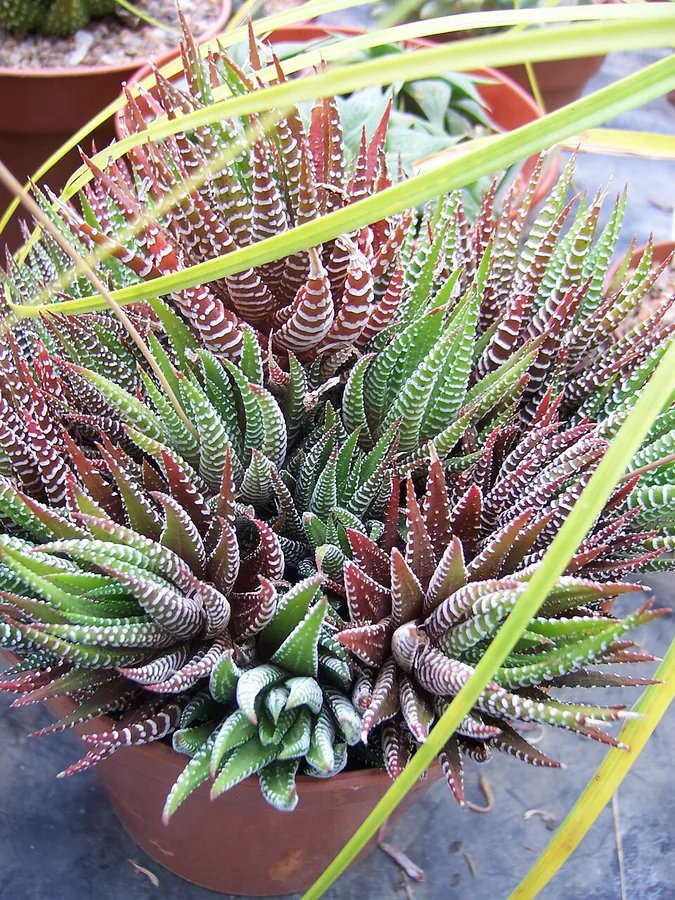
Haworthiopsis attenuata is a small, slow-growing succulent whose common name comes from the white tubercles banding its dark green leaves. The stiff, tapered leaves arrange into a compact rosette that holds its form for the plant's whole life, seldom exceeding 4 to 6 inches (10 to 15 cm) across. That restrained habit suits a windowsill, a desk, or a mixed succulent planting.
The species sits in the Asphodelaceae and originates in South Africa, where it grows among the light shade cast by taller vegetation rather than in exposed desert. That native habitat explains its light preference: bright indirect light serves it better than strong direct sun, which its foliage is not adapted to. Established specimens send up a slender inflorescence of small tubular white flowers in spring to summer, though the plant is grown chiefly for its foliage.
Its drought tolerance follows directly from its anatomy. The thick leaves function as water-storage organs, so the plant withstands a missed watering and in fact performs best when the medium dries fully between drinks. The single condition it will not tolerate is prolonged soil moisture, which invites rot and is the most common cause of loss.
Care
The short version: supply bright indirect light, a gritty free-draining medium, and a thorough soak only after the soil has dried completely. Reduce watering further in winter, and the plant needs little more.
Light
Provide bright indirect light, the exposure found near a window shielded from direct midday sun. The species also accepts partial sun and medium indirect light, but strong direct radiation exceeds what the foliage can tolerate and produces scorching and loss of pigment.
Water
Irrigate thoroughly, then withhold water until the medium has dried completely, an interval that generally falls every 14 to 21 days. Because the leaves hold their own reserve, underwatering carries far less risk than overwatering. Reduce the frequency sharply in winter, when cold, saturated soil promotes rapid rot.
Soil
Grow it in a gritty cactus or succulent mix engineered to drain freely and never remain saturated. The species accepts a pH from 6.0 to 7.5, so the physical structure of the medium governs success far more than its chemistry.
Temperature
Ordinary interior temperatures suit it, with an ideal band of 50°F and 77°F (10°C to 25°C). Protect it from frost and cold drafts, as the species has no frost hardiness.
Humidity
This is a low-humidity plant fully adapted to dry indoor air. Misting and humidity management are unnecessary, and stagnant, humid conditions work against it.
Feeding
Nutrient demand is low. During the spring and summer growth period, apply a dilute, half-strength low-nitrogen cactus or succulent fertilizer on a seasonal schedule. Suspend feeding through autumn and winter while growth pauses.
Pruning
Pruning requirements are minimal. Remove senescent outer leaves and spent flower stalks at the base as they occur, and no more. The plant needs no structural cutting.
Repotting
Repot only every 2 to 3 years, or earlier once offsets have filled the container. The indicators are pups crowding the rim, roots emerging from the drainage holes, and a medium that dries almost immediately after watering.
Size & spacing
This is a small species by nature, reaching roughly 4 to 6 inches (10 to 15 cm) in both height and spread. A single rosette occupies a small pot comfortably, and a cluster of offsets can be grown together in one shallow dish.
Troubleshooting
Nearly every disorder in this species traces to watering or light, and the leaves and rosette register the earliest evidence. Read those signs, identify the cause below, and correct it before secondary damage sets in.
Basal leaves softening, browning, and turning translucent
Soft, translucent basal tissue indicates root and crown rot, the result of water retained in a medium that drains too slowly. Withhold water at once, lift the plant, and excise every soft, brown root with a clean blade. Allow the cut surfaces to callus, replant into dry gritty mix, and resume light watering only after the plant has re-established.
Fix:
- Stop watering immediately
- Remove the plant and cut away all soft, rotted tissue with a clean blade
- Allow cut surfaces to callus, then replant in fresh dry gritty mix
- Resume watering sparingly only once re-established
Elongated, pale growth with widely spaced leaves
The elongation is etiolation, a response to light insufficient for compact growth. The rosette loses its tight geometry and inclines toward the light source. Relocate the plant to steady bright indirect light and rotate the pot periodically to restore even development.
Fix:
- Move to a brighter location with bright indirect light
- Rotate the pot periodically for even growth
Foliage flushing red, orange, or bleaching to white
This discoloration is sunburn, and it develops on the surface exposed to the strongest light, typically after relocation to a brighter position. Return the plant to bright indirect light and screen it from intense midday sun. To increase brightness later, raise the exposure incrementally across a week or two so the foliage can acclimate.
Fix:
- Move to bright indirect light
- Shade from intense midday sun
- Acclimate gradually to brighter spots over one to two weeks
Toxicity
For pet-owning households the assessment is straightforward: Haworthiopsis attenuata is regarded as non-toxic and pet-safe around cats, dogs, and other animals. It does not appear on the ASPCA list of toxic plants, and its tissues contain no compounds known to poison an animal that samples them. The likeliest consequence of ingestion is a mild, self-limiting digestive upset caused by the bulk of the firm leaves.
Safe for
People · Cats · Dogs · Horses · Rabbits · Livestock · Birds
Cats None
The species poses no toxic risk to cats. A cat that chews a few leaves may experience brief gastric irritation, attributable to the plant material itself rather than any toxin.
Dogs None
Dogs face no risk of poisoning. A dog that mouths the firm rosette may drool or vomit slightly in response to the bulk of the tissue, but the plant contains nothing harmful.
Horses Safe
The plant is non-toxic to horses. As a small windowsill succulent it seldom enters their environment in any case.
Rabbits Safe
It is safe for rabbits. The thick, tough leaves hold no toxic constituents, and their firmness makes them an unlikely food.
Livestock Safe
Grazing stock such as cattle, goats, and sheep are unaffected, as the plant carries no compounds capable of harming them.
Birds Safe
Pet birds are safe in its presence, the tissue being free of toxins, and the dense leaves are too firm to attract most of them.
People Safe
The plant is harmless to people, children included. It is not cultivated for consumption, but an exploratory bite causes nothing worse than a possible mild stomachache.
Varieties
Cultivation holds only a handful of forms, and they are readily confused with one another and with the unrelated look-alike that shares the common name. The following are the forms most often encountered.
Haworthiopsis attenuata var. attenuata
This represents the type form, bearing raised white tubercles that band across both the upper and lower leaf surfaces.
Haworthiopsis attenuata 'Concolor'
In this cultivar the white tubercles are distributed evenly across the leaf surface rather than aligning into the discrete stripes associated with the species.
Haworthiopsis fasciata (true zebra haworthia)
The genuine fasciata carries smooth inner leaf surfaces with tubercles confined to the exterior, yet nearly all material sold under that name proves to be H. attenuata.
How to propagate
Once a specimen is established, propagation is simple and requires no material cost. The two reliable routes are separating the basal offsets it produces and dividing a mature clump at repotting.
Offsets & pupsEasy
Spring to summer during active growth · 4 to 8 weeks to root once potted
The most dependable method is separating the offsets, the basal pups that accumulate around the parent. Detach them in spring or summer during active growth, allow any cut surface to callus, and pot each offset into dry gritty mix. Apply light water once it has anchored, and rooting proceeds over roughly 4 to 8 weeks.
DivisionEasy
At repotting in spring or summer · 4 to 8 weeks
A mature clump can alternatively be divided at repotting in spring or summer. Separate it into rooted sections, hold each dry until it establishes, and allow approximately 4 to 8 weeks for it to settle.
Myths
The zebra haworthia is the same plant as the zebra plant, Aphelandra.
The two are unrelated species linked only by a shared common name. This plant is a small Asphodelaceae succulent with striped, fleshy rosettes, whereas Aphelandra squarrosa is a leafy member of the Acanthaceae grown for its large veined leaves and yellow bracts.
Zebra haworthia is a cactus suited to full desert sun.
It is a succulent within the Asphodelaceae and taxonomically not a cactus, and in habitat it frequently occupies partial shade. Under cultivation it performs best in bright indirect light, and harsh direct sun scorches the foliage.