Ornamental · Asphodelaceae
Red-hot Poker
Kniphofia uvaria
Set red-hot poker in full sun over free-draining ground, and it answers with tall torches of red-to-yellow spikes across the summer.
Full sun
Every 7–14 days
USDA 5–9
2–4 ft · 0.6–1.2 m
Overview
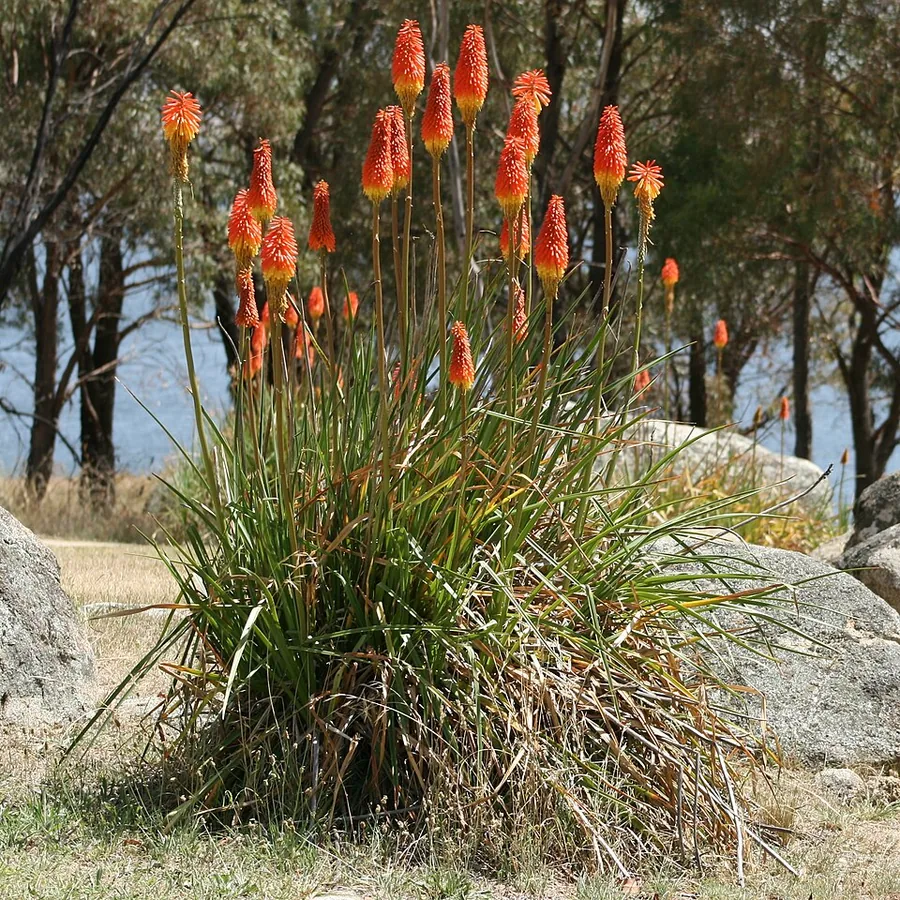
The common name describes the inflorescence accurately. Each stem carries a dense terminal torch of tubular flowers that emerge red in bud and mature to yellow, presenting two colors on one spike at any given moment. The plant builds a grassy clump of arching leaves and belongs among the aloes, an ancestry evident in its tough, succulent-textured foliage.
It performs as an undemanding border perennial, hardy across USDA zones 5 to 9. Once established it needs little intervention and withstands heat, drought, and impoverished sandy soils without decline. Its one intolerance is wet, heavy soil held around the crown, which the species cannot survive for long.
It has clear pollinator value. Hummingbirds and butterflies work the nectar-rich spikes through the warm months, while deer and rabbits typically bypass it. One qualification applies: the species has become invasive in some parts of the U.S., so confirm local guidance before planting.
Care
The short version: flowering hinges on full sun, and survival hinges on drainage. Provide moisture during establishment, then rely on its drought tolerance, keep the crown dry through winter to prevent rot, and deadhead to prolong bloom.
Light
Provide full sun, meaning at least 6 hours of direct light daily, because spike production depends on high light. Partial shade is tolerated, but reduced light diverts the plant toward foliage at the expense of the flower spikes.
Water
Supply medium moisture during establishment while the root system develops, then reduce it, since an established clump is genuinely drought tolerant. Prolonged wet, heavy, or soggy soil, particularly over winter, deprives the roots of oxygen and triggers rot from below.
Soil
Grow it in well-drained loam or sand of average to rich fertility with organic matter incorporated. Its wide tolerance of pH from 6.0 to 8.0, acidic through alkaline, means reaction is rarely limiting, and rapid drainage is the decisive factor.
Humidity
Ambient outdoor humidity is adequate, so no target range applies. The relevant variable is substrate moisture at the base: the crown and roots must stay on the dry side to avoid rot.
Feeding
An all-purpose balanced fertilizer applied through the growing season, as needed, meets its modest demand. This is a lean-soil species, so heavy feeding offers no advantage.
Pruning
Remove spent flower spikes promptly, since deadheading redirects energy into further bloom. Retain the foliage over winter to insulate the crown, and in colder zones mulch or tie the leaves so meltwater cannot collect and freeze within the crown.
Size & spacing
Expect mature clumps of 2 to 4 feet (60 to 120 cm) in flower with a spread of 24 to 35 inches (60 to 90 cm). Spacing to that width maintains an open habit and airflow through the foliage.
When to plant
Growth and flowering track the warm season. Sowing indoors in late winter gives seedlings a head start, transplanting or dividing in spring after frost avoids cold damage to disturbed roots, and fall planting also works; the bloom sequence then runs from early summer into early autumn.
Northern hemisphere
Southern hemisphere
Typical months for a temperate climate: start earlier in warm zones, later where spring frosts linger.
- Sow: Start seed indoors in late winter, about 6 to 8 weeks before the last frost
- Plant: Transplant or divide in spring after frost danger passes, or in fall
- Harvest: Late spring to early fall, with main flush from early summer; spikes are red in bud and mature to yellow
Hardiness
USDA hardiness zones: 5–9
Temperature: down to -29°C
Troubleshooting
Most disorders on this durable perennial reduce to a single cause: excess soil moisture. Monitoring the crown, the foliage, and the flower count catches the common problems while they are still correctable. Identify the symptom below, then intervene before it advances.
Softened brown crown preceding collapse
The diagnosis is root rot, a consequence of saturated soil rather than a pathogen or pest introduced from outside. Heavy ground and winter moisture retained in the crown are the typical triggers, since neither drains freely. Amend with sand or organic matter to raise porosity, reduce irrigation, and relocate the plant to a raised, free-draining position wherever the substrate stays sodden.
Fix:
- Improve drainage by amending with organic matter or sand
- Avoid overwatering and standing water
- Relocate to a raised or well-drained site if soil stays wet
Suppressed flowering and few spikes
The limiting factor is usually insufficient light, because spike initiation requires full sun of at least 6 hours of direct exposure. An aged, congested clump can also flower less as it competes with itself, so leave established plants undisturbed and divide only once crowding is evident.
Fix:
- Site in full sun with at least 6 hours of direct light
- Leave established clumps undisturbed
- Divide only when clumps become overcrowded
Silvery scarring and stippling on the leaves
The cause is thrips, whose rasping mouthparts abrade the leaf surface and leave the characteristic silvery scarring. Close inspection reveals the slender insects on the foliage. A forceful water spray dislodges light populations, removing the most damaged leaves reduces the reservoir, and an insecticidal treatment is warranted only where infestations persist.
Fix:
- Hose off light infestations with water
- Remove and destroy heavily damaged foliage
- Treat persistent infestations with an appropriate insecticidal control
Toxicity
The toxicology here is straightforward: no part of red-hot poker is poisonous. The ASPCA classifies torch lily as non-toxic to cats, dogs, and horses, and no toxin is present to affect other animals or people. Any reaction is limited to mild, mechanical stomach upset from overeating fibrous foliage.
Safe for
People · Cats · Dogs · Horses · Rabbits · Livestock · Birds
Cats None
The ASPCA classifies torch lily as non-toxic to cats, so incidental browsing poses no poisoning risk. Ingestion of a large quantity of any plant may provoke mechanical vomiting, but the tissue contains no toxin.
Dogs None
Dogs may consume the foliage without toxic effect, the species being rated non-toxic to them as well. Excessive intake of plant material produces at most transient gastrointestinal upset.
Horses None
Horses are unaffected, the ASPCA extending its non-toxic rating to them. Neither the leaves nor the flower spikes hold a compound capable of causing poisoning if grazed.
Rabbits Safe
No constituent of the plant is toxic to rabbits. They generally avoid it regardless, as it is documented rabbit resistant, so plantings usually remain intact.
Livestock Safe
Cattle, goats, and sheep face no poisoning risk from this species. The coarse, fibrous foliage is seldom preferred, and a mouthful causes no injury.
Birds Safe
The plant contains no avian toxin. Hummingbirds and other pollinators are in fact drawn to the nectar-rich spikes, a notable ecological value in the garden.
People Safe
Red-hot poker is safe to handle and to cultivate around children. No portion is consumed as food, but contact with the leaves or a fallen flower carries no risk of poisoning.
Varieties
The named selections differ mainly in flower color and mature stature, spanning warm oranges through compact dwarf forms. The three below are the ones most often offered.
Echo Mango
A selection whose spikes read warm mango-orange rather than the species' typical fiery red.
Redhot Popsicle
A compact member of the Popsicle series bearing bright red-and-yellow spikes over an exceptionally extended bloom period.
POCO Orange
A dwarf form near 20 to 24 inches in height with clear orange flowers, well suited to a small bed or the front of a border.
How to propagate
Two methods increase red-hot poker, vegetative division and seed, and each carries a lag before the plants reach flowering size.
DivisionModerate
Spring or fall · One to two growing seasons
Division is the dependable route, carried out in spring or fall. The clump's tough, vigorous root system resists separation, so a spade, a saw, or an axe is often required to split a mature specimen. Divisions re-establish over one to two growing seasons, which is reason enough to leave a productive clump undisturbed.
SeedModerate
Start indoors in late winter or sow when ripe · Seed-grown plants may take a few years to reach flowering size
The species also comes from seed, started indoors in late winter or sown fresh at ripeness. Flowering is delayed, as seed-raised plants commonly need a few years to reach flowering size. Seed collected from a hybrid seldom breeds true, so expect variable, off-type seedlings.
Myths
Red-hot poker is toxic to household pets.
The fiery coloring suggests a hazard that the toxicology does not confirm. The ASPCA lists torch lily (Kniphofia) as non-toxic to dogs, cats, and horses, so ingestion of a small amount warrants no veterinary intervention.
Removing the leaves at soil level in autumn protects the crown.
The practice is counterproductive. Retaining the foliage through winter insulates the crown, and in cold regions binding the leaves or mulching over them prevents water from pooling and freezing at the plant's center, where ice would injure the crown.