Houseplant · Asphodelaceae
Gasteria
Gasteria
Grown for its bright indirect light and a dry rest between waterings, this drought-adapted succulent needs little once its watering is right.
Bright indirect
Every 10–21 days
50–77°F · 10–25°C
USDA 10–12
Overview
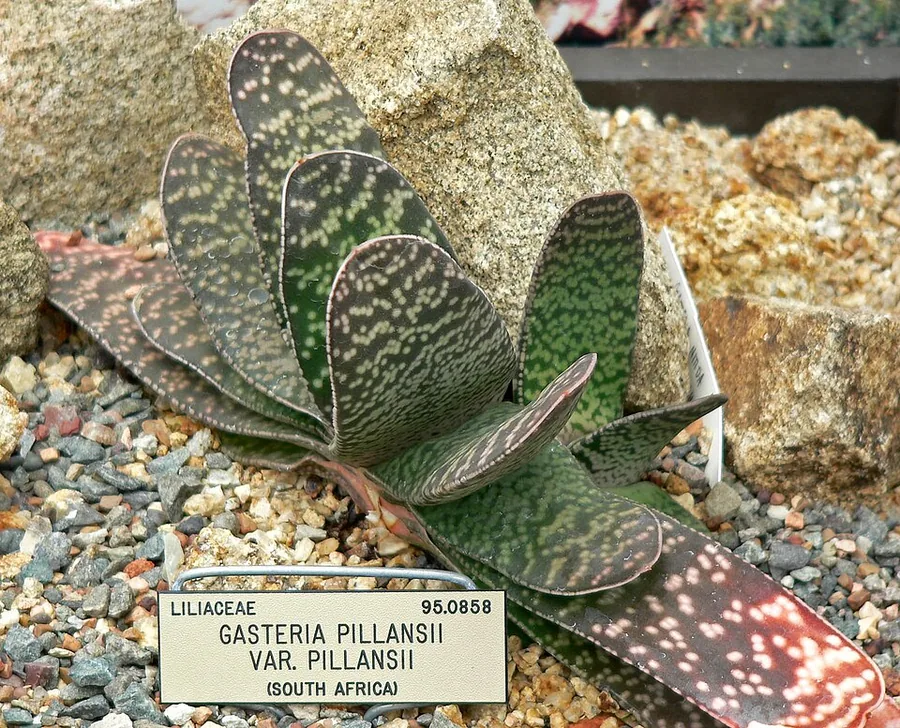
Gasteria is a small South African succulent grown for its thick, tongue-shaped leaves, the trait behind common names such as ox tongue and cow tongue. The leaves form stacked ranks or a low rosette and are frequently speckled or set with raised white tubercles. Its mature height rarely exceeds a foot, which makes it one of the more manageable succulents for windowsill culture.
It sits in the Asphodelaceae alongside aloe and haworthia, and that relationship shows in the fleshy foliage and the arching inflorescences. In spring and summer it can produce a slender raceme of curved, pinkish tubular flowers. Growth is slow and the plant is long-lived, accumulating a clump of basal offsets as it matures.
Its appeal rests on modest requirements. Gasteria tolerates lower and indirect light than most succulents, withstands an occasional missed watering, and seldom outgrows its container. The single real vulnerability is waterlogged soil, so effectively all of its care reduces to keeping the root zone on the dry side.
Care
The short version: bright indirect light, a gritty fast-draining mix, and water applied only after the soil has dried out completely, with the plant held nearly dry through winter.
Light
Gasteria performs best in bright indirect light and tolerates medium light or partial shade, a shade tolerance that distinguishes it from sun-demanding succulents. Screen it from harsh midday sun, because leaf tissue acclimated to softer light scorches when exposed to strong rays abruptly. Under insufficient light the compact rosette elongates and loses form as the leaves stretch toward the source.
Water
Allow the medium to dry out completely between waterings, then water thoroughly, typically every 10 to 21 days during active growth. Reduce this to near-dry conditions in winter, supplying only enough to prevent the leaves from shriveling. Because the plant is highly rot-prone, water at the base and avoid leaving moisture in the rosette, where it promotes decay.
Soil
Grow it in a gritty cactus or succulent mix that drains rapidly and retains no standing water. This sharp drainage is what protects the rot-prone roots from prolonged saturation, so amend a heavy mix with additional perlite or coarse sand to improve porosity.
Temperature
Hold it within 50°F to 77°F (10°C to 25°C), a range that ordinary room temperatures satisfy. It lacks frost hardiness, so return it indoors well before the first cold nights, when low temperatures would damage the tissue.
Humidity
Gasteria suits low humidity and dry foliage, and standard indoor air meets that need. Withhold misting, since surface moisture on the leaves lingers and creates the conditions under which fungal problems develop.
Feeding
Feed sparingly from spring into early autumn during active growth, about once a month. Apply a dilute, low-nitrogen liquid cactus fertilizer, and suspend feeding through winter when growth halts and the plant cannot use the nutrients.
Pruning
Pruning is minimal. Remove dead, shriveled, or damaged leaves at the base, and cut back the spent flower stalk once blooming has finished.
Repotting
Repot every 2 to 3 years, or sooner once offsets have filled the container. Move it into fresh gritty mix when roots emerge from the drainage holes or the medium dries almost as fast as you apply water, both signs the pot has become crowded.
Size & spacing
This is a small plant, reaching 4 to 12 inches (10 to 30 cm) in height with a spread near 6 to 12 inches (15 to 30 cm). Its compact dimensions make it well suited to a windowsill, a shelf, or a grouped succulent dish.
Troubleshooting
Almost every gasteria disorder resolves to water or light. Soft leaves indicate excess water, elongated growth indicates a light deficit, and a small group of pests accounts for the remainder. Match the symptom below, then correct the underlying cause rather than the visible symptom.
Soft, see-through, mushy leaves
Soft, translucent leaves indicate rot, which nearly always develops when excess water sits in poorly draining soil and excludes oxygen from the roots. Examine the roots, and if they are soft and blackened, cut away every rotted part and repot into fresh gritty mix. Then reduce watering and allow the medium to dry completely before the next application.
Fix:
- Stop watering and allow the soil to dry out
- Remove rotted tissue and repot into fresh gritty, fast-draining mix
- Resume only sparing watering once the soil is fully dry
White cottony spots or fine webbing on the leaves
Cottony masses indicate mealybugs and fine webbing indicates spider mites, both of which shelter in the leaf bases where they are easily overlooked. Remove them with a cotton swab dipped in isopropyl alcohol and isolate the plant from its neighbors. Where infestations persist, follow with insecticidal soap or horticultural oil.
Fix:
- Wipe pests off with isopropyl alcohol on a cotton swab
- Isolate the affected plant
- Treat with insecticidal soap or horticultural oil as needed
Brown or reddish scorched patches on the leaves
Brown or reddish scorched patches indicate sunburn, which occurs when foliage grown in softer light is moved abruptly into hot, direct sun before it can acclimate. Return the plant to bright filtered light and the new growth emerges clean. To increase sun later, raise exposure over a week or two so the leaves harden first.
Fix:
- Move the plant to bright filtered or indirect light
- Acclimate gradually before increasing sun exposure
Stretched, pale, leggy growth
Under insufficient light the rosette loses its compact form and the leaves elongate and lean toward the window. This is etiolation, and the stretched tissue does not revert to a tight habit. Move the plant to brighter indirect light gradually, since an abrupt increase would risk sunburn instead.
Fix:
- Move gradually to brighter, indirect light
Toxicity
For households with pets, gasteria reads as non-toxic and safe around cats, dogs, and children. It does not appear on the ASPCA toxic list, and no toxin has been identified in the foliage. The most a determined nibbler risks is a mild, transient gastrointestinal upset from the tough, fibrous tissue.
Safe for
People · Cats · Dogs · Horses · Rabbits · Livestock · Birds
Cats Safe
Gasteria contains no toxin harmful to cats, so ingestion carries no risk of poisoning. Its fibrous tissue is difficult to digest, and a cat that consumes a large amount may salivate or vomit.
Dogs Safe
Dogs can chew the leaves with no risk of poisoning. The most a substantial mouthful is likely to cause is a brief episode of gastrointestinal upset.
Horses Safe
Nothing in gasteria is harmful to horses. As a small windowsill succulent rather than pasture forage, it rarely presents any opportunity for exposure.
Rabbits Safe
The leaves are non-toxic to rabbits. The thick, fibrous flesh falls outside their normal diet, however, so it is better treated as an occasional taste than a regular green.
Livestock Safe
Goats, sheep, and cattle face no risk of poisoning from gasteria. As a slow-growing potted succulent, it is unlikely ever to be within their reach.
Birds Safe
Gasteria presents no toxic hazard to birds. A pecked leaf is harmless, though the tough succulent flesh offers little of value to a bird.
People Safe
The plant is non-toxic and safe around children. It is not grown for consumption, so there is no cause to eat a leaf, and an incidental nibble produces no harm.
Commonly regarded as pet-safe; even so, ingestion of fibrous succulent leaves may cause mild, transient gastrointestinal upset or vomiting in cats and dogs.
Varieties
The genus spans numerous species and hybrids, but a few appear repeatedly in cultivation. These are the ones worth recognizing by name.
Gasteria gracilis
A small clumping species whose slender, tongue-shaped leaves account for the common names cow tongue and ox tongue.
Gasteria carinata var. verrucosa
The warty keeled ox tongue, whose leaves are covered in raised white tubercles that produce a rough, pebbled surface.
Gasteria glomerata
A compact species that forms tight clusters of short, stubby grey-green leaves.
Gasteria 'Little Warty'
A popular hybrid valued for its bumpy, marbled leaves and pronounced warty texture.
How to propagate
Gasteria is among the simplest succulents to increase, largely because the plant supplies its own propagation material in the form of basal offsets ready to lift and pot on.
Offsets & pupsEasy
Spring to summer during active growth · 4-8 weeks to root
The most reliable method is to detach the basal offsets, or pups, that crowd the clump and pot each on its own. Carried out in spring or summer during active growth, the divisions form roots in roughly 4 to 8 weeks.
DivisionEasy
When repotting in spring · 2-4 weeks
A clump that has filled its pot can be divided into rooted sections at repotting time in spring. Because each section already bears roots, it re-establishes rapidly and generally resumes growth within 2 to 4 weeks.
Leaf cuttingsModerate
Spring to summer · Several weeks to a few months
A whole leaf taken in spring or summer can also be rooted. Allow the cut surface to callus for several days, lay it on gritty mix, and wait, since establishment ranges from several weeks to a few months and is slower and less reliable than propagation from offsets.
SeedDemanding
Spring in warm conditions · Many months to years to reach size
Seed is the slowest route, sown in spring under warm conditions. Germination is protracted and seedlings require many months to years to reach appreciable size, so this method serves mainly to generate new variation rather than to bulk up plants quickly.
Myths
Gasteria is the same plant as the snake plant called mother-in-law's tongue.
The two share only a folk name. Gasteria is a distinct Asphodelaceae succulent, whereas mother-in-law's tongue is a Sansevieria, now placed within Dracaena, so their culture and their botany diverge entirely.
Like its relative aloe, gasteria is toxic to pets.
Aloe is recorded on the ASPCA toxic list, but gasteria is not. Its toxicity has never been established, and it is widely maintained as a pet-safe succulent.
Misting keeps gasteria healthy.
This species originates in dry habitat and requires low humidity with dry foliage. Misting only leaves water standing in the rosette, the precise site where fungal decay and rot begin.