Houseplant · Asphodelaceae
Haworthia
Haworthia
Give it bright indirect light and a long dry spell between drinks, and this little windowed succulent asks for almost nothing.
Bright indirect
Every 14–21 days
59–81°F · 15–27°C
USDA 9–11
Overview
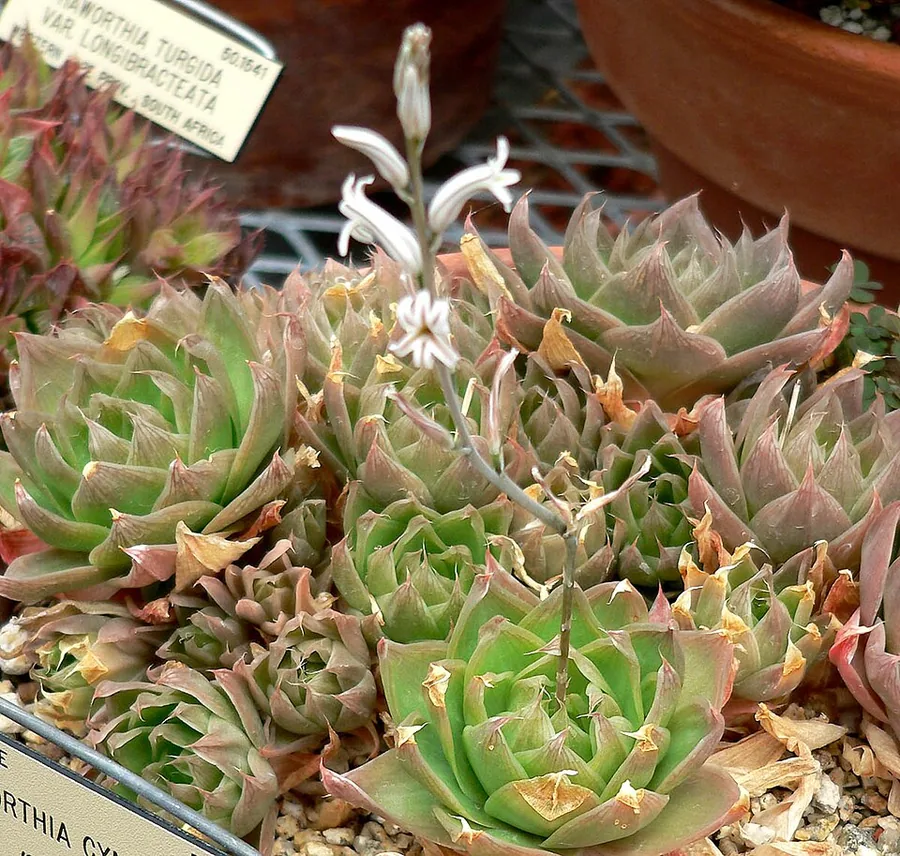
Haworthia is a small rosette succulent native to the arid regions of southern Africa, and among indoor succulents it ranks as one of the most tolerant of imperfect care. The fleshy leaves are arranged in a tight rosette, and many species carry translucent leaf windows at the tips, a structural adaptation that channels light down into the buried tissue. Growth is slow and the plant remains compact, reaching only 3 to 6 inches (8 to 15 cm) across at maturity.
Its defining trait among succulents is a genuine tolerance for lower light. In habitat it grows sheltered among rocks and grasses in part shade, so it copes with the medium light of an interior room far better than a high-light genus such as echeveria. That adaptation makes it a dependable choice where sun exposure is limited and other succulents etiolate.
Its principal vulnerability is waterlogging. As a drought-adapted species it stores water in its leaves and is physiologically suited to dry intervals, so saturated substrate is far more dangerous to it than drought. Manage irrigation to respect that adaptation and the plant is largely self-sufficient, producing steady slow growth and a ring of offset pups that propagate it readily.
Care
The short version: bright indirect light, a gritty free-draining substrate, and a thorough irrigation applied only after the soil has dried through completely. Reduce watering in winter, apply dilute feed during active growth, and never leave the root zone standing in water.
Light
Provide bright indirect light at a window shielded from harsh midday sun. It sustains itself in medium or even low light more successfully than most succulents because of its shade-adapted origins, whereas excess direct sun induces red or brown pigmentation in the leaves.
Water
Allow the substrate to dry completely before irrigating, then water thoroughly until it drains from the base to flush the root zone. In active growth that interval is roughly every 14 to 21 days, and considerably longer in winter. Because the species is highly prone to root rot, err toward delaying rather than advancing a watering.
Soil
Use a gritty cactus or succulent mix with rapid drainage so the root zone never remains saturated. A pH between 6.0 to 7.5 is suitable, though adequate drainage and a pot with drainage holes govern success far more than the precise formulation.
Temperature
Standard interior temperatures are optimal, in the range of 59°F and 81°F (15°C to 27°C). Protect it from cold drafts and frost, as the tissue has no frost tolerance and will be damaged by freezing.
Humidity
Low ambient household humidity is its preference, so supplemental trays or misting are unnecessary. Dry air is well tolerated and in fact reduces the moisture load that favors rot.
Feeding
Apply a balanced liquid fertilizer at half strength during spring and summer while the plant is in active growth. Given the slow growth rate, an occasional application across the season meets its nutrient demand, and no feeding is warranted in winter dormancy.
Pruning
Structural pruning is essentially unnecessary. Simply remove dead, dried, or damaged outer leaves and excise spent flower stalks once they have finished.
Repotting
Repot every 2 to 3 years, or earlier once offsets crowd and begin lifting from the pot. Roots protruding from the drainage holes and substrate that dries unusually quickly are the additional indicators that the root system has outgrown its container.
Size & spacing
This is a diminutive species, attaining only 3 to 6 inches (8 to 15 cm) in height and a comparable spread. A close-fitting container suits its slow root development, and several specimens can be grouped in one shallow dish with modest spacing between rosettes.
Troubleshooting
Almost every haworthia disorder resolves to a water or light imbalance, and the plant signals the deficit early through its leaves and rosette form. Read those signs against the entries below and correct the underlying condition before the tissue is permanently compromised.
Soft, blackened leaf bases and crown collapse
The cause is root and crown rot, which claims more haworthias than any other disorder because the roots suffocate and decay when held in wet, slow-draining substrate. Once collapse reaches the crown the tissue is compromised, so unpot promptly, excise every soft brown root back to firm tissue with a clean blade, and let the wounds callus. Repot only into dry gritty mix so the remaining roots can breathe.
Fix:
- Stop watering immediately
- Unpot and cut away all soft, rotted roots and tissue with a clean blade
- Allow cuts to callus, then repot into fresh dry gritty mix
- Resume watering only sparingly once established
Wrinkling, shriveled, thin-feeling leaves
Wrinkling reflects an underwatered plant drawing down the water reserves stored in its leaf tissue, which loses turgor and collapses inward. Confirm the substrate is dry through the full depth of the pot, then irrigate thoroughly until water exits the drainage holes and the root zone rehydrates. Turgor returns and the leaves refill within a few days.
Fix:
- Water thoroughly until it drains from the bottom
- Allow excess to drain fully
- Return to a regular dry-then-water cycle
Red, orange, or brown discoloration on the leaves
The warm coloration is sun stress, a pigment response to excess direct light rather than a pathogen, which is why it emerges first on the leaf faces oriented toward the window. Relocate the plant to bright indirect light to halt the progression. Existing pigmentation is permanent because the affected cells will not revert, but subsequent growth emerges in normal green.
Fix:
- Move the plant to bright indirect light
- Shade from intense midday sun
- Damaged leaves will not recover but new growth returns to normal color
Elongated, pale rosette with widening leaf spacing
Under insufficient light the plant elongates its growth toward the source, the response known as etiolation, and the internodes lengthen so the once-compact leaves separate. Chlorophyll production falls as well, which pales the rosette. Move it into strong indirect light to correct the deficit, and rotate the pot periodically so one-sided phototropism does not distort the form.
Fix:
- Move to a brighter spot with bright indirect light
- Rotate the pot regularly for even growth
Toxicity
For an indoor specimen the toxicological profile is reassuring: haworthia is non-toxic and pet-safe. It does not appear on the ASPCA toxic listing, and the foliage contains no compounds hazardous to a cat, dog, or child. Ingestion may cause only transient gastrointestinal irritation from the fibrous plant matter, with no systemic toxicity.
Safe for
People · Cats · Dogs · Horses · Rabbits · Livestock · Birds
Cats None
Non-toxic to cats. Ingestion may produce transient gastrointestinal upset from the plant matter itself, but no poisoning follows.
Dogs None
No poisoning hazard to dogs. A dog that chews the fibrous leaves may develop mild digestive irritation and nothing further.
Horses None
Non-toxic to horses, and its diminutive size makes accidental grazing effectively irrelevant.
Rabbits None
Harmless to rabbits on ingestion. The thick succulent leaf tissue contains no toxic constituents.
Livestock None
No toxic risk to grazing livestock, and as an indoor container specimen it seldom enters their environment.
Birds None
Safe in the presence of pet birds, since the foliage holds no compounds toxic to them.
People None
Not poisonous to people, children included. It is not cultivated as food and offers no reason to ingest, though an incidental nibble causes no harm.
Varieties
The genus encompasses dozens of species, but a limited set recurs in cultivation. The following are the ones a grower is most likely to encounter and should be able to distinguish.
Haworthia cooperi
Its plump, rounded leaves terminate in translucent windows that transmit light and appear to glow when illuminated from behind.
Haworthia cymbiformis
Boat-shaped leaves assemble into a compact rosette, each bearing faint window markings toward the apex.
Haworthia retusa
A star-shaped rosette of triangular leaves whose flattened upper surfaces remain clear and translucent.
Haworthia truncata
Its leaves appear cleanly truncated across their windowed tops and align in a rank reminiscent of a horse's teeth.
How to propagate
Haworthia propagates readily with minimal intervention, and a single established plant will typically supply all the divisions a grower needs.
Offsets & pupsEasy
Spring to summer during active growth · 4 to 8 weeks to root
The most reliable method is division of the basal offsets, the pups that form around the parent, taken during spring or summer when active growth supports rapid rooting. Detach each offset, allow the cut surface to callus for a day or two to seal against pathogens, and set it into dry gritty mix. Rooting follows in roughly 4 to 8 weeks.
DivisionEasy
Spring, often at repotting · 4 to 8 weeks
A clump of multiple crowded rosettes divides cleanly in spring, conveniently timed to coincide with repotting. Separate the root mass so each rosette retains a functional share of roots, then pot the divisions individually. Establishment occurs over approximately 4 to 8 weeks.
Leaf cuttingsModerate
Spring to summer · Several weeks to a few months
A single leaf can regenerate a new plant when taken in spring or summer. Remove an entire healthy leaf at the base, let it callus, and place it on dry mix so it can initiate roots. This route is slower and less dependable than offsets and may require several weeks to a few months before roots appear.
Myths
Haworthia needs full, direct sun all day like a desert cactus.
In habitat it occupies part shade among rocks and grasses rather than fully exposed ground, so it is adapted to filtered light. Its optimum is bright indirect light, and unshaded direct sun scorches and discolors the foliage through pigment stress and tissue damage.
Haworthia is a kind of aloe.
The historical circumscription placed these plants alongside aloes, and they remain co-classified within the family Asphodelaceae, which explains the persistent confusion. Taxonomically, haworthia constitutes a distinct genus of small rosette succulents separate from the true aloes.