Houseplant · Asphodelaceae
Aloe Vera
Aloe vera
Built to ration its own moisture, aloe thrives on strong light, sharply drained soil, and a full dry-down between waterings.
Bright indirect
50–86°F · 10–30°C
USDA 9–11
12–24 in · 30–60 cm
Overview
Aloe vera is a leaf-succulent adapted to arid ground, and that adaptation explains nearly everything about its care. Each plump blade functions as a water-storage organ, holding enough reserve to carry the plant through long rainless stretches, which is why a forgotten watering rarely sets it back. The medicinal nicknames burn plant and first-aid plant trace to the gel packed inside those same leaves.
Few houseplants are more tolerant of neglect, precisely because their physiology expects scarcity. Place it in a bright window, root it in a free-draining medium, and let the soil run fully dry before each watering. The single condition it cannot withstand is persistently wet roots, since a desert-evolved root system has no defense against the rot that follows waterlogging.
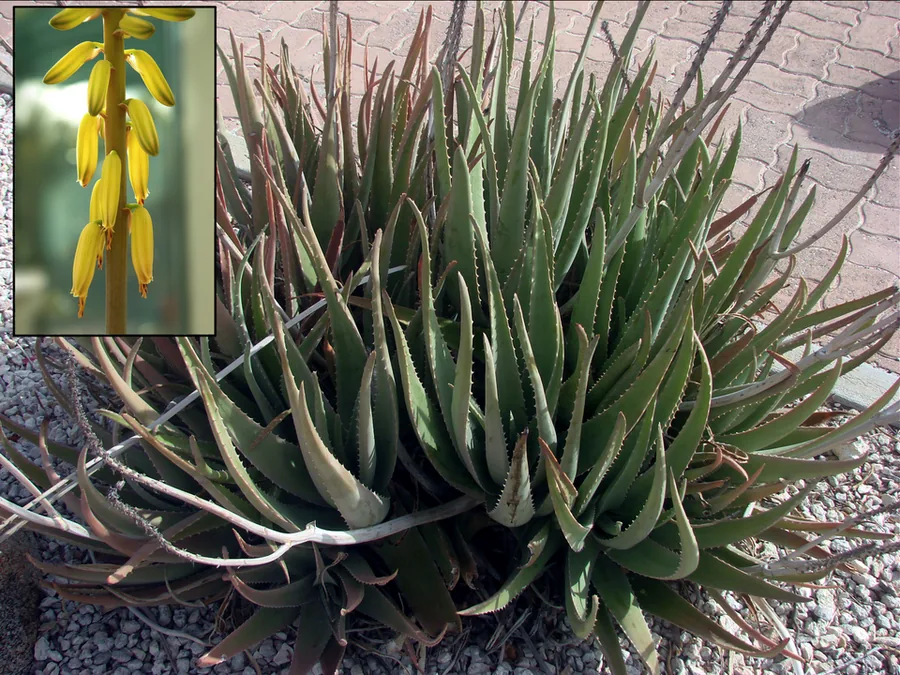
This is a long-lived, slow-growing perennial that propagates itself by sending up offset pups around the base, each a ready clone of the parent. Established specimens grown outdoors in warm climates can push up a tall inflorescence carrying tubular yellow to orange flowers.
Care
The short version: give it strong light, a gritty fast-draining medium, and a thorough soak only after the soil has dried out completely. Feed lightly, hold it warm, and never leave the roots standing in water.
Light
Aloe performs best in strong light, such as a sunny window or a position receiving several hours of direct sun. It will take full sun once gradually conditioned to it, but tissue moved straight into intense light scorches, while a plant held in shade etiolates, growing pale and stretched as it reaches for the source.
Water
Watering is where most failures begin, and the rule follows from the plant's storage habit: let the medium dry out completely, water deeply until it drains from the base, then withhold until the soil is bone dry again. Constant moisture and a saturated pot are exactly the conditions that rot the roots and crown.
Soil
Use a gritty cactus or succulent mix that drains within seconds rather than a dense compost that retains moisture against the roots. Aloe favors mildly alkaline conditions around a pH of 7.0 to 8.5, a range most commercial cactus mixes already meet.
Temperature
Standard indoor warmth suits it well, across a band of 50°F to 86°F (10°C to 30°C). It carries no frost tolerance, so any plant summered outdoors must come back inside before temperatures drop.
Humidity
Dry indoor air poses no difficulty, because this is a low-humidity desert species evolved for it. There is no target reading to chase and no reason to mist the foliage.
Feeding
Nutrient demand is minimal in a succulent like this. A dilute balanced houseplant fertilizer applied occasionally over spring and summer covers its needs, and omitting feed altogether causes little setback.
Pruning
Maintenance amounts to very little. Trim away withered or dead lower leaves flush with the base using a clean knife, and clear a flower stalk once it has spent itself.
Repotting
Plan to repot every 2 to 3 years, or earlier when offsets crowd the surface and roots emerge through the drainage holes. Step up a single pot size into fresh gritty medium in a free-draining container.
Size & spacing
Indoor specimens grow to roughly 12 to 24 inches (30 to 60 cm) in height and clump out to 12 to 35 inches (30 to 90 cm) across. Choose a pot broad enough to hold the offsets it generates.
Troubleshooting
Nearly every aloe complaint comes down to one of three variables: water, light, or the container and its drainage. The leaves record which one has gone wrong, so reading them points you to the cause. Find your symptom below and correct the underlying condition rather than the surface sign.
Soft, mushy leaves browning at the base
Soft, translucent tissue at the leaf base signals root and crown rot, a disorder driven by excess moisture rather than drought. Saturated soil starves the roots of oxygen, the tissue collapses, and the decay travels upward into the crown. Withhold water, unpot the plant, excise every rotted root and slimy leaf with a sterile blade, and replant into fresh gritty medium in a container that sheds water freely.
Fix:
- Stop watering and let the soil dry out
- Remove the plant, cut away rotted roots and mushy leaves with a clean blade
- Repot into fresh gritty succulent mix in a pot with drainage holes
Thin, curling, or wrinkled leaves
An aloe leaf is essentially a water reservoir, so a flattened, creased blade means the stored reserve has been drawn down. The cause is straightforward drought stress, and rehydration reverses it within days. Saturate the medium until water exits the drainage holes, then return to soaking only after the soil has fully dried.
Fix:
- Water thoroughly until it drains from the bottom
- Resume a regular deep-but-infrequent watering schedule
Reddish-brown or scorched patches on the leaves
Pale bleached or reddened patches indicate sunburn, a response to a rapid jump in light intensity rather than any pathogen. Tissue that has not built up protective pigments scorches where the strongest rays strike, which is why a plant taken abruptly from a windowsill to open sun marks on its exposed face. Return it to bright indirect light, and reintroduce stronger sun across one to two weeks so the leaves can adapt their pigmentation.
Fix:
- Move the plant to bright indirect light
- Acclimate gradually to stronger sun over one to two weeks
Toxicity
Aloe sits in an unusual position, benign for people yet hazardous to pets. The clear gel is formulated into burn creams and lotions, but the bitter yellow latex lining the leaf skin contains saponins and anthraquinones such as aloin that purge the digestive tract. Since the ASPCA classes aloe as toxic to cats, dogs, and horses, position it where animals and small children cannot bite into a leaf.
Toxic to
Cats · Dogs · Horses · Rabbits · Livestock · Birds · People
Cats Moderate
In cats, the purgative latex typically provokes vomiting and loose stools, often alongside refusal of food and noticeable lethargy. A heavier dose can add tremors or red-tinged urine, both markers of greater exposure.
Dogs Moderate
A dog shows the same gastrointestinal picture as a cat: vomiting, diarrhea, and a subdued, low-energy demeanor. Larger amounts of ingested leaf can trigger tremors and discolor the urine reddish.
Horses Moderate
Because the latex acts as a purgative, an affected horse develops diarrhea along with dullness and reduced appetite. Consuming a substantial quantity of leaf may bring on tremors as well.
Rabbits Toxic
A rabbit's digestive tract reacts severely to the same anthraquinones that purge other animals. Site the plant where it cannot be reached, because a rabbit has no safe way to nibble it as it would ordinary forage.
Livestock Toxic
When cattle, goats, or sheep browse the leaves, the purgative latex sets off heavy scouring. Exclude the plant from any paddock or pasture the animals can access.
Birds Toxic
Relative to a bird's small body mass, the aloin in the foliage acts as a potent laxative. A curious chicken or parrot should be kept entirely away from the plant.
People Caution
The clear inner gel appears in many products meant for human use, yet the yellow latex below the skin is an aggressive laxative that cramps the digestive tract and is not for swallowing. Store whole leaves away from young children, who would take in both layers at once.
This is a medicinal-for-people, toxic-to-pets plant; the inner gel differs from the toxic latex, but pets chewing whole leaves ingest both.
Helpline numbers

United States
ASPCA Animal Poison Control: (888) 426-4435 (fee applies)
Poison Control: (800) 222-1222



Canada
Poison Centres: 1-844-764-7669
Varieties
Almost all plants sold under the name aloe vera are one and the same species, yet a couple of recognized forms surface often enough to be worth telling apart.
Aloe vera 'Chinensis'
Marked by denser cream speckling across the foliage, this form holds a looser, more sprawling habit than the upright standard plant.
Aloe vera var. barbadensis
Cultivated commercially for its thick, gel-laden leaves, this is the traditional medicinal selection behind countless skin-care goods.
How to propagate
Aloe multiplies readily on its own, chiefly by way of the offsets it produces at the base. Dividing a clump or sowing seed are also options, though seed is much the slowest path to a finished plant.
Offsets & pupsEasy
Spring to summer during active growth · 4 to 8 weeks to root and establish
Separating the small pups that cluster at the parent's base is the simplest route to new plants. Carry it out in spring or summer while growth is active, allow any cut to dry and callus over a day or two, and set each pup into gritty medium. Allow 4 to 8 weeks for roots to form and the plant to settle.
DivisionEasy
At repotting in spring · 4 to 8 weeks
At the spring repotting, a congested clump bearing several rooted crowns can be teased apart and each crown grown on by itself. As with pups, expect the divisions to need 4 to 8 weeks to anchor.
SeedModerate
Spring, warm conditions · Several months to a year
Raising aloe from seed is slow and seldom justifies the effort. Surface-sow on gritty medium in spring under warm conditions, then be prepared to wait several months to a year before a usable plant emerges. Offsets deliver the same result far sooner.
Myths
Aloe gel is good for people, so the whole plant is safe for pets to chew.
Two distinct substances are at play: the clear gel sold for human use and the bitter yellow latex sitting just below the skin. An animal biting through a whole leaf takes in both, and that latex carries saponins along with anthraquinones such as aloin, the compounds that induce vomiting and diarrhea. The ASPCA lists aloe as toxic to cats, dogs, and horses, so position it beyond their reach.