Ornamental · Asphodelaceae
Daylily
Hemerocallis fulva
Vigorous, adaptable, and quick to establish, the daylily turns full sun into a fresh bloom each morning through summer.
Full sun
Every 7–14 days
USDA 3–9
2–6 ft · 0.8–1.8 m
Overview
The flowering habit explains the common name: each bloom lasts a single day, opening at dawn and senescing by nightfall, while successive buds on the same scape continue the display. Hemerocallis is a clumping herbaceous perennial of Asian origin now widespread across the temperate zones, and its tolerance of varied conditions lets it perform in a managed border or persist unaided in a roadside ditch. Its low input demand is what sets it apart.
Growth arises from thick, fleshy storage roots that fuel arching, grass-like foliage and tall scapes carrying the flowers through midsummer. The rhizomatous habit of the common orange fulva drives the rapid colonizing spread that lets it dominate a bed, whereas clump-forming named hybrids hold their position and supply nearly every color but true blue. The flowers and buds are edible, with a sweet, mild flavor.
One hazard overrides every horticultural consideration. Daylilies are deadly to cats: ingestion of even a trace of leaf, flower, or pollen can precipitate acute renal failure in a cat. Where a cat shares the household, treat that risk as decisive before planting, and exclude cut daylilies from indoor arrangements entirely.
Care
The short version: site it in full sun on average well-drained soil, supply moderate moisture across the growing season, and divide the clump every few years to sustain flowering.
Light
Flowering output correlates directly with light, so site daylilies in full sun for 6 or more hours daily. They persist in partial shade, but insufficient light produces etiolated, stretched growth and a measurable decline in bloom count.
Water
Provide a moderate, even supply through the growing season, on the order of every 7 to 14 days once established. The fleshy roots buffer the plant against drought better than most perennials, yet consistent soil moisture during active growth is what drives the heaviest flush of flowers.
Soil
Almost any well-drained loam serves, and incorporated organic matter improves performance. Optimum response falls within a pH of 6.0 to 7.0, though the species tolerates poor and heavy clay substrates that would limit less adaptable plants.
Humidity
No specific humidity target applies, since ambient outdoor conditions suffice. Air movement around the crown matters more, because the crown and root rots that affect daylilies establish under warm, stagnant, humid conditions.
Feeding
Daylilies are light feeders with modest nutrient demand. A single application of balanced general-purpose fertilizer in spring supplies most plantings for the remainder of the season.
Pruning
Deadhead spent flowers daily to maintain appearance, and remove the flower scapes once flowering concludes. Cut back the dead foliage in late fall or early spring before new growth resumes.
Size & spacing
Mature height ranges from 2.5 to 6 feet (76 to 183 cm) by cultivar, with clumps spreading 24 to 30 inches (61 to 76 cm) wide. Space plantings so air circulates freely around the crown.
When to plant
Hardiness across zones 3 through 9 makes the daylily a reliably perennial subject that regrows from its crown each year. Establish new plants in spring or early fall once hard frost has passed, with peak flowering expected across July and August.
Northern hemisphere
Southern hemisphere
Typical months for a temperate climate: start earlier in warm zones, later where spring frosts linger.
- Sow: Not typically grown from seed by home gardeners; hybrids do not come true from seed.
- Plant: Spring or early fall, after the danger of hard frost has passed.
- Harvest: Summer, roughly July to August in the temperate northern hemisphere.
Hardiness
USDA hardiness zones: 3–9
Temperature: down to -40°C
Troubleshooting
Few perennials present fewer problems, and the disorders that do appear are largely cosmetic rather than lethal. Identify the symptom below to intervene before a localized issue progresses through the clump.
Crown rot and collapse under warm, humid conditions
Sudden basal rot accompanied by a white mycelial web and tan, seed-sized sclerotia at the soil line identifies southern blight, a pathogen favored by hot, humid weather. An infected plant cannot be salvaged. Excavate it with the surrounding soil, then correct drainage and keep mulch off the crown, since the disorder establishes in poorly drained, mulch-smothered crowns.
Fix:
- Remove and destroy infected plants and surrounding soil
- Improve drainage and air circulation
- Avoid burying the crown too deeply
Declining flowering in aging, congested clumps
Rapid rhizomatous spread congests a clump over several seasons until the center thins and flowering falls off, a predictable consequence of overcrowding. The remedy is division. Lift the clump in early spring or immediately after bloom, separate it into fans, and reset each at soil level.
Fix:
- Dig and divide the clump in early spring or after bloom
- Replant divisions with the crown at soil level
Pale serpentine tunnels within the leaf blade
The agent is the daylily leafminer, whose larvae mine the internal leaf tissue and leave the characteristic winding tracks. Transmitted light through a held leaf reveals the larval tunnels. Because the injury is purely cosmetic and does not kill an established clump, removing the heavily mined leaves and sustaining plant vigor is sufficient.
Fix:
- Remove and destroy heavily mined leaves
- Maintain plant vigor with adequate water and division
Toxicity
This section is critical for any cat-keeping household. Daylilies are deadly to cats, because ingestion of any tissue, including pollen groomed from the coat or water from a cut-flower vase, can induce fatal acute renal failure within hours. Dogs and horses face far milder effects, and the flowers are genuinely edible for people, but no exposure is tolerable for a cat.
Toxic to
Cats · Dogs · Horses · Rabbits · Livestock · Birds
Safe for
People
Cats Severe
Any feline exposure constitutes a clinical emergency. A nibble of leaf or flower, ingestion of pollen groomed from the coat, or a sip of vase water can each induce acute renal failure that becomes fatal within hours. The earliest signs are vomiting, inappetence, and progressive lethargy advancing to complete renal shutdown. Veterinary intervention must begin at once, since therapy is effective only when initiated early.
Dogs Mild
Dogs are affected far less severely than cats. A dog that chews the plant may salivate or experience a transient episode of vomiting or loose stools, without the renal hazard that makes daylilies lethal to cats.
Horses Mild
In horses, grazing on the foliage generally produces no more than mild gastrointestinal upset, with slight salivation or loose manure following larger intakes.
Rabbits Caution
The effect on rabbits is poorly documented, so the plant warrants off-limits status, with no grazing of foliage or flowers permitted.
Livestock Caution
Firm data on grazing livestock is scarce, so excluding cattle, goats, and sheep from daylily stands is a reasonable precaution against an untested plant.
Birds Caution
Effects on pet and backyard birds remain unstudied, so cuttings and pollen should be kept out of reach pending further evidence.
People Flowers edible
For people the flowers and buds are edible, sweet and mild, with a long culinary history, making them safe to consume in moderation. That edibility provides no reassurance regarding cats, in which any contact can be fatal.
A feline emergency: keep all parts of the plant, fallen pollen, and any cut-flower water completely away from cats.
Helpline numbers

United States
ASPCA Animal Poison Control: (888) 426-4435 (fee applies)

United Kingdom
Animal PoisonLine: 01202 509000 (fee applies)

Australia
Animal Poisons Helpline: 1300 869 738
Varieties
Registered hybrids number in the tens of thousands, yet a small set of species and established cultivars defines the group's range. These reward attention first.
Hemerocallis fulva (Orange / Tawny daylily, 'Ditch lily')
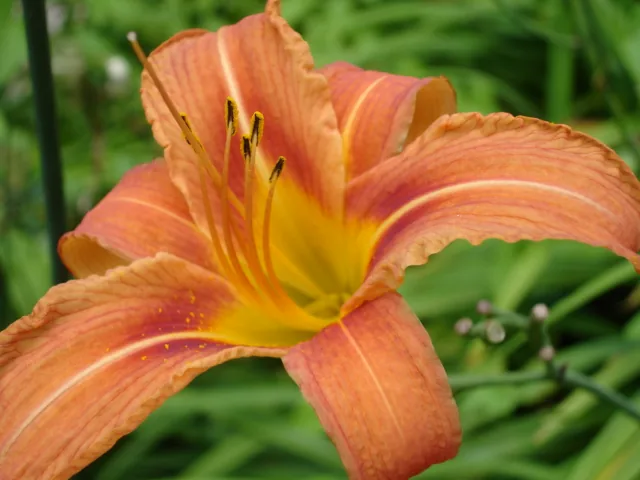
This vigorously rhizomatous species bears rusty-orange unscented flowers and has naturalized along North American roadsides extensively enough to acquire the colloquial name ditch lily.
Hemerocallis fulva 'Kwanso'
A double-flowered selection with supernumerary petals and nonfunctional stamens, it produces no seed and propagates exclusively by rhizome.
Hemerocallis lilioasphodelus (lemon daylily)
An early-flowering species bearing fragrant clear-yellow blooms, it contrasts markedly with the unscented orange of the common fulva.
Hemerocallis 'Stella de Oro'
A compact reblooming hybrid that flowers across the season, producing successive flushes of golden-yellow blooms.
How to propagate
Daylilies increase readily, and division is the only technique most growers require to populate a bed from a single established clump.
DivisionEasy
Early spring as new growth emerges, or in fall after blooming has finished. · Divisions typically reestablish and resume strong growth within one growing season, often blooming the following year.
Division is the standard means of multiplying daylilies, carried out in early spring as new growth emerges or in fall after flowering ceases. Lift the clump, separate it into fans that each retain roots and a crown, and replant at the original depth. Given rapid rhizomatous spread, divisions generally reestablish within a single growing season and frequently flower the following year.
Myths
Daylilies are true lilies and therefore endanger cats exactly as other lilies do.
Taxonomy separates the two: Hemerocallis lies outside Lilium, the true lily genus, so the classification genuinely differs. The clinical risk, however, converges. Both induce acute kidney failure in cats and demand strict separation from them.
Daylily flowers are toxic to people in the same manner they are toxic to cats.
For humans the flowers and buds are edible, carrying a sweet, mild flavor with centuries of culinary use behind it. That edibility does not extend to cats, in which even minor exposure can prove fatal.