Tree · Rutaceae
Yuzu
Citrus junos
The most cold-hardy of the true citrus, yuzu exchanges quick fruit for patience and a sheltered, sunny site.
Full sun
Every 7–14 days
USDA 8–11
6–18 ft · 1.8–5.5 m
Overview
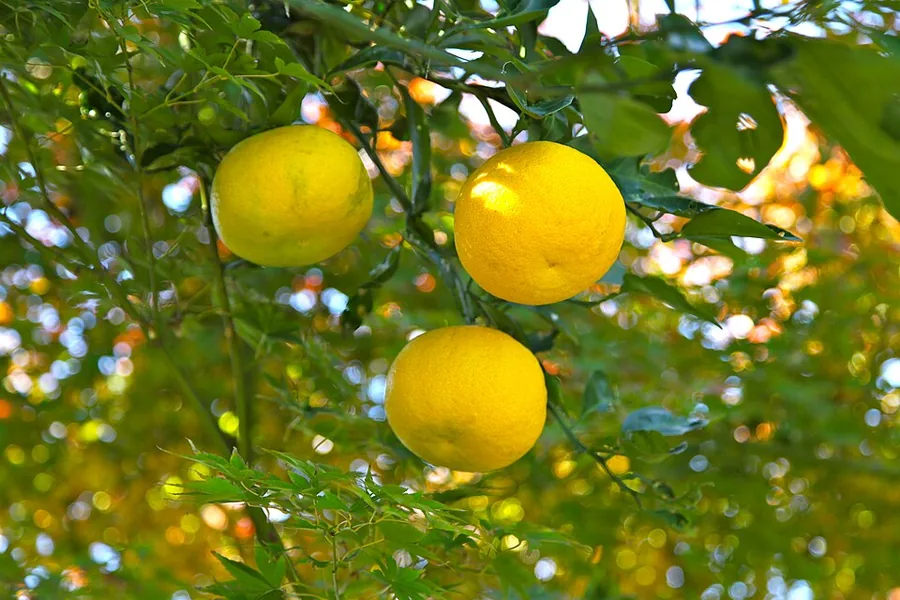
Yuzu is the true citrus that extends fruit-growing well beyond the traditional citrus belt. Native to East Asia, its knobbly yellow fruit seasons preparations from ponzu sauce to winter baths, and the value lies in the aromatic peel and tart juice rather than sweet flesh. Structurally it is a thorny evergreen, retaining its foliage through the year.
The exchange for that hardiness is time. Growth runs at a moderate rate, so a grafted tree fruits within a year or two while a seedling needs several. Its defining trait is cold tolerance: an established tree withstands temperatures near 14°F (-10°C), an extreme that lies well beyond the range of most citrus.
In zone 8 and warmer the tree performs in open ground, while in colder regions a large container that can move under cover carries it through hard freezes. The requirements are consistent: full sun, free-draining soil, and shelter from severe cold. Prune with the long thorns in mind, and the tree yields fragrant fruit each autumn.
Care
The short version: full sun, slightly acidic and well-drained soil, and watering once the surface dries. Feed monthly across the growing season, protect young trees from hard frost, and handle the thorns with thick gloves.
Light
Yuzu is a full sun species, needing six or more hours daily to ripen fruit well, because fruiting draws on the sugars that ample light produces. It tolerates partial shade, but reduced light yields leggier growth and lighter crops.
Water
Allow the top inch or so (3 cm) of soil to dry, then irrigate deeply, roughly every 7 to 14 days, so the roots alternate between moisture and air. Containers dry faster and demand more frequent watering, while winter dormancy calls for less.
Soil
Use well-drained, slightly acidic sandy loam enriched with organic matter, since free drainage protects the roots and organic matter holds nutrients. A pH of 6.0 to 7.0 keeps iron and the other micronutrients soluble and available for uptake.
Temperature
The workable range runs from about 14°F to 95°F (-10°C to 35°C), the widest cold tolerance among the true citrus. That hardiness accrues with maturity, so young trees still require frost protection until the wood ripens.
Humidity
Average humidity of 40% to 60% meets the plant's needs, so outdoor culture requires no intervention. Under dry indoor winter air, added moisture around the foliage offsets the shortfall.
Feeding
Feed monthly through spring and summer with a citrus fertilizer higher in nitrogen and supplying iron, zinc, and manganese to match active growth and the plant's micronutrient demand. Withhold feed late in the season, because a nitrogen flush late on produces tender shoots vulnerable to frost.
Pruning
Prune in late winter to early spring, before growth resumes, to shape the canopy and remove dead, crossing, or frost-damaged wood. The branches carry long, sharp thorns, so thick gloves are essential protection during the work.
Repotting
Repot container trees every 2 to 3 years, before roots circle the pot or emerge from the drainage holes and constrict growth. Water passing straight through without absorbing signals a root-filled, exhausted medium in need of renewal.
Size & spacing
Mature dimensions reach roughly 6 to 18 feet (1.8 to 5.5 m) in height and 5 to 13 feet (1.5 to 4 m) in spread, so allow generous space. Final size depends on the rootstock and on whether the tree grows in open ground or is restrained in a container.
When to plant
Yuzu keeps the citrus calendar but tolerates far more cold. Flowering occurs in spring, the fragrant fruit ripens through late autumn as the skin turns yellow, and planting follows the last frost in zone 8 and warmer. Propagation is normally by grafting rather than seed.
Northern hemisphere
Southern hemisphere
Typical months for a temperate climate: start earlier in warm zones, later where spring frosts linger.
- Sow: Seed late winter to early spring; yuzu is usually propagated by grafting rather than seed
- Plant: After the last frost in spring in zone 8 and warmer
- Harvest: Flowers in spring; aromatic fruit harvested in late autumn as it turns yellow
Hardiness
USDA hardiness zones: 8–11
Temperature: down to -12°C
Troubleshooting
Most disorders in yuzu resolve to two causes: cold injury, or a soil chemistry that does not suit citrus. Because the earliest signs appear on twigs and new foliage, close inspection buys time to correct the cause. Match the symptom below, then treat before decline sets in.
Dieback of twig tips and leaf loss following winter
The cause is cold or frost damage, and it concentrates on young trees taken beyond their hardiness threshold. A scratch test settles it: dry brown tissue at the twig tip over green wood below marks the killed section. Allow spring growth to define the live boundary, prune back to it, and protect young trees with frost cloth during severe freezes.
Fix:
- Wait until new growth resumes in spring, then prune back to live wood
- Protect with frost cloth or move containers under cover during hard freezes
Interveinal yellowing on the youngest leaves
This is interveinal chlorosis, a deficiency of iron, zinc, or manganese that commonly follows alkaline or waterlogged soil, both of which block uptake. The pattern is diagnostic: new leaves yellow between green veins while older foliage stays green. Supply a citrus fertilizer with chelated micronutrients and restore drainage so the roots can absorb iron again.
Fix:
- Apply a citrus fertilizer containing chelated micronutrients
- Correct drainage and avoid overwatering
Toxicity
The fruit is edible and safe for people, which is the reason for cultivation, but the vegetative parts are another matter for animals. The peel, leaves, and stems contain essential oils and psoralens that provoke gastrointestinal upset in cats, dogs, horses, and others. Keep prunings and fallen peel away from pets and livestock.
Toxic to
Cats · Dogs · Horses · Rabbits · Livestock · Birds
Safe for
People
Cats Mild
The essential oils and psoralens concentrated in the peel, leaves, and stems can produce drooling, vomiting, appetite loss, and loose stools in a cat. Direct contact with the peel may also cause skin irritation.
Dogs Mild
In a dog, chewing the leaves or peel commonly leads to gastrointestinal upset, marked by vomiting, diarrhea, and a subdued, sluggish demeanor. The same oils can redden the skin where they touch it.
Horses Mild
The peel, leaves, and stems hold the identical citrus oils, so a horse that samples them may salivate and develop diarrhea or general gut disturbance. The intense aroma usually deters significant intake.
Rabbits Caution
The oily peel and foliage disagree with a rabbit's sensitive digestive tract and can trigger soft stools or reduced appetite. Trimmings are best excluded from the hutch rather than offered as forage.
Livestock Caution
Goats, sheep, and cattle may browse fallen leaves or prunings, and a large quantity of the oily tissue can disturb the rumen. The bitter flavor generally curbs how much they consume.
Birds Caution
The essential oils in the peel and leaves can disrupt avian digestion, so pet birds should be kept from the clippings. A small amount of flesh presents far less risk than the peel.
People Fruit safe
The fruit, juice, and zest are prized in cooking and entirely safe to eat, which is the purpose of cultivating the tree. Extended handling of peel under sun can provoke a reaction in sensitive skin, so rinsing the hands after juicing is prudent.
The branches also bear long, sharp thorns that can scratch curious pets and people.
Helpline numbers

United States
ASPCA Animal Poison Control: (888) 426-4435 (fee applies)
Poison Control: (800) 222-1222



Canada
Poison Centres: 1-844-764-7669
Varieties
Few named yuzu circulate outside Japan, and those that do divide into culinary selections and ornamentals. Two are worth knowing.
Yuzu Ichandrin
A widely grown seedling-type selection valued for added cold hardiness and consistent fruiting where the climate stays cool.
Shishi Yuzu
Maintained chiefly as an ornamental curiosity rather than a juice source, it bears unusually large, bumpy fruit.
How to propagate
Grafting is the standard method because it delivers speed and cold hardiness, though seed remains an option for growers willing to accept a long establishment period.
GraftingModerate
Late spring through summer when bark slips easily · 1 to 2 years before reliable fruiting
Grafting is the standard commercial approach, performed from late spring through summer while the bark slips and unites readily. Placed on trifoliate rootstock, the scion acquires cold hardiness and vigor and reaches reliable fruiting within 1 to 2 years.
SeedEasy
Late winter to early spring, sown fresh · Several years to fruit
Fresh seed sown in late winter or early spring germinates readily and offers the simplest start, but at the cost of time. Seedlings develop slowly and take several years to fruit, making seed the easiest route rather than the quickest to harvest.
Myths
Toxicity to pets means the fruit of yuzu is poisonous to people.
The two are unrelated. The animal hazard comes from essential oils and psoralens that irritate cats and dogs, not from the edible flesh. Yuzu zest, peel, and juice are safe culinary ingredients for people and feature in dishes from ponzu sauce to marmalade.
Yuzu is entirely winter-proof and unaffected by any freeze.
It does rank among the most cold-hardy true citrus, enduring roughly 10°F to 15°F (-12°C to -9°C) once established. Maturity is the qualifier, however: young trees still need frost protection and remain prone to tip dieback after a hard freeze.