Houseplant · Asparagaceae
Yucca
Yucca
Supply strong light and free-draining medium, then irrigate sparingly, and a yucca will persist for years with minimal intervention.
Full sun
Every 14–21 days
50–86°F · 10–30°C
USDA 7–11
Overview
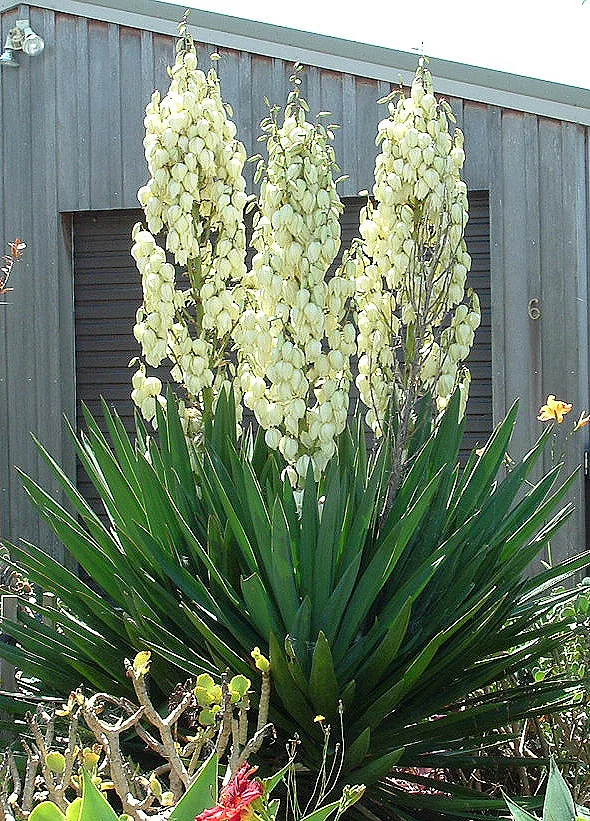
Yucca contributes a bold, architectural profile indoors, its rigid sword-shaped leaves radiating from a thick woody cane. The genus sits in the asparagus family, Asparagaceae, and originates in the hot, arid regions of the Americas, a provenance that dictates nearly every element of its culture. In practical terms it demands strong light and minimal intervention.
The yucca offered as a houseplant is almost invariably the spineless species, Yucca gigantea, selected for its soft leaf tips and clean trunk. Congeners bear genuinely sharp, bayonet-like apices, so the name on the label carries real consequence where children or pets pass close. Under interior conditions growth is steady and moderate, and a specimen can exceed head height given sufficient time and volume.
The trait that makes yucca undemanding also explains most failures. It stores water and tolerates neglect, yet it will not endure a saturated pot, and overwatering accounts for the majority of losses. Provide adequate light and drainage, and the plant requires almost nothing further.
Care
The short version: site it in the brightest available position, pot it in a sharply drained gritty medium, and irrigate only after the substrate has dried completely. The operative risk is excess water rather than deficit, so err toward the dry side.
Light
Yucca performs best in the brightest position available, ideally a south-facing window supplying several hours of direct sun, which its xeric physiology requires for compact growth. It will tolerate bright indirect light, but low light induces etiolation, leaving the plant drawn and leaning toward the source.
Water
Water management governs survival, so irrigate only once the medium has dried completely throughout, on the order of every 14 to 21 days. Water deeply, allow the surplus to drain, then wait. Under low light or cool temperatures the plant transpires little and rots rapidly if kept moist.
Soil
Grow it in a gritty, sharply drained cactus or succulent mix that retains no free water at the roots. A pH between 6.0 and 7.5 is suitable, though functional drainage, and therefore a pot with drainage holes, outweighs the precise formulation.
Temperature
Ordinary interior temperatures suit it, within a band of 50°F to 86°F (10°C to 30°C). Keep it away from cold drafts and unheated winter rooms, since the combination of chill and moist substrate is the principal trigger for rot.
Humidity
The plant prefers low ambient humidity and requires no amendment. Average household air is adequate, and misting or grouping to raise moisture is unnecessary and, in still air, counterproductive.
Feeding
Fertilize modestly through spring and summer during active growth, roughly monthly, with a diluted balanced liquid feed or a cactus formulation. Suspend feeding through autumn and winter as growth ceases, and avoid excess, since accumulated fertilizer salts scorch the leaf tips.
Pruning
Excise dead or damaged leaves at the base for appearance. Where a specimen outgrows its space, the cane can be cut back to the desired height, and the plant will resprout from below the cut.
Repotting
Repot every 2 to 3 years, or sooner when roots circle the container, the plant becomes top-heavy and tips, or the substrate dries almost immediately after watering. Advance by a single pot size and renew the gritty medium.
Size & spacing
Indoors a yucca may attain 3 to 30 feet (90 cm to 9 m) in height over its lifespan, though container culture keeps most far below the maximum. Allow clearance for the leaf crown, which extends 2 to 10 feet (60 cm to 3 m) across on mature plants.
Troubleshooting
Nearly every yucca disorder resolves to water relations or air movement. A softened base signals saturation at the roots, desiccated tips signal deficit or salt injury, and lesions and pests appear where the air remains humid and stagnant. Match the presentation below and correct the underlying cause rather than the visible symptom.
Soft, mushy base and wilting leaves
A spongy cane over brown, mushy roots is root and cane rot, the predictable result of waterlogged, poorly drained media that starves roots of oxygen and lets pathogens in. Reduce watering at once, lift the plant, and excise every rotted section back to firm tissue. Repot into fresh gritty mix and let it dry fully before watering, since dry medium halts the rot.
Fix:
- Reduce watering immediately
- Unpot and cut away all rotted tissue
- Repot into fresh gritty, well-drained mix
- Allow soil to dry fully before watering again
Spots and lesions spreading on the leaves
Discrete lesions that enlarge and coalesce are fungal leaf spot, favored by humid air and foliage that stays wet long enough for spores to germinate. Remove and destroy affected leaves to cut the inoculum, improve air circulation to dry the canopy faster, and keep irrigation water off the foliage.
Fix:
- Remove and dispose of affected leaves
- Improve air circulation
- Avoid wetting foliage when watering
Sticky residue and white fluff on leaves and stems
Honeydew, cottony ovisacs, or small raised bumps are the calling cards of scale or mealybugs, sap-feeders whose excreted sugars invite sooty mold. Abrade them off with an alcohol-dampened cloth, then treat with insecticidal soap or horticultural oil to smother survivors. Isolate the plant so the crawlers do not disperse to neighbors.
Fix:
- Wipe pests off with alcohol-dampened cloth
- Treat with insecticidal soap or horticultural oil
- Isolate the plant until controlled
Brown, crispy leaf tips
Desiccated brown tips on an otherwise firm leaf indicate the plant cannot move enough water to its extremities, whether from underwatering or dry air. Accumulated salts or fluoride from feed or tap water compound this by drawing moisture from tissue. Water thoroughly once the medium is fully dry, leach the pot periodically to clear those salts, and trim the affected tips as cosmetic tidying.
Fix:
- Water thoroughly when soil is fully dry
- Flush soil periodically to leach accumulated salts
- Trim browned tips for appearance
Toxicity
Regard this plant as unsafe around animals. All tissues contain steroidal saponins toxic to cats, dogs, horses, and grazing livestock, producing vomiting, hypersalivation, weakness, and ataxia at higher doses. Humans are essentially unaffected, and the cooked flowers feature in several cuisines, but the raw foliage is not food, and the sharp leaf tips of many species pose an independent mechanical hazard.
Toxic to
Cats · Dogs · Horses · Rabbits · Livestock · Birds · People
Cats Moderate
In cats, the saponins irritate the gastrointestinal lining, so a cat that chews the foliage typically drools, vomits, and becomes anorexic. Expect a lethargic animal until the irritation subsides.
Dogs Moderate
Dogs respond to ingestion with hypersalivation and vomiting, and appetite often falls away for a day. A large dose delivers enough saponin to produce weakness and an unsteady stance.
Horses Moderate
Horses show gastrointestinal upset and dullness after eating yucca. Consumption of a large quantity while grazing can progress to overt weakness and ataxia, an uncoordinated gait.
Rabbits Toxic
The saponin content renders the foliage unsuitable for rabbits, whose sensitive digestive tract reacts poorly. Site the plant entirely beyond a house rabbit's reach.
Livestock Toxic
Grazing cattle, sheep, and goats develop digestive upset from yucca, and a heavy intake induces weakness and stumbling. Exclude stock from access with fencing.
Birds Caution
Given the saponins and the sparse documentation of effects in birds, the plant is a poor risk around pet species. Treat it as off-limits and keep inquisitive beaks away.
People Caution
For people the plant is essentially benign, and cooked flowers and certain parts appear in some cuisines. The raw foliage, however, is not food, so avoid ingestion and wash the hands after cutting stems.
Many yuccas have stiff, sharp-pointed leaf tips that can cause eye or skin injury; the common indoor 'spineless yucca' (Y. gigantea/elephantipes) has softer tips that pose less risk.
Helpline numbers

United States
ASPCA Animal Poison Control: (888) 426-4435 (fee applies)
Poison Control: (800) 222-1222



Canada
Poison Centres: 1-844-764-7669
Varieties
A small set of yuccas recurs in cultivation, spanning the soft-leaved interior favorite to spine-tipped species best sited at a distance. These are the taxa worth distinguishing.
Yucca gigantea (Y. elephantipes), spineless yucca
The dominant interior subject, distinguished by a stout tree-like trunk and soft, non-pungent leaf tips that will not puncture skin.
Yucca aloifolia, Spanish bayonet
Bears rigid leaves terminating in genuinely sharp, hazardous spines, warranting placement well clear of foot traffic.
Yucca filamentosa, Adam's needle
A stemless rosette margined with curly white filaments, and cold-hardy enough to withstand pronounced frost.
How to propagate
Yucca is among the more tractable genera to propagate. Root a section of cane, detach the basal pups it produces around the crown, divide an established clump, or sow seed where the extended timeline is acceptable.
Stem cuttingsEasy
Spring or summer during active growth · 3 to 8 weeks to root
Cane cuttings root readily when taken during the spring and summer growth flush, when rooting hormones are most active. Allow the cut surface to dry and callus first to bar rot pathogens, then pot it, and expect rooting within 3 to 8 weeks.
Offsets & pupsEasy
Spring or summer · 4 to 8 weeks
During spring or summer a yucca produces basal offsets, or pups, from the crown. Sever one with a portion of root attached and pot it independently, whereupon it establishes over roughly 4 to 8 weeks.
DivisionModerate
Spring · Several weeks to a few months
Clump-forming yuccas can be divided at the root crown in spring, at the start of the growth cycle. The operation is more invasive than detaching a pup, and the resulting divisions require several weeks to a few months to reestablish.
SeedModerate
Spring · Several weeks to germinate, then months to size up
Seed propagation is slow and seldom used for named interior selections, which will not come true. Sown in spring, seed needs several weeks to germinate and then many months to reach a usable size.
Myths
All yuccas are safe houseplants because they look like harmless palms.
The superficial palm habit masks two genuine hazards. Yucca tissue contains saponins toxic to pets, and many species bear rigid, spine-tipped leaves capable of puncturing skin or the eye. Position it with both liabilities accounted for.
Yucca houseplants need frequent watering like tropical foliage plants.
As a xerophyte, yucca is adapted to drought and intolerant of saturated media. Overwatering and the resulting root rot claim far more specimens than desiccation does, so withhold water until the mix is fully dry before irrigating again.