Ornamental · Geraniaceae
Wild Geranium
Geranium maculatum
Give it dappled shade and moist woodland soil and this hardy native forms a spreading spring carpet of pink.
Partial shade
Every 5–10 days
USDA 3–8
8–24 in · 20–61 cm
Overview
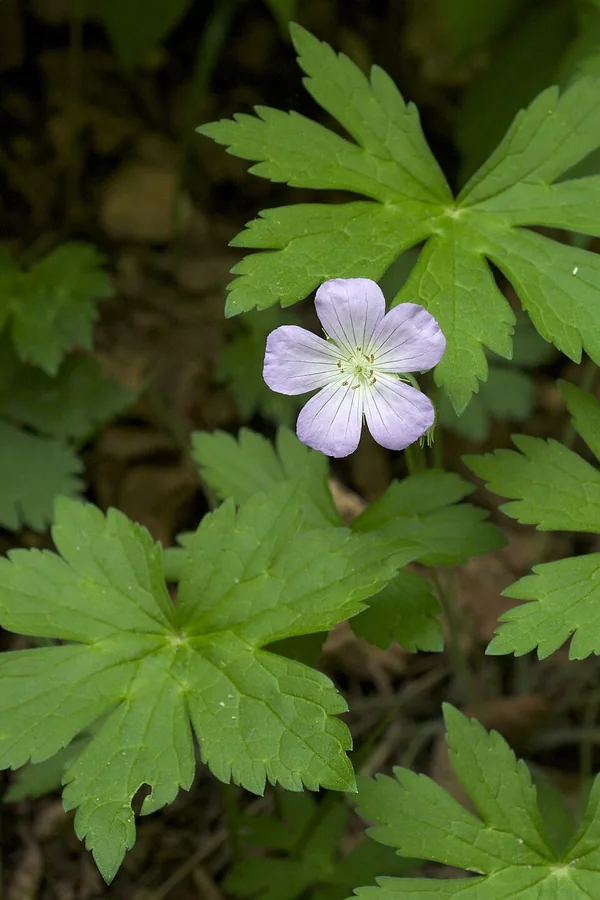
Geranium maculatum is a clump-forming herbaceous perennial of eastern North American woodlands and a true member of the genus Geranium, long called cranesbill for the elongated, beak-shaped fruit that develops after flowering. From mid to late spring it produces loose cymes of pink to lavender flowers held above deeply palmately lobed leaves. Its placement in Geranium, not the unrelated Pelargonium sold as a houseplant, is the taxonomic point most often confused.
In cultivation it behaves as an easy, low-maintenance perennial once established, reflecting the fertile, humus-rich substrate of its native forest floor. It prefers part shade and spreads at a measured pace by rhizome, knitting into a tidy ground-covering colony. The flowers are an effective nectar and pollen source for bees and flies, which recommends it for native and pollinator plantings.
The species is broadly cold-hardy, overwintering reliably across USDA zones 3 to 8, and it is largely free of significant pests and diseases. Its principal limitation is intolerance of hot, dry soil in midsummer, which induces foliar yellowing and decline. Maintained cool and evenly moist, it holds good condition from spring through fall.
Care
The short version: provide part shade over rich, moist, humus-rich soil, sustain even moisture through summer heat, feed sparingly where the soil is already fertile, and divide congested clumps at a few-year interval.
Light
Wild geranium performs best in partial shade, the filtered light characteristic of a woodland margin. It tolerates full sun where soil moisture is dependable and full shade at the other extreme, but intense sun over dry soil scorches the foliage because transpirational demand outruns supply.
Water
Maintain evenly moist soil, on the order of every 5 to 10 days, and avoid letting the root zone dry out. Established plants withstand occasional drought, yet foliage yellows quickly in hot, dry conditions when the roots cannot keep pace with water loss.
Soil
It favors rich, humus-rich, well-drained soil high in leaf mold, replicating its native forest floor, though it adapts to clay or sand. Target a slightly acidic to neutral reaction of pH 5.5 to 7.0.
Temperature
The species is markedly cold-hardy, functional across -40°F to 95°F (-40°C to 35°C) and winter-hardy through USDA zones 3 to 8. The limiting factor in summer is not heat per se but the soil desiccation that usually accompanies it.
Humidity
Ambient outdoor humidity is adequate, so there is no target level to manage. Far more consequential is canopy air movement, since stagnant, humid air within the clump favors rust and leaf spot.
Feeding
Fertile woodland soil largely meets this plant's nutrient demand, so feed conservatively. A spring topdressing of compost or a balanced fertilizer is the most it requires, and it is dispensable where the soil is already rich.
Pruning
Structural pruning is unnecessary. Deadhead spent inflorescences or shear tired foliage back after bloom to stimulate a fresh flush of leaves; beyond that, no intervention is needed.
Repotting
In the ground it needs lifting only when a clump becomes congested, roughly every 3 to 4 years. A crowded, declining center, reduced flowering, or summer foliar yellowing indicate the appropriate time to divide.
Size & spacing
Mature plants attain about 8 to 24 inches (20 to 61 cm) in height with a comparable 12 to 24 inch (30 to 61 cm) spread. Allocate that spacing so each clump develops fully without crowding adjacent plants.
When to plant
This species follows a temperate woodland cycle keyed to cold. The seed carries a chilling requirement, so sow in late winter after 2 to 3 months of cold stratification, transplant young stock outdoors in spring after the last frost or in fall, and anticipate flowering from April through June.
Northern hemisphere
Southern hemisphere
Typical months for a temperate climate: start earlier in warm zones, later where spring frosts linger.
- Sow: Late winter after 2 to 3 months cold stratification
- Plant: Spring after last frost, or fall
- Harvest: April to June (mid to late spring)
Hardiness
USDA hardiness zones: 3–8
Temperature: down to -40°C
Troubleshooting
Wild geranium seldom develops serious problems, and the disorders that do appear are essentially cosmetic. Three factors account for most of them: moisture-favored foliar fungi, mollusk feeding, and summer heat stress. Match the symptom below and intervene early, while the response is still meaningful.
Orange-brown pustules or dark spots on the leaves
These lesions point to rust or a leaf spot fungus, pathogens that establish once a film of surface moisture lingers on the foliage and still air prevents it drying. Remove and destroy the marked leaves to cut the spore load, then irrigate at the base so the canopy stays dry. Clearing fallen debris at season end removes the overwintering inoculum that would otherwise reinfect the clump.
Fix:
- Remove and destroy affected leaves
- Improve air circulation and avoid overhead watering
- Clean up fallen debris at season end
Ragged holes in the leaves with silvery slime trails
Slugs and snails are the feeders here; they are most active after dark and after rain because their soft bodies need humidity to move, and the dried mucus leaves the characteristic sheen. Handpicking at dusk removes the population directly, while iron-phosphate bait offers a slower chemical control. Because these mollusks shelter in cool damp cover by day, clearing boards, mulch piles, and debris denies them the harborage they depend on.
Fix:
- Handpick snails and slugs in the evening
- Set out traps or iron-phosphate bait
- Remove damp hiding spots such as debris and boards
Foliage yellows and looks tired by midsummer
As a woodland species adapted to a cool, moist root zone, wild geranium responds to dry soil in summer heat by yellowing and declining, since the roots cannot supply water fast enough to match transpiration. Deep irrigation through hot dry spells restores that balance, and an organic mulch buffers soil temperature and slows evaporation. Where a clump has already exhausted itself, shearing it back hard removes the spent tissue and prompts a fresh flush of foliage.
Fix:
- Water deeply during hot dry periods
- Apply organic mulch to conserve moisture
- Shear back declining foliage to flush fresh growth
Toxicity
For pet owners the assessment is favorable: true wild geranium, Geranium maculatum, is not toxic and is regarded as safe around cats, dogs, livestock, and people. The confusion is nomenclatural. The scented houseplant geranium, Pelargonium, is a separate genus and the one that is genuinely poisonous to pets.
Safe for
People · Cats · Dogs · Horses · Rabbits · Livestock · Birds
Cats None
Geranium maculatum carries no documented toxic principles, so a cat that brushes past or samples the foliage is at no risk. The genus that warrants caution is Pelargonium, the scented geranium, which is the taxon ASPCA actually lists.
Dogs None
No case of canine poisoning is on record for true wild geranium, so an exploratory chew carries no toxicological concern. The relevant distinction is Pelargonium, the unrelated genus marketed as a houseplant, which is the toxic one.
Horses None
Grazing around a woodland stand of wild geranium presents no hazard to horses, as the species has no toxic compounds attributed to it.
Rabbits None
Both wild and domestic rabbits can browse the foliage without any toxic effect on record.
Livestock None
Cattle, goats, and sheep encounter no documented risk from this native geranium, whether in pasture or garden.
Birds None
The plant is non-toxic to birds, and its spring flowers are an ecological asset, supplying nectar and pollen to bees and flies.
People None
No poisoning risk to people is associated with the species; routine hand-washing after handling any garden plant is sufficient precaution.
No special handling required; wash hands after gardening as a general precaution.
Varieties
Most plantings use the straight species, but several selected forms are grown for darker foliage or altered flower color. The following are the ones worth knowing.
Espresso
Distinguished by anthocyanin-rich chocolate-brown to reddish-brown foliage that contrasts against its pale pink to lavender flowers.
Elizabeth Ann
Recognized by bronze-tinted leaves paired with cool blue-lavender blooms.
Album
The white-flowered form of the species, designated botanically as f. albiflorum.
Companions
Plant near
Ferns: Share the same part-shade, moist woodland conditions and contrast in foliage texture.
Woodland phlox (Phlox divaricata): Blooms at the same spring time in similar shade gardens for a layered native display.
Wild columbine (Aquilegia canadensis): Native spring woodland companion that suits the same shade and soil and supports pollinators.
How to propagate
The species spreads naturally by rhizome, and the gardener can propagate it deliberately either by dividing established clumps or by sowing the seed it disperses.
DivisionEasy
Fall or early spring · One growing season
Division is the most reliable method of increase. Lift a clump in fall or early spring and separate the rhizomes, which characteristically branch at right angles and part cleanly along those joints. Replanted divisions re-root and establish within a single growing season.
SeedModerate
Sow fresh in fall outdoors, or stratify cold 2 to 3 months and sow in spring · One to two growing seasons
Seed propagation is slower and demands closer timing. The dehiscent capsules eject their seed explosively at maturity, so enclose the ripening heads in a bag and collect once they darken. Sow fresh outdoors in fall to meet the winter chilling requirement, or apply 2 to 3 months of cold stratification and sow in spring; expect one to two seasons to establishment.
Myths
Every plant called a geranium is toxic to cats and dogs.
The toxic taxon is the scented houseplant geranium, Pelargonium, which ASPCA lists as poisonous to cats and dogs owing to the essential-oil compounds geraniol and linalool, producing vomiting, anorexia, depression, and dermatitis. Geranium maculatum belongs to a separate genus within the same family and carries no toxicity listing whatsoever. The overlap in common name, not in chemistry, is the source of the error.