Ornamental · Geraniaceae
Rozanne Cranesbill
Geranium 'Rozanne'
A sterile, exceptionally long-flowering hybrid that delivers a full season of bloom with minimal input.
Full sun
Every 5–10 days
USDA 5–8
12–18 in · 30–46 cm
Overview
Hardy geranium 'Rozanne' is a clump-forming perennial in the true cranesbill group, a name that refers to the slender beak-shaped seed pods that follow the flowers in the genus Geranium. It should not be conflated with Pelargonium, the tender scented bedding plant marketed under the same common name but belonging to a separate genus. As a cold-hardy perennial, it persists and regrows across USDA zones 5 to 8.
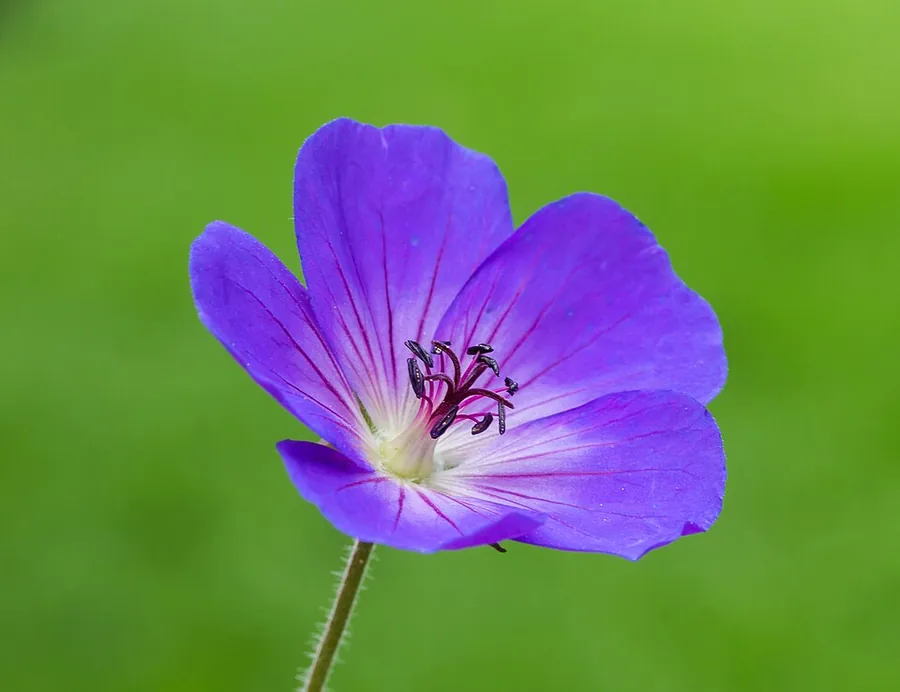
Its horticultural value rests on bloom duration. The plant carries violet-blue flowers with white centers in a near-continuous display from late spring through fall, borne on a low, spreading, groundcovering mound. That sustained flowering, combined with an undemanding constitution, earned the selection Perennial Plant of the Year in 2008.
It also tolerates summer heat better than many cranesbills and reads as both deer- and rabbit-resistant in the record. Sited in sun with adequate drainage and given a midseason cutback, 'Rozanne' returns an extended season of color for modest maintenance.
Care
The short version: site it in full sun to part shade in average, well-drained soil, irrigate through dry spells, and cut it back after the first flush to sustain flowering into fall.
Light
Flowering is heaviest in full sun, though the plant performs acceptably in partial shade and partial sun. In hot regions a period of afternoon shade is beneficial, because it reduces the heat load that causes midsummer flagging.
Water
Maintain average, medium moisture and allow the top inch or so of soil to dry between waterings, which corresponds to roughly every 5 to 10 days. Established plants express some drought tolerance, but sustained water stress limits performance, so irrigate through dry spells to maintain bloom.
Soil
The plant is adaptable across loam, clay, or sand provided drainage is good, since standing water at the root zone is the limiting factor. It performs best in moist, organic-rich soil, so incorporating compost is advantageous. No specific pH requirement is recorded.
Temperature
This cold-hardy perennial withstands winter minima to -20°F (-29°C) and summer maxima near 90°F (32°C). That thermal range is precisely what enables reliable performance across zones 5 to 8 without supplemental protection.
Humidity
Ambient outdoor humidity is sufficient, so no target value applies. Air circulation is the operative factor, because stagnant, humid air within a crowded canopy is what predisposes the plant to leaf spot and rust.
Feeding
Nutrient demand is low. Incorporating compost or organic matter at the start of the growing season, or applying a balanced general-purpose feed in spring, meets the plant's needs for the year. Continued summer feeding is unnecessary.
Pruning
This is the single most productive operation. Once the first flush declines, cut the whole plant back hard to renew the foliage and induce a late-summer or early-fall rebloom. Errant side stems may be trimmed at any time to contain spread.
Repotting
In-ground plants seldom require lifting and divide on their own timetable. In containers, repot when you observe roots circling the pot, a decline in flowering, or the substrate drying out unusually fast.
Size & spacing
The plant forms a low mound of about 12 to 18 inches (30 to 46 cm) in height with a spread of 12 to 24 inches (30 to 61 cm). Spacing toward the upper end of that range promotes air movement and keeps the foliage clean.
When to plant
As a hardy perennial, 'Rozanne' is managed for establishment rather than against a frost deadline. Plant in spring after the last frost or in early fall while soil warmth still supports root growth, and the flowering window runs from late spring through to early autumn.
Northern hemisphere
Southern hemisphere
Typical months for a temperate climate: start earlier in warm zones, later where spring frosts linger.
- Plant: Spring after the last frost, or early fall
- Harvest: Late spring (May) through summer to early fall, often nearly continuous
Hardiness
USDA hardiness zones: 5–8
Temperature: down to -29°C
Troubleshooting
'Rozanne' is regarded as trouble-free, and the few disorders it does encounter are largely foliar and driven by moisture and crowding. Recognizing the signs below allows early intervention while control remains straightforward. Good air movement and base watering prevent the majority of them.
Systemic wilt and collapse despite adequate soil moisture
Collapse in hot weather while the soil remains wet points to southern bacterial wilt caused by Ralstonia, a soilborne pathogen that plugs the vascular system and is favored by warm, waterlogged conditions. No cure exists once the plant is infected, so the correct response is to remove and destroy it and to keep susceptible perennials out of that soil. In hot regions, afternoon shade and free-draining ground lower the soil temperature and moisture that the bacterium requires.
Fix:
- Remove and destroy affected plants
- Avoid replanting susceptible species in the same soil
- Reduce afternoon heat stress by providing some afternoon shade in hot climates
Discrete brown or tan lesions across the foliage
These lesions are fungal leaf spot, a foliar infection favored by prolonged leaf wetness from rain or overhead irrigation. Because the fungus needs a wet leaf surface to germinate and spread, removing the marked leaves, opening the clump for airflow, and watering at the crown all deny it those conditions. The infection stays cosmetic, and the plant recovers once the canopy dries.
Fix:
- Remove and discard affected leaves
- Improve air circulation by thinning or spacing plants
- Water at the base rather than overhead
Raised orange spore pustules on the lower leaf surface
The raised orange-to-brown pustules on the undersides are the fruiting bodies of rust fungus, which reproduces by wind- and splash-borne spores and colonizes crowded, humid foliage. Stripping the infected leaves removes the spore source, while wider spacing and drier leaves interrupt the moisture cycle the fungus depends on. Damage remains superficial, so flowering continues uninterrupted.
Fix:
- Remove and destroy infected foliage
- Increase spacing and air circulation
- Avoid overhead irrigation
Toxicity
For pet owners the assessment is favorable: true hardy geranium is non-toxic. The cranesbills carry no principle hazardous to cats, dogs, horses, or other animals, and no poison rating applies to humans. The only relevant caution concerns the unrelated scented Pelargonium, which is occasionally sold under the same common name.
Safe for
People · Cats · Dogs · Horses · Rabbits · Livestock · Birds
Cats None
True hardy geranium is non-toxic to cats, since the genus carries no poison rating. A cat that samples a leaf faces no poisoning, though ingesting a large volume of any plant material can produce transient gastric upset.
Dogs None
Dogs encounter no toxic principle in cranesbill. Because the plant lacks the compounds that characterize toxic species, a chewed stem or flower yields at most the mild, self-limiting digestive upset common to bulk plant intake.
Horses None
Horses can graze the area safely, as the plant contains no compounds hazardous to equines. Grazing animals also tend to avoid the aromatic foliage, which limits intake in the first place.
Rabbits None
Rabbits face no toxicity risk, and true geranium is documented as rabbit-resistant, meaning they generally decline to feed on it. That combination makes it well suited to gardens with rabbit pressure.
Livestock None
Cattle, goats, and sheep are not endangered by true geranium, which holds no principle toxic to farm animals. A grazed clump therefore represents a horticultural loss rather than a veterinary concern.
Birds None
Both aviary and wild birds are safe in contact with it, as neither foliage nor flowers contain a toxin. Incidental pecking carries no physiological risk.
People None
True cranesbill carries no poison rating for humans, children included. Routine handwashing after handling any plant is sound practice, but no plant-specific hazard applies here.
Wash hands after handling as a general gardening practice; no specific toxicity hazard is reported for true Geranium.
Varieties
'Rozanne' is the reference selection, but two related plants are worth noting where a lighter tone or a different flower color is wanted.
Geranium 'Rozanne' (syn. 'Gerwat')
This is the patented sterile hybrid itself, a clump-forming selection that produces violet-blue, white-centered flowers from late spring to fall and tolerates summer heat, a performance that secured it Perennial Plant of the Year in 2008.
Geranium 'Azure Rush'
A sport of 'Rozanne' that retains the extended bloom season while presenting paler, lighter blue flowers on a more compact, tidier mound.
Geranium sanguineum (Bloody Cranesbill)
A true cranesbill species rather than a hybrid, valued for its bright magenta-pink flowers and frequently planted alongside 'Rozanne' for direct comparison.
Companions
'Rozanne' shines as a long-blooming groundcover at the feet of taller plants, weaving between shrubs and upright perennials that enjoy the same sun and average moisture.
Plant near
Roses: Mounding hardy geranium foliage covers bare lower rose stems and provides a long-blooming groundcover at the base.
Ornamental grasses: Contrasting upright form pairs well with the sprawling mound and extends seasonal interest in borders.
Daylilies and other clumping perennials: Similar culture (full sun to part shade, average moisture) and complementary bloom times in mixed borders.
How to propagate
Because 'Rozanne' is a sterile hybrid, it cannot be raised from seed. Every plant is produced vegetatively, by dividing an established clump or rooting a cutting, both of which reproduce the parent exactly.
DivisionEasy
Spring or early fall · One growing season
Division is the most reliable method for increasing this sterile hybrid, because it clones the parent exactly. Lift an established clump in spring or early fall, separate it into divisions that each retain healthy roots, and replant them without delay. Each division establishes and fills out over a single growing season.
Stem cuttingsModerate
Spring to early summer · Several weeks to a few months to root and establish
Basal or softwood cuttings taken from spring through early summer offer a second vegetative route, though rooting is slower and less certain than division. Allow the cuttings several weeks to a few months to root and establish. Seed is not an option, because the hybrid is sterile.
Myths
Hardy geranium 'Rozanne' is toxic to cats and dogs.
The claim rests on a taxonomic confusion. The entry the ASPCA lists as toxic 'Geranium' is in fact Pelargonium, a distinct genus of tender scented bedding plants. True hardy Geranium, the cranesbill, including 'Rozanne', is not listed as toxic to pets, so it can be grown safely in their company.
You can propagate 'Rozanne' from its own seed.
'Rozanne' is a sterile hybrid that produces little or no viable seed, and any seed it sets will not breed true to the parent. Vegetative propagation is therefore the only dependable method, achieved by dividing an established clump or rooting basal cuttings.