Houseplant · Piperaceae
Watermelon Peperomia
Peperomia argyraea
Supply bright, filtered light and disciplined watering, and this compact striped species largely maintains itself.
Bright indirect
50–86°F · 10–30°C
USDA 10–12
6–9 in · 15–23 cm
Overview
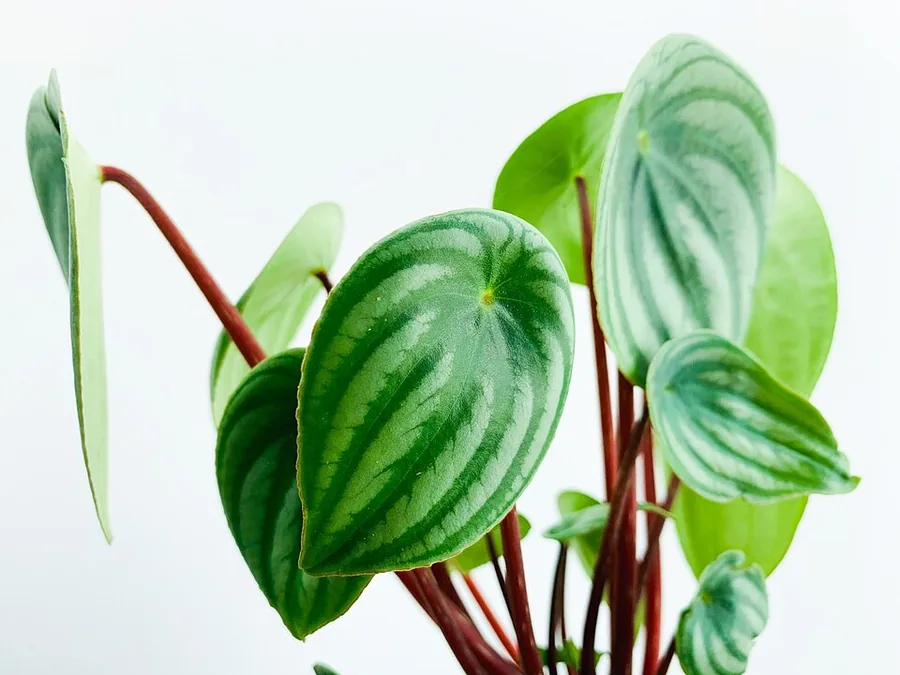
Watermelon peperomia takes its name from the foliage, whose round, glossy blades carry silver bands radiating from the center between the veins, echoing a melon rind. The species originates in the Brazilian rainforest, where it occupies the shaded forest floor beneath the canopy. Red petioles support the leaves in a compact mound, and the plant remains small enough for a desk or shelf.
It rewards growers who prefer restraint. Growth is slow, mature height settles at roughly 6 to 9 inches (15 to 23 cm), and the plant tolerates being pot bound in one container for several years. Cultivated for foliage rather than bloom, it produces thin flower spikes that are commonly removed without loss to the display.
Its single real demand is measured watering. Excess moisture drives root rot, while complete drying leaves the foliage limp, so the working principle is to let the upper soil dry before rewatering. Managed on that basis, it ranks among the least demanding houseplants.
Care
The short version: provide bright indirect light out of direct sun, a freely draining container, and water only once the upper soil has dried. Hold it warm, feed lightly through the growing season, and reduce inputs for the remainder of the year.
Light
Position it in bright but indirect light, such as near an east or west window where direct rays never reach the leaves. It persists in medium or low light, but the silver markings fade and the growth elongates as it reaches for a stronger source. Direct sun overloads and scorches the tissue outright.
Water
Water moderately during active growth and let the top half of the soil dry before rewatering, since the roots need air between drinks. Saturated soil induces rot, while complete drying causes wilting, so the target lies between the two. Reduce watering from fall through late winter as growth slows.
Soil
Use a well drained, peaty or loam based mix of the kind sold for houseplants or cactus. Because the roots will not tolerate standing moisture, drainage governs the choice more than fertility. A pot with a functioning drainage hole is essential.
Temperature
Hold it within 50°F to 86°F (10°C to 30°C), ideally toward the warmer part of that band. Exposure below 50°F (10°C) risks chilling injury, and cold drafts from a window or door trigger leaf drop.
Humidity
Average room humidity is adequate, so there is no need to target a specific figure. The plant benefits from slightly moister air and accepts a light misting, yet it acclimates well to ordinary indoor conditions.
Feeding
Apply a half strength liquid houseplant fertilizer every two weeks through the growing season, spring into summer. Suspend feeding across fall and winter while the plant is dormant. A dilute, regular supply serves it better than infrequent concentrated doses.
Pruning
Pruning requirements are minimal. Remove damaged, faded, or dead leaves as they appear, and cut the slender flower spikes since the plant is grown for foliage rather than bloom. Beyond that, little intervention is needed.
Repotting
Repot infrequently, as the species tolerates being pot bound for several years. Move it up only when roots crowd the container, the soil dries abnormally fast, or new growth stalls. Fresh well drained mix and a marginally larger pot suffice.
Size & spacing
The plant stays compact, reaching 6 to 9 inches (15 to 23 cm) in height with a spread of 3 to 6 inches (8 to 15 cm). That modest footprint accommodates a desk, windowsill, or shelf without crowding.
Troubleshooting
Nearly every disorder in this plant resolves to a watering fault, with light and a handful of pests accounting for the rest. The foliage signals the problem before it becomes severe. Read the symptom below against what you observe and intervene early.
Soft stem bases and collapse in waterlogged soil
The soft, mushy stem bases and general collapse are signs of root and stem rot, a condition that develops when soil is held too wet or the pot stands in water and the roots are starved of oxygen. Because this species is noted as susceptible to rot in overly moist soil, recovery depends on halting irrigation, lifting the plant, excising all rotted roots, and repotting into fresh, well drained medium. Withhold water until the surface has dried.
Fix:
- Stop watering and let the soil dry
- Remove the plant and trim away soft, brown, rotted roots
- Repot into fresh well-drained potting mix
- Resume watering only after the soil surface has dried
Drooping foliage and slackened petioles
Because this plant is intolerant of drying out completely, foliage that droops over bone dry soil reflects simple moisture stress and rehydrates once watered. The same wilt over wet soil with softened stems points instead to compromised roots that can no longer take up water, which is rot. Assess soil moisture before choosing between a thorough watering and the root-rot protocol.
Fix:
- If dry, water thoroughly and let excess drain
- If wet/rotting, follow the root-rot remedy instead
- Keep soil lightly moist but never soggy during active growth
Chlorosis and leaf drop from wet or cold roots
Yellowing and abscission over saturated soil indicate overwatering and waterlogged roots, the same oxygen-starved condition that precedes rot. A sudden drop following exposure to cold reflects chilling injury below the safe minimum or a persistent draft. Correct the watering and drainage, and hold the plant above 10°C (50°F) and away from cold air currents.
Fix:
- Correct watering and ensure good drainage
- Move away from cold drafts and keep above 10°C (50°F)
- Remove fallen and yellowed leaves
Stippling and fine webbing from spider mites
Pale stippling on the upper surface with fine webbing beneath is diagnostic of spider mites, which build up under warm, dry conditions that favor rapid reproduction. Physical removal by rinsing and wiping reduces the population before treatment with insecticidal soap or horticultural oil, applied to an isolated plant and repeated as the life cycle demands. Raising ambient humidity works against the dry microclimate the mites prefer.
Fix:
- Rinse foliage and wipe leaves
- Treat with insecticidal soap or horticultural oil
- Isolate the plant and repeat treatment as needed
- Raise humidity to discourage mites
White cottony masses at the petiole bases
White, cottony masses lodged at the petiole bases and leaf joints are the waxy colonies of mealybugs, and scale and whitefly frequently occur alongside them. Because the wax repels sprays, spot-treating with an alcohol-dipped swab first, then following with insecticidal soap or horticultural oil, gives better control. Isolate the plant and repeat until no new colonies appear.
Fix:
- Dab mealybugs with a cotton swab dipped in alcohol
- Treat with insecticidal soap or horticultural oil
- Isolate the plant and repeat until clear
Loss of silver banding and bleached leaf tissue
The silver banding depends on suitable light, so it degrades at both extremes. Excess direct sun overloads the tissue and bleaches it into crisp patches, while insufficient light produces elongated, dull growth as the plant reaches for a stronger source. The remedy is bright but filtered light, such as an east or west aspect, keeping the plant out of both direct sun and deep shade.
Fix:
- Move to a spot with bright but indirect/filtered light
- Shield from direct summer sun (an east- or west-facing window)
- Avoid deep shade and very low light
Toxicity
For households with animals, the record is reassuring: watermelon peperomia is non-toxic throughout. The ASPCA lists it safe for cats and dogs, and NC State Extension extends that to horses. A curious nibble may cause brief gastric upset, as any plant material can, but the foliage contains nothing toxic.
Safe for
People · Cats · Dogs · Horses · Rabbits · Livestock · Birds
Cats None
The ASPCA classes watermelon peperomia as non-toxic to cats, so no toxin is present to cause poisoning. Ingestion of a large volume of any foliage may still produce transient gastric upset through mechanical irritation, nothing more.
Dogs None
The same non-toxic listing applies to dogs, meaning no poisoning risk from the plant itself. A chewed leaf might prompt a brief, self-limiting stomach upset that resolves without treatment.
Horses Safe
NC State Extension records the species as non-toxic to horses, so it presents no poisoning hazard to them.
Rabbits Safe
With no toxic principle in the tissue, a rabbit can ingest a leaf without harm, though the plant is not part of its normal forage.
Livestock Safe
The absence of any toxin means grazing animals face no poisoning risk, and as an indoor subject the plant remains outside their range in any case.
Birds Safe
None of the foliage holds a toxic compound, so pet birds can perch and forage near it without exposure to harm.
People Safe
Cultivated for its striped foliage rather than as an edible, the plant nonetheless carries no toxin, so an accidental taste by a child warrants no concern.
Although non-toxic, ingestion of any plant material can cause mild, transient stomach upset in pets
Varieties
Most growers keep the straight species, though a couple of named selections appear in collections and merit a note on how to distinguish them.
'Costa Rica'
This cultivar is identified by the maroon dimple positioned at the base of each leaf.
'Harmony's Gold Dust'
This selection is recognized by the speckled gold variegation distributed across its foliage.
How to propagate
Few houseplants propagate as reliably as this one. A single leaf, a stem tip, or a divided clump each establishes with minimal intervention, so one specimen readily yields several.
Leaf cuttingsEasy
Spring to summer · Several weeks to root
A whole leaf retained with its petiole and inserted into moist medium will regenerate roots unaided over the course of a few weeks. Undertake this from spring through summer, when active growth supports the fastest establishment.
Stem cuttingsEasy
Spring to summer · Several weeks to root
A tip or stem cutting will root readily in either water or moist potting medium, whichever suits the setup. Taken in spring or summer, it needs a few weeks to develop a working root system.
DivisionEasy
Spring at repotting · Several weeks
A mature clump can be separated into sections at the spring repotting, which coincides with resuming growth. Each division re-establishes over a few weeks and continues as an independent plant.
Myths
Watermelon peperomia is a kind of begonia.
The vernacular name watermelon begonia misleads, since the plant has no botanical link to the begonias. It is Peperomia argyraea, placed in the pepper family, Piperaceae, a lineage entirely separate from the Begoniaceae.