Houseplant · Piperaceae
Baby Rubber Plant
Peperomia obtusifolia
Because its semi-succulent leaves bank their own moisture, this peperomia thrives on bright indirect light with infrequent, thorough watering.
Bright indirect
USDA 10–12
6–24 in · 15–61 cm
Overview
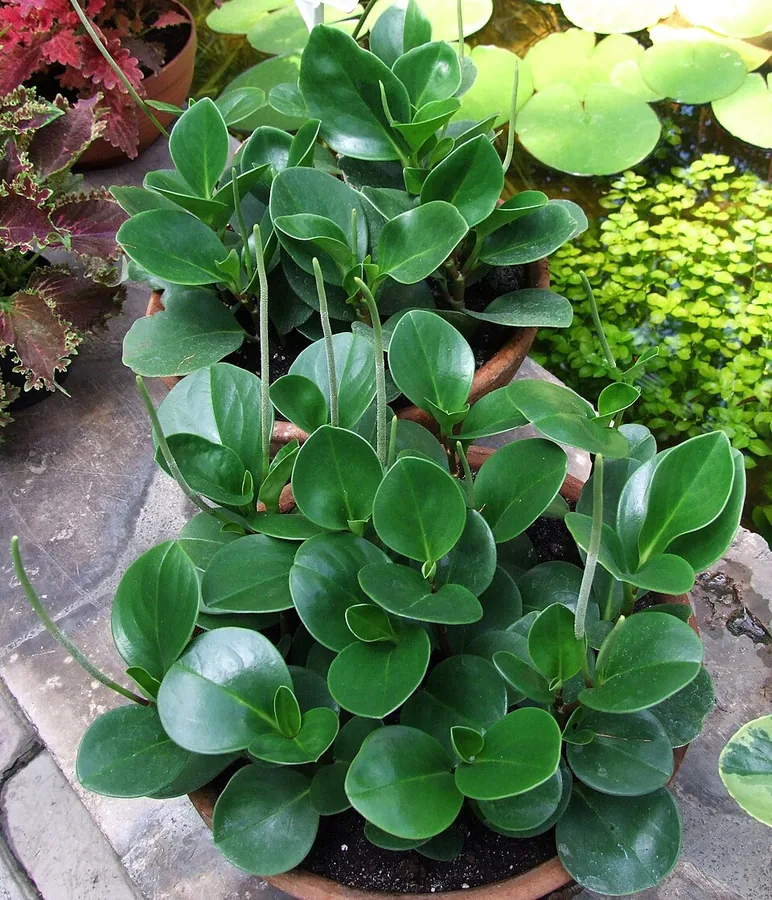
The baby rubber plant ranks among the most tolerant houseplants a grower can keep. A member of the pepper family, it occurs wild from Florida through tropical America, where it grows low across the forest floor. Under interior conditions it remains compact, holding at 6 to 24 inches (15 to 61 cm), with thick, glossy foliage of near-artificial regularity.
The fleshy leaves govern how the plant is managed, because they function as internal water storage in the manner of a succulent. That reserve buffers a missed watering, but the same tissue cannot cope with roots left standing in wet soil. Establish the correct watering interval and the remaining requirements are modest, since the species demands little light, little feeding, and little intervention.
Variegated selections introduce cream, white, and gold pigmentation, which persists only under brighter light where the pale tissue can hold its color. The plain green forms are the most robust of the group and accept a dim position that would leach the coloration from a more ornamental cultivar.
Care
The short version: provide bright indirect light and allow the potting mix to approach complete dryness before rewatering. Grow it in a fast-draining medium, feed sparingly through spring and summer, and maintain it above 50°F (10°C).
Light
Provide bright, indirect light to support vigorous growth and full leaf coloration. The species tolerates low light, particularly the plain green forms, but a variegated plant fades and etiolates in a dim position because the pale tissue needs more light. Keep it clear of direct sun, which scorches the foliage.
Water
Watering is the decisive variable for this plant. Allow the medium to dry almost completely before rewatering, since the fleshy leaves supply their own reserve and the roots rot rapidly in saturated soil. Reduce the frequency further from fall through late winter, when growth slows and water demand falls.
Soil
Use a well-drained houseplant or cactus mix, or a peaty blend with free drainage. The species is indifferent to pH across the range 6.0 to 8.0, but the medium must never remain waterlogged. A container with drainage holes is as consequential as the medium itself.
Temperature
Manage it as the tropical plant it is and hold it above 50°F (10°C). Standard room temperatures suit it year-round, though cold drafts and chilled winter windowsills will check its growth.
Humidity
Ambient indoor humidity is sufficient, so no target figure applies. It withstands dry rooms better than most tropicals, yet slightly higher atmospheric moisture helps suppress spider mites.
Feeding
Fertilize only through the spring and summer growth, when the plant can assimilate the nutrients. A diluted liquid houseplant fertilizer applied monthly is adequate, or a slow-release granular formulation once a year. Withhold feeding through fall and winter.
Pruning
Remove aged or damaged leaves as they appear. To develop a fuller, bushier habit, cut a stem immediately above a leaf node, which stimulates lateral branching from that point.
Repotting
The plant is content to remain in the same container for several years. Repot only once the roots crowd or circle the pot, the medium dries unusually fast, or new growth stalls.
Size & spacing
Anticipate a compact plant of 6 to 24 inches (15 to 61 cm) in height and comparable spread. The small, mounding form is suited to a desk, shelf, or windowsill without encroaching on adjacent plants.
Troubleshooting
Almost every disorder in this plant originates with water, and the majority with a surplus of it. Read the leaves and stems as diagnostic indicators, and root rot can be intercepted before it advances. Match the presentation below, then correct the underlying cause before it progresses.
Soft, discolored stem bases on a wilting, collapsing plant
This collapse is root and stem rot, driven by soil that held excess moisture against the roots. Because the water-storing leaves load the plant top-heavy, the crown gives way quickly once the root system fails. Lift the plant, excise every soft brown root and stem, and repot into fresh fast-draining medium so the remaining tissue can breathe. Should the crown already be lost, propagate from healthy cuttings, since the same rot cannot be reversed once the base has softened.
Fix:
- Remove the plant from wet soil and cut away all soft, brown, rotted roots and stem tissue
- Repot into fresh, well-drained potting or cactus mix in a pot with drainage holes
- Withhold water until the mix is nearly dry, then water sparingly
- If the crown is lost, root healthy stem or leaf cuttings to save the plant
Leaves yellowing and dropping off
Yellowing that ends in leaf drop is the earliest visible signal of excess moisture at the roots. Since the fleshy leaves already hold an internal water reserve, the medium should approach dryness before the next irrigation, or the roots stay saturated and shed foliage. Suspend watering, drain the saucer, and let the medium dry down. The species withstands a short drought far more readily than saturated soil, so err toward dry.
Fix:
- Stop watering and allow the soil to dry out almost completely
- Improve drainage and empty any standing water from the saucer
- Resume a let-dry-completely watering routine
Silken webbing, cottony masses, or honeydew residue across the foliage
Three sap-feeding pests account for most infestations. Spider mites produce fine webbing and a stippled surface as they drain cell contents, mealybugs congregate as cottony masses in the leaf axils, and whiteflies lift off when the plant is disturbed. Isolate the specimen to halt spread, spot-treat mealybugs with an alcohol-dipped swab, then rinse and treat the foliage with insecticidal soap or horticultural oil, repeating until the population clears.
Fix:
- Isolate the plant to prevent spread
- Wipe off mealybugs with a cotton swab dipped in alcohol
- Rinse foliage and treat with insecticidal soap or horticultural oil, repeating as directed
- Raising humidity discourages spider mites
Scabby, corky protrusions clustered beneath the leaves
These raised, scab-like spots are oedema, a physiological water-balance disorder rather than a transmissible pathogen. They develop when the roots absorb water faster than the leaves can transpire it, a state favored by wet soil combined with low light or high humidity. Reduce irrigation, raise light levels, and improve air movement so subsequent growth emerges unblemished. Existing lesions are permanent, so remove badly marked leaves for appearance only.
Fix:
- Reduce watering and let the mix dry between waterings
- Increase light levels and air circulation
- Lower ambient humidity around the plant
- Remove badly affected leaves for appearance (damage is permanent on existing leaves)
Etiolated, elongated stems with diminishing variegation
Under insufficient light the stems elongate as the plant extends toward the source, a classic etiolation response. Variegated cultivars lose contrast and shift back toward green, since the white and cream tissue needs stronger light to hold its coloration. Relocate the plant to brighter indirect light out of direct midday sun, rotate it periodically to even out the reach, and pinch the drawn stems above a node to restore a compact, branching habit.
Fix:
- Move to a brighter spot with bright indirect light (out of direct midday sun)
- Rotate the plant periodically for even growth
- Pinch or prune leggy stems above a node to encourage branching
Necrotic, bleached lesions on the most light-exposed foliage
Dry, bleached patches confined to the most exposed leaves indicate leaf scorch from direct sun, which this species cannot tolerate for long. Strong afternoon exposure supplies more radiant energy than the foliage can dissipate, and the tissue burns. Return the plant to bright but indirect light, and trim the worst-affected leaves, since scorched tissue does not regenerate.
Fix:
- Move the plant out of direct sun to a bright indirect location
- Remove severely scorched leaves
Toxicity
Reassuring for households with animals: the baby rubber plant is non-toxic and pet-safe. The ASPCA and university extensions document it as harmless to cats, dogs, and horses, so an incidental nibble by a pet or a child presents no toxicological concern.
Safe for
People · Cats · Dogs · Horses · Rabbits · Livestock · Birds
Cats None
The ASPCA classifies this species as non-toxic to cats, so ingestion introduces no poisoning risk. A cat that overconsumes any foliage may regurgitate briefly from bulk alone, but the leaf tissue contains no harmful compound.
Dogs None
The record is equally clear for dogs, with the ASPCA documenting no toxic effect. A large mouthful may pass as a loose stool through mechanical irritation, yet no toxin is involved.
Horses None
NC State records the plant as non-toxic to horses, so an incidental taste poses no chemical hazard. Its stature as a small indoor plant means a horse rarely encounters it regardless.
Rabbits None
The tissue carries none of the compounds that would concern a rabbit, so it presents no toxicity. Purpose-grown greens remain the more suitable staple, but this plant poses no danger.
Livestock None
It lacks the constituents that trouble grazing animals, so it is chemically harmless to livestock. As an indoor ornamental rather than forage, it seldom enters their environment in any case.
Birds None
No compound in the plant is toxic to birds, so an incidental peck from a household parrot carries no risk. The thick foliage simply has no place in an appropriate avian diet.
People None
The absence of toxic compounds makes it safe around children, with no harm expected if a leaf is chewed. It is an ornamental rather than a food plant, so a small accidental taste warrants no concern.
No special handling required for pet households; documented non-toxic
Varieties
The named selections are distinguished chiefly by foliage, spanning solid green through pronounced cream and gold variegation. The following are the cultivars most often encountered.
'Variegata'
Grey-green leaves carry green blotching within a broad creamy-white margin, and that margin retains its coloration best under brighter indirect light.
'Alba'
New foliage emerges almost pure white to yellow with a bright red flush, then deepens toward green as it matures.
'Albomarginata'
A silvery border rims the grey-green leaves, and the 'Albomarginata Minima' selection reduces the entire plant to a dwarf.
'Minima'
A compact selection bearing small leaves only one to two inches long, suited to a confined position or a small pot.
'Gold Tip'
Marbled variegation runs through each leaf, which terminates in a gold tip.
'USA'
The foliage resolves into multi-shaded variegated patches that read as a busier, mottled pattern.
'Obtipan Green'
A short, clumping selection with solid emerald-green foliage and no variegation.
How to propagate
Few houseplants propagate as readily as this species. A single leaf, a stem tip, or a divided clump each root with minimal input, so one healthy specimen is quickly multiplied into several.
Leaf cuttingsEasy
Spring to summer · Several weeks to root
Detach a single leaf retaining about an inch of petiole during spring or summer and insert it into moist medium, where adventitious roots form over several weeks and develop into a new plant. It ranks among the simplest propagation routes for the species.
Stem cuttingsEasy
Spring to summer · Several weeks to root
Remove a tip or stem cutting during the spring and summer growth phase and root it in water or moist medium. Roots initiate over a few weeks, and because the cutting is a clone, it develops identically to the parent.
DivisionEasy
Spring at repotting · Several weeks
At spring repotting, separate a congested clump into smaller divisions, each retaining its own root mass. The divisions reestablish over several weeks and yield full-sized plants immediately.
Myths
Peperomia obtusifolia is a close botanical relative of Ficus elastica, the genuine rubber tree.
Nomenclature is the sole connection. Peperomia obtusifolia is placed in the pepper family, Piperaceae, whereas the true rubber plant, Ficus elastica, belongs to the fig family. The common name references only the thick, glossy, rubbery-looking leaves, and no botanical relationship underlies it.
The species is cold-hardy enough for permanent planting in temperate landscapes.
The species is tropical, hardy only in USDA zones 10 to 12 and readily damaged by chilling. Keep it above about 50°F (10°C), which is why it is cultivated indoors across most climates and moved outdoors only for summers where night temperatures remain warm.
Sources
- ASPCA Animal Poison Control
- NC State Extension Gardener Plant Toolbox
- Missouri Botanical Garden Plant Finder
- Clemson Cooperative Extension HGIC
- University of Missouri Integrated Pest Management
- UF/IFAS Extension (EDIS FPS466/FP466)
- UMass Amherst Center for Agriculture, Food, and the Environment (Greenhouse & Floriculture)
- Plants of the World Online, Royal Botanic Gardens Kew