Houseplant · Piperaceae
Peperomia 'Hope'
Peperomia deppeana × quadrifolia 'Hope'
A tropical epiphyte at heart, Peperomia 'Hope' thrives on bright indirect light and a mix allowed to dry between waterings.
Bright indirect
USDA 11–12
3–6 in · 8–15 cm
Overview
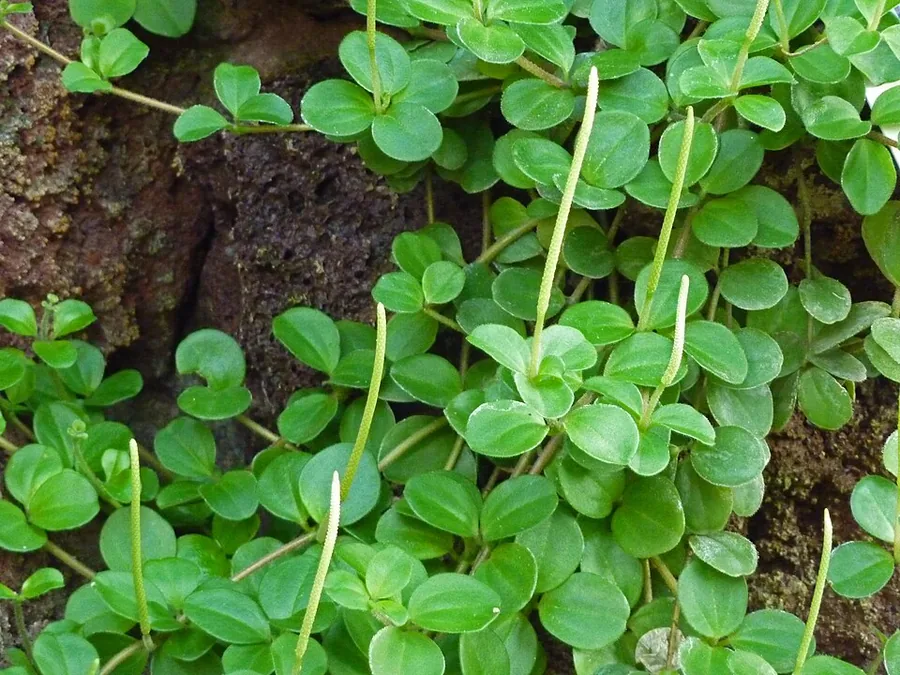
Peperomia 'Hope' is a compact trailing member of the pepper family, grown for the round, coin-shaped leaves arranged in whorls along each stem. It is a hybrid derived from two species native to Mexico and Central America, and the semi-succulent leaves function as a water store, which is why the plant tolerates an occasional lapse in watering without visible stress.
Its ornamental value rests on the cascading habit. Mature stems extend to 2 to 4 feet (61 to 122 cm), trailing from a hanging basket or over a shelf edge, while the crown itself holds low at 3 to 6 inches (8 to 15 cm). Growth proceeds at a moderate pace, so the plant retains a well-formed outline with minimal intervention.
For the grower, the practical advantage is its tolerance of error. Meet its light preference, moderate the watering, and it persists for years. It is also non-toxic and pet-safe, which supports its use in households that include cats, dogs, or small children.
Care
The short version: provide bright, indirect light and a free-draining mix, then let that mix approach dryness before watering again. Feed lightly through the growing season, hold it above 60°F (15.6°C), and restrain watering because the water-storing leaves leave little margin for saturation.
Light
Site it in bright, indirect light, the exposure found near a north or east window. It persists in medium or even low light, but reduced irradiance slows growth and lengthens the internodes, which produces leggier stems. Keep it clear of harsh direct sun, whose intensity scorches the foliage.
Water
Allow the top half of the soil to dry before watering, then water thoroughly and discard whatever collects in the saucer. Because the semi-succulent leaves hold an internal reserve, the operative risk is overwatering rather than underwatering. Curtail watering through fall and winter as growth and water demand both decline.
Soil
Grow it in a well-draining mix opened up with orchid bark, coconut coir, or perlite so free water moves through rather than lingering. It prefers a mildly acidic root zone, around pH 6.0 or slightly below, and a loam and sand blend serves the parent species equally well.
Temperature
Hold it warm, no lower than 60°F (15.6°C). As a frost-intolerant tropical, it has no cold reserve, so an interior position away from cold glass and drafts matches its requirement.
Humidity
Average household humidity satisfies it, and no target figure applies. It responds to slightly moister air, but it acclimates to ordinary room conditions without special provision.
Feeding
Apply a liquid houseplant fertilizer at half strength, monthly from spring through early fall. Suspend feeding entirely from fall through winter, when dormancy leaves the plant unable to use the added nutrients.
Pruning
Pinch or prune whenever a stem runs long and sparse. Tip-pruning removes apical dominance and triggers branching, which sustains a full, bushy form rather than a stringy one, and the excised tips root readily as new plants.
Repotting
This slow grower performs best kept slightly potbound, so repot only every 2 to 3 years, or sooner once roots circle the rootball and emerge from the drainage holes. When repotting, advance a single pot size into fresh mix.
Size & spacing
The crown remains low at 3 to 6 inches (8 to 15 cm) while the trailing stems extend to 2 to 4 feet (61 to 122 cm). Position it where the stems can hang freely from a shelf or basket to display the pendulous habit.
Troubleshooting
The great majority of complaints with Peperomia 'Hope' resolve to two variables: soil moisture and light intensity. Excess water at the roots and insufficient light account for most disorders, with a short list of common pests behind the remainder. Identify the symptom below, then correct the underlying cause rather than the visible sign.
Mushy black stems and collapse at the soil line
A collapse at the crown signals root rot, the predictable result of a medium held saturated beyond what these roots can tolerate. Lift the plant and assess the root system, because rotted tissue reads brown to black, disintegrates under light pressure, and gives the soil a sour, anaerobic odor. Excise all softened root and stem tissue, take several healthy tip cuttings as a hedge, and repot the remaining sound tissue into fresh, fast-draining mix.
Fix:
- Remove the plant from wet soil and cut away all soft, blackened roots and stems with clean tools
- Take healthy tip cuttings to salvage the plant if the base is badly rotted
- Repot remaining healthy tissue into fresh, fast-draining mix
- Withhold water until the plant recovers and the top of the soil dries
Shriveled, soft leaves that have lost their turgor
When the round leaves lose turgor and wrinkle, the plant is drawing down its stored water because the medium ran dry or the surrounding air is too arid, so read it as underwatering or low humidity. Confirm by feel, since a bone-dry rootball paired with soft, semi-succulent foliage points to depletion rather than excess. Water thoroughly, let the excess drain, and the tissue rehydrates and firms within a day or two, with a pebble tray useful where indoor air runs persistently dry.
Fix:
- Water thoroughly and let excess drain
- Resume a consistent moderate watering schedule
- If air is very dry, raise humidity with a pebble tray or grouping plants
Sudden leaf drop across the plant
An abrupt shed usually reflects one of two stresses at the root zone: saturated soil or chilling. Assess moisture and placement together, since a wet rootball indicates overwatering while a windowsill running below 60°F (15.6°C) indicates cold injury, and both prompt the plant to abscise foliage. Reduce watering, move the plant off any cold draft, and excise any root tissue that has already begun to rot.
Fix:
- Correct watering: let the soil almost dry between waterings and ensure good drainage
- Move the plant away from cold drafts and keep it above the recommended minimum temperature
- Inspect roots and trim any rot, repotting into fresh mix if needed
Fine webbing and stippled leaves with moving dots
Fine webbing and a pale, stippled leaf surface indicate spider mites, which build populations quickly in hot, dry, stagnant air. Dislodge one onto white paper by tapping a leaf and the specks will crawl, confirming a mobile pest rather than static damage. Rinse and wipe the foliage to reduce numbers mechanically, then treat with insecticidal soap or horticultural oil on the label interval, and hold the plant in isolation until no live mites remain.
Fix:
- Rinse foliage and wipe leaves to physically remove mites
- Treat with insecticidal soap or horticultural oil, repeating per label
- Isolate the plant from others until controlled
White cottony masses in the leaf axils
White, waxy clusters lodged in the leaf axils are mealybugs, and the sticky honeydew they excrete confirms an active feeding colony. Address individuals directly with a cotton swab charged in 70% isopropyl alcohol, which strips the protective wax, then treat the whole plant with insecticidal soap or horticultural oil and repeat as concealed crawlers emerge. Isolate the specimen and inspect adjacent plants, because mealybugs disperse readily to new hosts.
Fix:
- Dab insects with a cotton swab dipped in 70% isopropyl alcohol
- Treat with insecticidal soap or horticultural oil, repeating as needed
- Isolate the plant and inspect nearby plants
Long bare stems with widely spaced leaves
Elongated internodes and thin, gappy stems are etiolation, the plant's response to light below what it needs. The stems bend toward the brightest source and each new flush spaces small leaves further apart along the extending shoot. Relocate it to brighter, indirect light near a north or east window, pinch the drawn stems to release the lower buds into branching, and root the removed tips to restore density.
Fix:
- Move to a brighter spot with bright, indirect light (near a north or east window)
- Pinch or prune back leggy stems to encourage branching
- Propagate trimmed cuttings to refill the pot for a fuller look
Toxicity
For pet owners the record is reassuring: Peperomia 'Hope' is non-toxic and safe around cats, dogs, and other animals. The genus is documented as pet-friendly, so a curious nibble carries no real hazard. As with any houseplant, ingesting a large quantity can produce brief, mild gastrointestinal upset, so limiting access still makes sense.
Safe for
People · Cats · Dogs · Horses · Rabbits · Livestock · Birds
Cats None
Cats face no toxic risk in the same room. The ASPCA lists related peperomia species as non-toxic to cats, so a curious nibble will not poison one, although a large volume of any plant material can provoke a transient upset stomach in any animal.
Dogs None
Dogs are not endangered by this plant. The record documents peperomia as non-toxic to dogs, and the likeliest outcome of a chewed leaf is brief, mild gastrointestinal upset if a dog ingests a large quantity.
Horses None
No toxic constituents place horses at risk, and extension references classify the genus as non-toxic to them. No barrier is required to keep a horse away from it.
Rabbits None
Rabbits can occupy the same space without concern. The plant holds nothing poisonous to them, so an opportunistic bite is harmless even though it has no place in a proper rabbit diet.
Livestock None
Grazing animals encounter no toxicity from this plant. As a small trailing houseplant it seldom enters their range in any case, and contact produces no harm.
Birds None
Pet birds share the space safely, since the plant carries no toxic parts. A bird that picks at a leaf sustains no injury.
People None
The plant is harmless to people and a defensible choice for a household with small children. It is not cultivated as an edible, but a leaf reaching a curious mouth warrants no alarm.
As a semi-succulent the sap is generally regarded as non-irritating, but as with any houseplant ingestion of large amounts may cause mild, transient stomach upset in pets; supervise curious pets
How to propagate
Peperomia 'Hope' propagates with little difficulty, and the same tip growth removed to maintain a dense habit serves directly as propagation material.
Stem cuttingsEasy
Spring to summer · Several weeks to root
Stem cuttings are the most reliable way to increase this trailer, since each node carries the meristematic tissue that generates adventitious roots. Take a tip bearing at least one node, then either suspend it in water or insert it into moist medium, timing the operation for spring or summer when the plant is in active growth. Roots establish over several weeks, after which the rooted cutting can be potted on as an independent plant.
Leaf cuttingsModerate
Spring to summer · Several weeks to root
Leaf cuttings provide a secondary method common across the genus, though regeneration from a leaf demands more time and care than a node-bearing stem. Take them in spring or summer as well, and anticipate slower, less certain results, with rooting spread over several weeks before new shoots initiate.
Myths
Peperomia 'Hope' is a true species, Peperomia rotundifolia 'Hope' or Peperomia tetraphylla 'Hope'.
Taxonomically, 'Hope' is a patented hybrid cultivar rather than a species. It originated from a controlled cross of Peperomia deppeana and Peperomia quadrifolia, both accepted names on Kew's Plants of the World Online, and is protected under plant patent PP24794. Commercial labels recurrently file it as a rotundifolia or tetraphylla cultivar, yet the patent designation is the botanically accurate one.
Peperomia is toxic to cats and dogs, like so many trailing houseplants.
The toxicological record documents Peperomia as non-toxic to cats and dogs. The ASPCA classifies several peperomia species as safe for both, and NC State Extension tags the entire genus as non-toxic to cats, dogs, and horses. On that basis, 'Hope' is appropriate for a pet household.
Sources
- Missouri Botanical Garden Plant Finder
- NC State Extension Gardener Plant Toolbox
- Missouri Botanical Garden Plant Finder
- NC State Extension Gardener Plant Toolbox
- Clemson Cooperative Extension HGIC
- ASPCA Animal Poison Control
- ASPCA Animal Poison Control
- United States Patent and Trademark Office (USPP24794P3)
- Plants of the World Online, Royal Botanic Gardens Kew
- Plants of the World Online, Royal Botanic Gardens Kew