Houseplant · Piperaceae
String of Turtles
Peperomia prostrata
A trailing peperomia whose fingernail-sized leaves carry a shell-like vein pattern, holding form for years as a compact houseplant.
Bright indirect
Every 7–14 days
68–75°F · 20–24°C
USDA 10–12
Overview
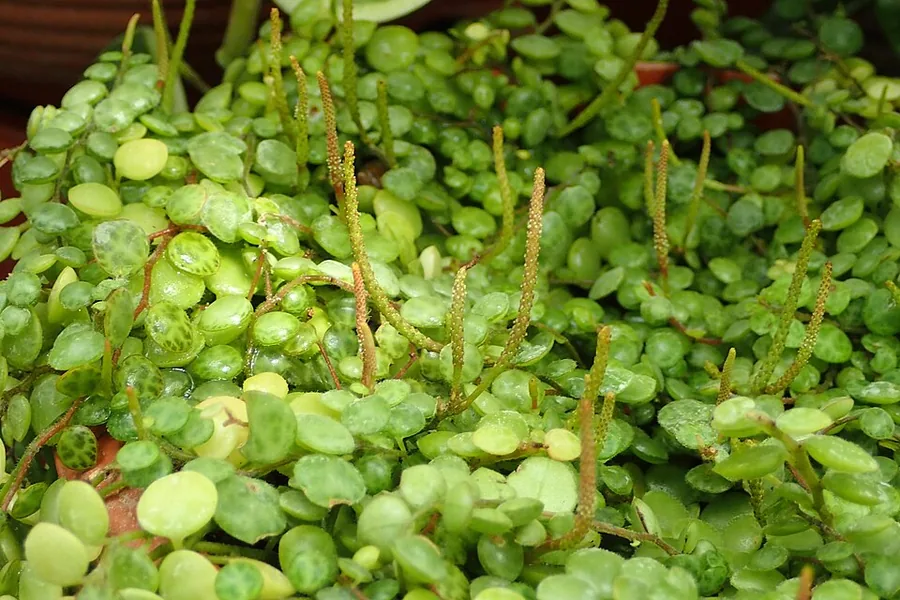
Peperomia prostrata, known as string of turtles, is a diminutive trailing peperomia native to Ecuadorian rainforest, where it grows as a low creeper across the forest floor and mossy logs. Its appeal is horticultural rather than floral: each leaf is round, roughly the size of a fingernail, and traced with a pale vein network that mimics a turtle's shell. Growth is slow and the habit stays compact, with trails reaching only 9 to 12 inches (23 to 30 cm), which suits a shelf edge or a small hanging container.
Its reputation for easy culture rests on modest requirements and a degree of built-in drought tolerance. Bright, indirect light and a freely draining substrate meet nearly all of its needs. Because the foliage is semi-succulent and holds an internal water reserve, the plant weathers a missed watering with little stress, and underwatering does far less harm than saturation.
The critical failure point is prolonged root-zone moisture. Held constantly wet, in the manner of a fern kept evenly damp, the roots decline and rot within days. Allowed to dry partway and given adequate light, a single specimen develops into a dense, patterned trail that persists for years.
Care
The short version: supply bright, indirect light, a fast-draining pot, and irrigation only after the upper half of the profile dries. Hold it warm, apply light feeding during the growing season, and keep the root zone from staying wet.
Light
Provide bright, indirect light, comparable to the exposure a short distance inside a window facing east or south. It tolerates medium and low light, but the turtle-shell markings fade when illumination runs short, so brighter conditions preserve the pattern. Direct sun is best avoided, since the small leaf blades scorch.
Water
Irrigate only once the top half of the substrate has dried, which in practice falls at intervals of roughly 7 to 14 days. The semi-succulent leaves buffer the plant against drought, so a dry interval is tolerated far better than standing moisture, the principal cause of decline.
Soil
Use a sharply draining medium, a houseplant or cactus mix amended for porosity, so water passes freely and never lingers at the roots. A loamy or sandy texture is appropriate, and the plant accepts a soil pH from 5.5 to 7.5. Drainage is the single most important cultural factor.
Temperature
Maintain typical interior temperatures of 68°F to 75°F (20°C to 24°C). The species has no frost hardiness and resents cold drafts, so exposure to chilled glazing or exterior doorways during winter should be prevented.
Humidity
Ambient household humidity is adequate, so no specific target applies. The plant benefits marginally from slightly elevated moisture but performs well in ordinary room air, without misting or supplemental humidification.
Feeding
Fertilize sparingly during spring and summer, the period of active growth. A dilute liquid feed at roughly monthly intervals is sufficient, or a slow-release granular product applied once annually. Given the slow growth rate, restraint is warranted.
Pruning
Periodic pinching of the trailing stems redirects the plant toward fuller, denser growth. Removing leggy or damaged sections at the same time maintains form.
Repotting
This peperomia performs well pot-bound and can occupy the same container for several years. Repot only when roots protrude through the drainage holes, water passes through with negligible absorption, or growth slows, and then increase the pot by a single size.
Size & spacing
Mature dimensions are modest: trails of 9 to 12 inches (23 to 30 cm) and a spread of only 3 to 4 inches (8 to 10 cm). This compact stature accommodates a desk, a shelf, or a small suspended pot.
Troubleshooting
The great majority of disorders in this species reduce to a water or light imbalance. Because symptoms register early on the foliage and roots, prompt recognition usually allows a full recovery. Identify the pattern below, then intervene.
Leaf drop and yellowing accompanied by soft, mushy stems
These signs point to root rot, the consequence of overwatering and the most common cause of death in this species. Kept persistently saturated, the roots decay to brown and soft tissue and the plant sheds its leaves. Reduce irrigation immediately, repot into fresh free-draining medium, and excise the rotted roots to halt further spread.
Fix:
- Reduce watering frequency
- Let soil dry partway before watering again
- Repot into fresh well-draining mix and trim rotted roots if rot is present
Sticky residue, webbing, or insects on foliage and stems
Sticky honeydew, webbing, or visible insects signal sap-sucking pests, typically mealybugs, spider mites, scale, or whiteflies concentrated on leaf undersides and stem junctions. Remove them physically, treat with insecticidal soap, and isolate the plant to prevent transfer. The species is generally pest-resistant, so infestations most often enter on a newly acquired plant.
Fix:
- Wipe off pests
- Treat with insecticidal soap
- Isolate the plant to prevent spread
Faded foliage with indistinct markings
A flat, washed-out turtle-shell pattern indicates insufficient light. The plant has been held too far from a window in dim conditions. Relocate it to bright, indirect light at an east or south-facing window, and the markings regain their definition.
Fix:
- Move to a spot with bright, indirect light from an east or south-facing window
Toxicity
This species carries no known toxicity risk to a household with pets or children. The ASPCA classifies the trailing peperomia as non-toxic, and no plant part is documented to harm cats, dogs, or people who ingest it. It can be placed within easy reach without concern.
Safe for
People · Cats · Dogs · Horses · Rabbits · Livestock · Birds
Cats None
The ASPCA classifies this peperomia as non-toxic to cats, so incidental ingestion presents no clinical concern.
Dogs None
It is likewise recorded non-toxic to dogs by the ASPCA, and a chewed stem carries no risk of poisoning.
Horses Safe
No known toxicity to horses is associated with this plant, and its small trailing habit rarely brings it within their reach.
Rabbits Safe
A rabbit that ingests a portion of the foliage is not at risk, as the plant contains no compounds toxic to them.
Livestock Safe
Grazing stock such as cattle, goats, and sheep encounter no toxic hazard from this peperomia.
Birds Safe
Pet birds may perch on and nibble the plant safely, since it holds no avian toxins.
People Safe
The species is safe around children, and a leaf reaching a small hand poses no toxic danger.
How to propagate
Vegetative propagation is straightforward, and one established plant yields ample material. Both a single leaf and a length of stem will root readily, provided the work is done during the warm, actively growing period.
Leaf cuttingsEasy
Spring or summer during active growth · Several weeks to a few months to root and establish
Detach a healthy leaf with its petiole intact and insert the base into a moist, free-draining medium. Carry this out in spring or summer during active growth, and allow an extended establishment period, since rooting and the emergence of a new plantlet may require several weeks and sometimes a few months.
Stem cuttingsEasy
Spring or summer during active growth · Several weeks to root
Take a stem cutting several inches long during the spring or summer flush and lay it against a moist medium. Application of rooting hormone accelerates the process, and roots typically develop within a few weeks.
Myths
One persistent claim treats string of turtles as a true succulent to be watered like a cactus and kept bone dry.
The designation is inaccurate: this is a semi-succulent, not a true succulent. The leaves store a limited water reserve, yet the plant prefers to dry only partway between waterings rather than desiccate fully. Chronic underwatering causes decline, but overwatering remains the greater hazard and the usual cause of loss to rot.