Houseplant · Piperaceae
Ripple Peperomia
Peperomia caperata
A slow-growing member of the pepper family, ripple peperomia keeps its water in semi-succulent leaves and rewards a restrained watering routine.
Bright indirect
USDA 11–12
6–10 in · 15–25 cm
Overview
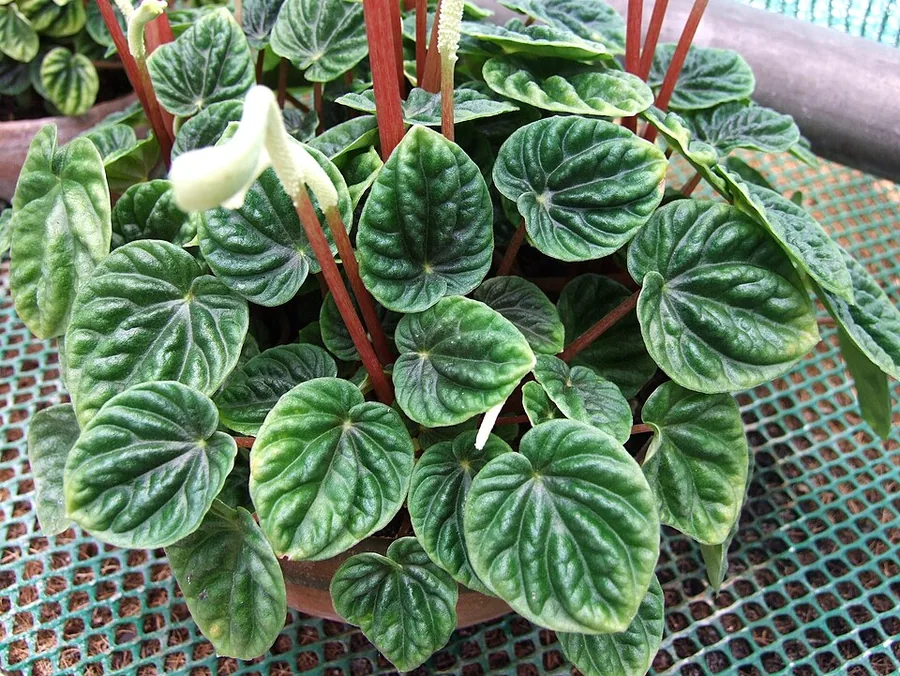
Ripple peperomia (Peperomia caperata) draws its name from the deeply furrowed, quilted heart-shaped leaves that define the species. It belongs to the pepper family, Piperaceae, and originates in the forests of southeast Brazil, growing in the dappled light beneath taller vegetation. That understory origin explains its preference for bright indirect light indoors, where it forms a compact mound of 6 to 10 inches (15 to 25 cm) in height and a comparable spread.
The foliage carries the ornamental value, ranging across cultivars from deep emerald green through burgundy red to silver-marked forms. Growth is slow, so the plant holds its scale for a long time and suits a desk, shelf, or windowsill under bright indirect light. It is also documented by the ASPCA as non-toxic to cats and dogs, which broadens where it can be kept.
The thick, semi-succulent leaves function as internal water storage, which is the key to its culture. Because the plant carries its own reserve, keeping the soil wet brings no benefit and instead invites the root and crown rot that is the primary cause of decline. Provide bright light, allow the medium to dry partway between waterings, and the plant remains healthy for years.
Care
The short version: site it in bright indirect light, use a porous free-draining medium, and irrigate only after the top half of the soil has dried. Water conservatively, maintain high humidity, and the plant is largely self-sufficient.
Light
Provide bright indirect light, ideally at an east or south exposure. The plant tolerates medium light and a period of low light, but insufficient light causes the stems to elongate and the pigmented cultivars to lose their coloration. Direct hot sun should be avoided, as it scorches the foliage.
Water
Allow the top half of the medium to dry before rewatering, since the semi-succulent leaves supply the plant's reserve. Overwatering is the single greatest cause of decline. Drain the saucer after each application, keep standing water out of the crown, and reduce the frequency through fall and winter as growth slows.
Soil
Use a porous, free-draining peaty houseplant or cactus medium so that water passes through quickly. Where overwatering is a tendency, incorporate additional perlite to raise porosity and keep the root zone from remaining saturated.
Temperature
Maintain warmth, with a minimum near 61°F (16°C). As a tropical species it has no cold tolerance, so exposure to drafts and chilled windowsills should be avoided.
Humidity
The species favors high humidity, consistent with its rainforest provenance. In dry indoor air, particularly during winter heating, grouping plants together or operating a humidifier raises the ambient moisture.
Feeding
Apply a dilute liquid houseplant fertilizer monthly during the spring and summer growth period, or substitute a slow-release granular product once annually. Withhold fertilizer in fall and winter, when growth is largely dormant.
Pruning
Remove aged or damaged foliage as it appears. Cutting a stem just above a leaf node stimulates branching at that point and produces a fuller, bushier habit over time.
Repotting
Repotting is infrequent; the plant can occupy the same container for several years without issue. Advance it a single pot size only when roots emerge from the drainage holes or the medium dries abnormally fast.
Size & spacing
At maturity the plant remains small, reaching 6 to 10 inches (15 to 25 cm) in both height and spread. This restrained dimension is what makes it well suited to shelf and desktop positions.
Troubleshooting
Nearly every disorder here has a single root cause: soil moisture. Excess water in the medium leads to rot and leaf loss, while insufficient light produces etiolated, faded growth. Identify the symptom below and correct the underlying cultural factor rather than treating the symptom alone.
Softened, blackened crown on a failing plant
A softened, blackened stem base with progressive collapse indicates root and crown rot, the consequence of prolonged saturation in the soil or standing water in the crown. Affected roots darken and turn slimy rather than remaining firm and pale. Cease watering, excise all rotted tissue with sterile tools, and repot into a fresh free-draining medium. Where the crown is beyond recovery, secure a few healthy leaf or stem cuttings to preserve the plant.
Fix:
- Stop watering and remove the plant from wet soil
- Cut away rotted roots and mushy crown tissue with clean tools
- Repot into fresh, fast-draining mix in a clean pot with drainage holes
- Take healthy leaf or stem cuttings as insurance if the crown is badly affected
Chlorotic, wilting foliage over rotting roots
Yellowing, wilting foliage on a saturated plant generally signals advancing rot at the roots or stem base. Remove the plant from its pot, examine the roots, and cut away any that are dark and soft before repotting into a fresh free-draining medium. The corrective measure lies in the watering regime, as both waterlogging and prolonged drought produce this response.
Fix:
- Check roots and soil moisture
- Trim affected roots and repot into fresh fast-draining mix if rot is present
- Correct the watering routine to avoid moisture extremes
Leaf drop from a saturated medium
Leaf abscission while the medium remains wet points almost invariably to overwatering. Permit the soil to dry fully, then correct drainage by incorporating perlite or repotting into a more porous medium. Resume cautious, light watering once the plant resumes growth.
Fix:
- Allow the soil to dry out
- Improve drainage by adding perlite or repotting into a porous mix
- Resume light, careful watering once the plant recovers
Webbing or cottony deposits in the leaf axils
Fine webbing with stippled foliage denotes spider mites, whereas white cottony deposits seated in the leaf axils denote mealybugs, both sap-feeding pests. Isolate the plant to limit spread, remove the visible insects, and apply insecticidal soap or horticultural oil. Repeated applications over several weeks are required to interrupt the pest life cycle.
Fix:
- Isolate the affected plant
- Wipe off mealybugs and treat with insecticidal soap or horticultural oil
- Repeat treatments as needed to break the pest life cycle
Etiolated stems and diminished leaf color
Elongating stems and diminished pigment in the colored cultivars both indicate inadequate light. Relocate the plant to bright indirect light at an east or south exposure, or supplement with fluorescent lighting where daylight is deficient. Pruning the elongated stems above a node restores a compact, branched form.
Fix:
- Move to a brighter spot with bright indirect light from an east or south-facing window
- Supplement with fluorescent lighting if natural light is limited
- Prune leggy stems above a node to restore a compact, bushy shape
Discrete lesions on the foliage
Discrete lesions that develop after the foliage remains wet are characteristic of fungal leaf spot. Remove the marked leaves, direct water to the soil surface to keep the foliage dry, and improve air movement around the plant. Because the pathogen requires leaf wetness to establish, keeping the foliage dry constitutes the whole of the control.
Fix:
- Remove affected leaves
- Keep foliage dry when watering by watering at the soil level
- Improve air circulation
Toxicity
Ripple peperomia carries no documented toxic principle. Both the ASPCA and NC State Extension classify it as non-toxic to cats, dogs, and horses, and with no toxin on record, the same clearance extends to other animals and to people. Ingestion of a small amount presents no recognized hazard.
Safe for
People · Cats · Dogs · Horses · Rabbits · Livestock · Birds
Cats None
The ASPCA and NC State Extension both classify this species as non-toxic to cats, and no toxic constituent is on record. A small quantity ingested presents no hazard.
Dogs None
It is likewise recorded as non-toxic to dogs, with no harmful principle documented. Foliage chewed by a dog carries no risk of poisoning.
Horses None
The same authorities rate it safe for horses, so an incidental mouthful is of no consequence.
Rabbits Safe
No toxin is present in the leaves or stems, so the plant presents no poisoning risk to a rabbit that samples it.
Livestock Safe
Grazing animals encounter nothing toxic in this species. As an indoor plant it is unlikely to be within their reach, and it holds no toxic compound in any event.
Birds Safe
With no toxic principle documented, a bird that perches on or pecks at the foliage remains out of harm's way.
People Safe
The plant is not poisonous to people, children included. It is not cultivated for consumption, but an incidental taste causes no harm.
Varieties
The named selections differ chiefly in foliage color rather than in leaf form. The following cultivars are the ones most often encountered.
'Emerald Ripple'
The type form for which the species is named, bearing the deeply furrowed, quilted green heart-shaped leaves characteristic of the plant.
'Rosso'
A cultivar documented by NC State Extension for its red leaf undersides contrasting with the green upper surface.
'Red Ripple'
A burgundy-red selection in which the deep pigment extends across the entire leaf.
'Red Luna'
One of the selections NC State Extension records for its pronounced red-toned foliage.
'Variegata'
A variegated selection whose green leaves carry silver patterning.
How to propagate
This species propagates readily by several vegetative methods, a reflection of the ease with which peperomias regenerate from leaf, stem, and divided tissue. Any of the three approaches below yields new plants with minimal intervention.
Leaf cuttingsEasy
Spring to summer · Several weeks to root
The standard peperomia technique. A healthy leaf taken with its petiole in spring or summer and inserted into moist medium develops roots over several weeks, generating a new plant.
Stem cuttingsEasy
Spring to summer · Several weeks to root
Tip and stem cuttings root with equal ease in water or moist medium. Taken in spring or summer, they require several weeks to form roots before potting on.
DivisionEasy
Spring at repotting · Several weeks
A mature clump can be separated into individual plants. Performed in spring during routine repotting, each division reestablishes over several weeks.
Myths
Ripple peperomia is toxic to cats and dogs, as many houseplants are.
Both the ASPCA and NC State Extension classify the species as non-toxic to cats, dogs, and horses. It qualifies as a genuinely pet-safe houseplant, suitable for households where other foliage plants would pose a concern.
Peperomias require frequent watering to keep the medium continuously moist.
The thick, semi-succulent leaves hold an internal water reserve, so the plant is adapted to dry down between waterings. Overwatering is the foremost cause of leaf drop and root rot, which makes underwatering the lower-risk error.