Shrub · Vitaceae
Virginia Creeper
Parthenocissus quinquefolia
A tough native vine that repays brilliant fall color with a standing demand to hold its vigor in check.
Full sun
Every 7–14 days
USDA 3–9
30–50 ft · 9.1–15.2 m
Overview
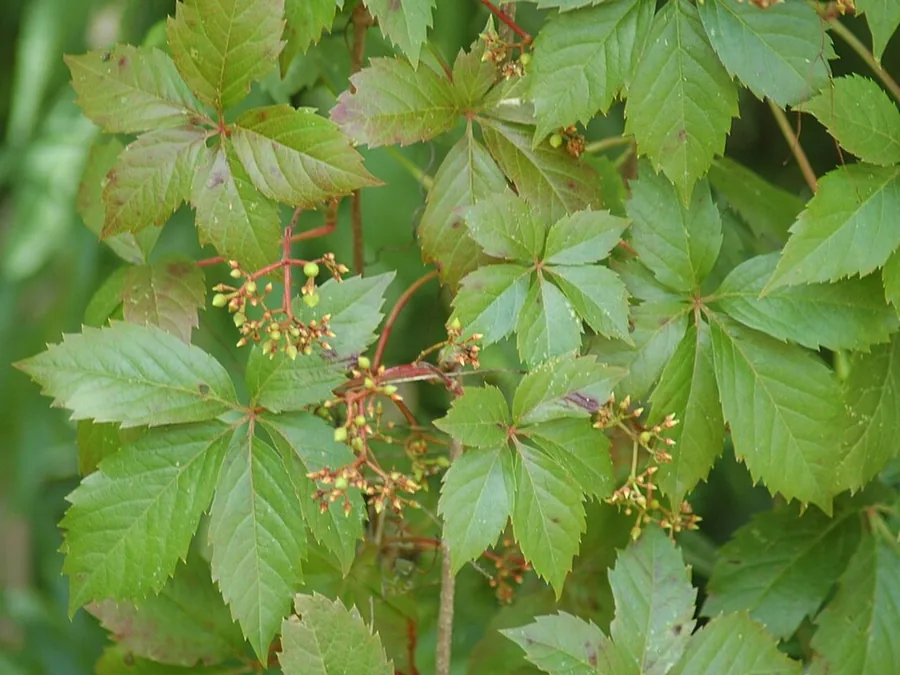
Virginia creeper is a fast-growing woody climber indigenous across eastern North America, valued chiefly for the intense scarlet coloration it develops in autumn. Its palmately compound leaves divide into five leaflets, a reliable diagnostic that separates it from three-leaflet poison ivy. Established on a fence, an arbor, or an exposed bank, it can cover the available ground within a season or two.
The mechanism that drives its climb is also the source of its management burden. The vine adheres by disk-tipped holdfasts that bond to nearly any substrate, allowing it to ascend trees, walls, and trellises to well above head height. That same adhesion draws at paint and mortar, which is the horticultural reason to give it dedicated space set apart from the house.
Once established, its cultural demands are minimal. Full sun or deep shade, sand or clay, drought or cold to -40°F (-40°C) all fall within its tolerance. The qualification arrives later in the season, when it sets clusters of dark blue-black berries that resemble small grapes but are toxic to people and animals alike.
Care
The short version: establish it in almost any well-drained soil, in full sun to maximize autumn coloration or in shade where sun is unavailable, water it through establishment, and thereafter confine your attention largely to pruning it back to its allotted space.
Light
Virginia creeper performs across the full span from full sun to full shade, a breadth uncommon among climbers. Sun drives the most intense red pigmentation in autumn, whereas shade still supports a healthy vine but yields subdued, muted coloration.
Water
Irrigate a young plant with a thorough soak every 7 to 14 days during establishment, allowing the upper half of the soil profile to dry between applications. Once established the vine becomes markedly drought tolerant and requires little beyond ambient rainfall.
Soil
It accommodates clay, loam, or sand equally, requiring only adequate drainage and a measure of organic matter. Its pH tolerance is broad, spanning 5.0 to 8.0, so most garden soils are suitable without amendment.
Temperature
Its cold tolerance is exceptional among vines. It withstands winter minima to -40°F (-40°C) and summer maxima to 100°F (38°C), and this thermal range is what permits cultivation across so wide a geographic band.
Humidity
Ambient outdoor humidity is entirely adequate, so no monitoring is warranted. Air movement is the operative factor, since stagnant, congested air is what predisposes the plant to the occasional leaf spot or mildew.
Feeding
As a vigorous native it seldom requires supplemental nutrition. Where growth is genuinely deficient, a light balanced application in spring suffices, and over-fertilizing only accelerates the excess growth that later must be removed.
Pruning
Pruning is the central cultural operation. Cut it hard in late winter or early spring, then trim through the season to keep it off masonry, gutters, shutters, and wiring, because an unmanaged vine extends rapidly and far.
Repotting
In the ground it never requires repotting, and even in a container the need is infrequent. Advance it one pot size only when roots circle the base or water passes straight through without appreciable absorption.
Size & spacing
Given support, the vine attains a considerable 30 to 50 feet (9 to 15 m) in height with a spread of 5 to 10 feet (1.5 to 3 m). Allocate that much room on a robust structure and hold it well clear of the house.
When to plant
As a cold-hardy perennial vine rather than a seasonal crop, its timing turns on establishment rather than on outrunning frost. Plant it out in spring or fall, anticipate the small greenish flowers from May into July, and expect the dark berries and characteristic red coloration from late summer through fall.
Northern hemisphere
Southern hemisphere
Typical months for a temperate climate: start earlier in warm zones, later where spring frosts linger.
- Plant: spring or fall
- Harvest: Greenish-white insignificant flowers May to July, followed by blue-black berries in late summer to fall
Hardiness
USDA hardiness zones: 3–9
Temperature: down to -40°C
Troubleshooting
Virginia creeper is robust to the point that most of its problems concern scale rather than health. The principal one is its habit of climbing where it is not wanted and adhering to walls. Identify its few cosmetic foliar disorders early, and the plant is easily kept in good condition.
Vine ascending structures and leaving bonded pads on the surface
The clinging pads are adhesive holdfasts, disk-tipped tendrils that let this vine scale almost any vertical surface it meets. Against a building they exploit that grip, drawing at paint films, seating into mortar joints, and choking gutters, while the bonded residue persists even after the stems are torn free. The remedy follows the biology: cut it back hard, detach the stems before the disks fully bond, and redirect growth onto a trellis positioned well clear of the structure.
Fix:
- Cut vines back hard and pull stems off surfaces before disks set
- Trim regularly through the growing season to keep growth in bounds
- Redirect onto a sturdy trellis, fence, or arbor away from buildings
Foliar spotting or a powdery white bloom on the leaves
Defined dark lesions indicate fungal leaf spot, while a chalky surface film signals powdery mildew, and both favor the shade and the still, humid air where evaporation slows and spores persist on the leaf. On a vine of this vigor the effect is essentially aesthetic, so treatment aims at conditions rather than cure. Thin congested growth to move air through the canopy, strip the most affected leaves, and irrigate at the base to keep the foliage dry.
Fix:
- Improve air circulation by thinning crowded growth
- Remove and dispose of badly affected foliage
- Avoid wetting foliage when watering
Grazed or stippled foliage with insects present
Japanese beetles account for most of the damage, grazing the leaf tissue between the veins until only a skeleton remains, while leafhoppers stipple the surface as they feed and scale settle as fixed bumps on the stems. Because the plant's vigor outpaces the loss, an established vine tolerates the feeding with little consequence. Drop beetles into soapy water, dislodge or excise localized colonies, and reserve horticultural oil for scale that escalates.
Fix:
- Hand-pick beetles into soapy water
- Hose off or prune out localized infestations
- Treat scale with horticultural oil if severe
Toxicity
Regard the entire plant as inedible. All tissue holds sharp calcium oxalate crystals, and the dark berries add oxalic acid to that load, which is why the plant has poisoned cats, dogs, horses, livestock, and people. The fruit represents the principal hazard, resembling wild grapes closely enough to induce children and pets to ingest it.
Toxic to
Cats · Dogs · Horses · Rabbits · Livestock · Birds · People
Cats Toxic
Insoluble calcium oxalate crystals occur throughout the tissue and pierce the oral lining on contact, so a cat that bites a leaf or berry salivates heavily, paws at its muzzle, and may vomit. Localized swelling of the lips and throat can develop as the reaction progresses.
Dogs Toxic
In a dog, chewing the foliage or the grape-like fruit produces immediate oral burning, profuse salivation, and gastrointestinal upset with vomiting or diarrhea. The berries concentrate the most oxalic acid and therefore drive the most severe response.
Horses Toxic
Ingestion irritates the equine mouth and digestive tract, producing salivation, oral pain, and colic-type discomfort. Excluding any creeper that ascends the paddock fencing removes the exposure at its source.
Rabbits Toxic
The same crystalline load renders the vine unsuitable as forage, and even a small amount can inflame the mouth and disturb the digestive tract. Keeping prunings and fallen fruit out of the enclosure prevents the problem.
Livestock Toxic
Cattle, goats, and sheep that browse the leaves or berries present with oral irritation, salivation, and digestive upset. Removing the vine from pasture margins before stock encounter it is the reliable control.
Birds Toxic
Wild birds consume the ripe fruit and disperse the seed without harm, yet the acid-rich berries are unsuited to pet birds. A companion bird that ingests the fruit can show oral irritation and digestive disturbance.
People Caution
No part of the plant is edible. The dark fruit mimics wild grapes closely enough to have caused human poisonings, most often in children, presenting as oral and pharyngeal burning, salivation, and vomiting, while contact with the sap can provoke a dermal rash.
Sap and oxalate crystals can cause skin irritation or contact dermatitis in sensitive people; wear gloves when pruning or removing the vine.
Helpline numbers

United States
ASPCA Animal Poison Control: (888) 426-4435 (fee applies)
Poison Control: (800) 222-1222



Canada
Poison Centres: 1-844-764-7669
Varieties
Most plantings use the straight species, but several named selections exchange a measure of vigor for improved coloration or variegated foliage. The following are the forms most often encountered in the trade.
var. engelmannii (Engelmannii)
A less rampant botanical form whose reduced leaflet size and bronze-red autumn coloration produce a denser habit and a finer overall texture than the species.
'Monham' (Star Showers)
A variegated cultivar marked with white, paint-like patterning on green foliage that develops pink pigmentation as temperatures drop.
'Troki' (Red Wall)
A selection that emerges bronze in spring, holds green through summer, and colors to a saturated fire-engine red in autumn.
How to propagate
The same vigor that spreads this vine in the landscape makes deliberate propagation straightforward. It roots from cuttings, layers readily from a pegged stem, or grows from seed once a cold requirement is met.
Stem cuttingsEasy
Late spring to summer from softwood or semi-hardwood · 4 to 8 weeks to root
Softwood or semi-hardwood cuttings taken from late spring into summer root readily, generating adventitious roots within 4 to 8 weeks. The same rooting capacity lets detached or trailing stems layer spontaneously wherever they rest on moist ground.
LayeringEasy
Spring through summer · One growing season
Layering exploits the vine's natural tendency to root at the nodes. From spring through summer a trailing stem held against the soil forms roots at the contact points, and a pinned shoot is generally severable as an independent plant after one growing season.
SeedModerate
Sow outdoors in fall or cold-stratify before spring sowing · Germination after cold stratification
Seed carries physiological dormancy that a period of cold must break. An outdoor fall sowing satisfies that chilling requirement, as does artificial cold stratification ahead of a spring sowing, with germination following the cold treatment. In the wild, frugivorous birds perform the dispersal, consuming the berries and voiding the seed across a wide range.
Myths
Virginia creeper is just poison ivy, so any vine with five leaflets is poison ivy.
Leaflet number resolves the identification cleanly. This species bears five leaflets, the basis of the mnemonic 'leaves of five, let it thrive,' whereas poison ivy bears three, 'leaves of three, let it be.' The tissue contains no urushiol, the compound responsible for poison ivy dermatitis, though the oxalate crystals in its sap can still elicit a mild rash on susceptible skin.