Shrub · Vitaceae
Grape
Vitis vinifera
Give a grapevine full sun, sturdy support, and a hard dormant prune, and it channels its vigor into fruit for decades.
Full sun
Every 7–14 days
730–1095 days
USDA 6–10
Overview
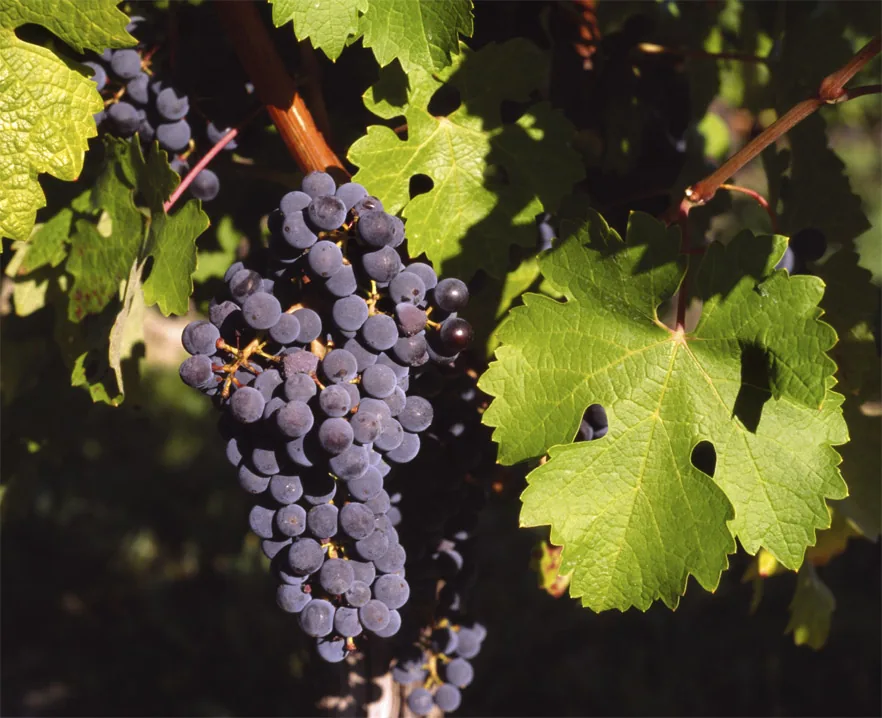
The grapevine is a long-lived deciduous woody climber that humans have cultivated for its fruit for thousands of years. European wine grapes form the backbone of most vineyards, while American species and their hybrids occupy the colder sites where vinifera falters. Established well, a single vine remains productive for decades.
Grapes demand full sun, deep well-drained soil, and a strong structure to climb, because the vine reaches for light through tendrils rather than standing on its own. Unmanaged it sprawls to 40 to 60 feet (12 to 18 m), and that natural vigor is precisely why the annual prune is so severe. The vine grows fast, and directing that growth back into wood and fruit is the whole discipline of grape culture.
Patience is a requirement, not a preference. A young vine invests its first seasons in a root system and a permanent framework before it can carry a crop, so fruit follows in 2 to 3 years. In return, an established vine yields grapes for fresh eating, juice, raisins, or wine across many seasons.
Care
The short version: full sun, deep well-drained soil, and a sturdy trellis or arbor for the vine to climb. Water young vines to establish them, restrain the nitrogen so growth goes to fruit, and prune hard each winter to sustain productivity.
Light
Grapes require full sun, ideally for the full day, because sunlight drives the sugar accumulation that ripens the fruit. Partial sun is tolerated, but shade produces a leafy vine, poor fruit set, and a damp, dim canopy that favors disease.
Water
Water young vines deeply every 7 to 14 days during establishment to push roots downward. Once those roots reach depth, the mature vine draws on soil moisture through dry spells, so irrigation can taper; keep the soil off the saturated end and avoid overhead wetting, since standing moisture on leaves invites fungal infection.
Soil
Plant in deep, loamy, humus-rich soil with free drainage. The vine accepts a fair range of soils and a pH from 5.5 to 7.0, but waterlogged ground suffocates the roots and is the one condition it will not tolerate.
Temperature
Grapes span a wide thermal range, roughly 5°F to 95°F (-15°C to 35°C) depending on type. American grapes and hybrids withstand cold well beyond the tolerance of European wine grapes, so matching the variety to local winters is what keeps a vine alive.
Humidity
Grapes favor low humidity, around 30% to 60%, because the fungal diseases that plague them germinate in still, saturated air. An open canopy and moving air do more to suppress powdery mildew and black rot than any humidity reading.
Feeding
Feed once in early spring as growth resumes, using a balanced fertilizer such as 10-10-10. Restrain the nitrogen, since a surplus drives vegetative growth and diverts the vine from fruiting.
Pruning
Prune hard every winter during dormancy, removing roughly 80% to 90% of the previous season's wood, because the vine fruits on new shoots from a limited framework. Train it onto a strong trellis or arbor and apply cane or spur pruning according to the variety; no single operation matters more to yield.
Repotting
Grapes belong in the ground or a large permanent container and are not repotted on a routine cycle. Where one is container-grown, increase pot size before the roots begin to circle, because a bound root system stunts the vine and dries out rapidly.
Size & spacing
Pruned and trained, a vine holds around 5 to 20 feet (1.5 to 6 m) with a spread of 4 to 10 feet (1.2 to 3 m). Left unpruned it can extend to 40 to 60 feet, which is why a sturdy support and managed spacing are non-negotiable.
When to plant
The grape follows a deliberate, multi-year rhythm. Set out dormant bare-root or potted vines in early spring once hard frost has passed, then cut them back hard each winter during dormancy, when the vine's reserves are safely stored in the wood. Flowering follows in late spring and the fruit ripens from late summer into fall, though the first substantial harvest arrives only after a couple of years.
Northern hemisphere
Southern hemisphere
Typical months for a temperate climate: start earlier in warm zones, later where spring frosts linger.
- Plant: Early spring after danger of hard frost has passed, as dormant bare-root or potted vines
- Harvest: Blooms late spring; fruit harvested late summer to fall (roughly Aug-Oct depending on variety and climate)
Hardiness
USDA hardiness zones: 6–10
Temperature: down to -23°C
Troubleshooting
Nearly all grape problems reduce to three sources: fungal disease that exploits damp, crowded canopies, soil-dwelling pests at the roots, and wildlife drawn to the ripening fruit. Early recognition is what preserves a crop. Identify the symptom below, then intervene before the agent spreads through the vine.
Tan leaf lesions preceding black mummified berries
This is black rot, caused by Guignardia bidwellii, which infects during warm, wet spells and announces itself as tan leaf lesions rimmed with dark borders before the berries desiccate into hard black mummies on the cluster. Because a single wet season can carry it through an entire crop, intervention needs to be early. Remove the mummified fruit and infected canes that harbor the fungus, prune to raise airflow, and spray from bud break through fruit set, the window when the berries are most susceptible.
Fix:
- Remove and destroy mummified berries and infected canes
- Apply fungicide from bud break through fruit set
- Prune and thin for better airflow
Progressive decline with galling on the root system
When an own-rooted V. vinifera vine loses vigor over successive seasons and its roots carry galls, the agent is grape phylloxera, the insect Daktulosphaira vitifoliae feeding below ground. No foliar or soil spray reaches the root-feeding population reliably, which is why chemical control fails. The durable remedy is to replant on phylloxera-resistant American rootstock, whose roots the insect cannot damage, and to pull the severely affected own-rooted vines.
Fix:
- Replant on phylloxera-resistant American rootstock
- Remove severely affected own-rooted vinifera vines
A powdery white colony over leaves, shoots, and berries
The coating is powdery mildew, driven by the fungus Erysiphe necator, which thrives where warm, humid air stagnates inside a crowded, shaded canopy. Though the growth rubs away, it distorts leaf tissue and russets and cracks the developing berries. Open the canopy through pruning and shoot thinning so airflow strips the humidity that the fungus needs, hold the vine in full sun, and keep a preventive sulfur or fungicide program running before infection sets.
Fix:
- Open the canopy with proper pruning and shoot thinning to improve airflow
- Apply sulfur or a recommended fungicide on a regular preventive schedule
- Site in full sun with good air circulation
Clusters stripped as the berries reach ripeness
Birds and other wildlife register ripening sugar in the fruit and can strip a cluster before the grower judges it ready. The reliable defense is exclusion: drape netting over the vines at veraison, as the berries begin to color and well before full ripeness. Then harvest the fruit promptly once ripe rather than leaving mature clusters exposed on the vine.
Fix:
- Drape bird netting over vines as fruit begins to color
- Harvest promptly once fruit is ripe
Toxicity
Ripe grapes are a safe, everyday food for people, yet the same fruit is seriously dangerous to dogs and cats. Grapes and raisins can cause acute kidney failure, and because the response is not dose-dependent, even a small amount may be enough. Keep fruit, fallen grapes, and prunings well away from pets, and treat any ingestion as a veterinary emergency.
Toxic to
Cats · Dogs · Horses · Rabbits · Livestock · Birds
Safe for
People
Cats Toxic
Extend the same caution used for dogs to cats, treating grapes and raisins as unsafe. The concern is identical kidney injury, so keep fruit and fallen grapes out of reach and seek veterinary care immediately if a cat ingests any.
Dogs Severe
A small quantity can precipitate acute kidney failure in a dog. The clinical picture includes vomiting, diarrhea, lethargy, a lost appetite, abdominal pain, marked thirst, and reduced urine output. Because the disorder progresses, contact a veterinarian at once rather than waiting for signs to develop.
Horses Caution
Toxicity in horses remains poorly documented. In the absence of data, withhold grapes, raisins, and vine prunings and do not offer the fruit as a treat.
Rabbits Caution
No sound evidence establishes safety for rabbits either way. Omit grapes and raisins entirely and confine the diet to greens and hay of known safety.
Livestock Caution
The effect on cattle, goats, and sheep is undefined. Given the renal risk demonstrated in companion animals, exclude them from dropped fruit and keep prunings out of grazing areas.
Birds Caution
Toxicity in birds has not been characterized. As a precaution, do not offer grapes or raisins to pet birds and monitor poultry ranging near the vines.
People Safe
For people the ripe fruit is a safe, everyday food, consumed fresh, dried as raisins, or pressed for juice and wine. The hazard is confined to animals, not to the grower.
Keep fruit, prunings, and fallen grapes out of reach of dogs, and never feed grapes or raisins to pets. Grapes and raisins are also advised against for cats as a precaution.
Helpline numbers

United States
ASPCA Animal Poison Control: (888) 426-4435 (fee applies)

United Kingdom
Animal PoisonLine: 01202 509000 (fee applies)

Australia
Animal Poisons Helpline: 1300 869 738
Varieties
Grapes divide broadly into the European wine grapes, the cold-hardy American species, and the interspecific hybrids that combine traits of both. The following represent the types a home grower most often encounters.
'Cabernet Sauvignon' (V. vinifera)
A classic European wine grape bearing small dark berries, it requires a long, warm season and performs best across zones 6 to 9.
'Thompson Seedless' (V. vinifera)
A seedless green table grape, it is also the cultivar most often dried into raisins.
'Concord' (American Vitis labrusca)
A slip-skin blue-black grape valued for juice and jelly, it carries the cold hardiness to hold zones colder than vinifera tolerates.
'Niagara' (American Vitis labrusca)
A cold-hardy white labrusca marked by a pronounced foxy flavor, it suits both juice and white wine.
'Reliance' (interspecific hybrid)
A seedless red table grape selected for cold hardiness and improved disease resistance.
Companions
Grapes do best with low plantings that improve the soil or warn of disease early, and worst near big trees that steal their light and water.
Plant near
Roses: Traditionally planted at vineyard row ends as an early-warning indicator, since powdery mildew often appears on roses before the vines.
Clover or legume cover crops: Living mulch between rows improves soil and reduces erosion without heavily competing once vines are established.
Keep apart
Large shade trees: Compete for light, water, and nutrients and cast shade that reduces fruiting and worsens disease.
How to propagate
Grapes propagate readily from the vine itself, so most new plants are clones that reproduce the parent exactly rather than variable seedlings. Cuttings and layering are straightforward, whereas grafting demands more skill but is the technique that resolves the phylloxera problem.
Stem cuttingsEasy
Late winter while the vine is dormant · Roots in one growing season; fruiting in about 2-3 years
Collect pencil-thick dormant hardwood cuttings carrying 3 to 4 buds in late winter, while the vine remains dormant and its reserves are stored in the wood. This is the standard means of propagating own-rooted American types and rootstocks, and the cuttings root within a single growing season, reaching fruiting in about 2 to 3 years.
LayeringEasy
Spring to early summer · Roots within one growing season
In spring or early summer, bend a low cane to the ground and bury a section so the buried nodes form roots while the cane stays attached to the parent. Within one growing season the layer has established its own root system, at which point it can be severed from the parent vine.
GraftingDemanding
Late winter as a bench graft, or in spring · 1-2 years to a productive vine
Unite European vinifera scions with phylloxera-resistant American rootstock, either as a bench graft in late winter or in the field in spring. This is standard practice on phylloxera-infested soils because the resistant roots protect the vinifera top, and the union develops into a productive vine within 1 to 2 years.
Myths
Only dried raisins are dangerous to dogs, not fresh grapes.
The drying process changes nothing about the hazard: fresh grapes carry the same risk as raisins, and sultanas and currants belong on the same list. Every form can induce acute kidney failure in dogs, fresh or dried.
Seedless or peeled grapes are safe for dogs.
Neither the seed nor the skin carries the toxic agent, so removing them offers no protection. Seedless and peeled grapes remain fully toxic, and because the toxic dose is unpredictable, no quantity can be considered safe.