Shrub · Vitaceae
Boston Ivy
Parthenocissus tricuspidata
Grown for its sheet of crimson fall color, it needs masonry to climb rather than your siding.
Full sun
Every 7–14 days
USDA 4–8
30–49 ft · 9–15 m
Overview
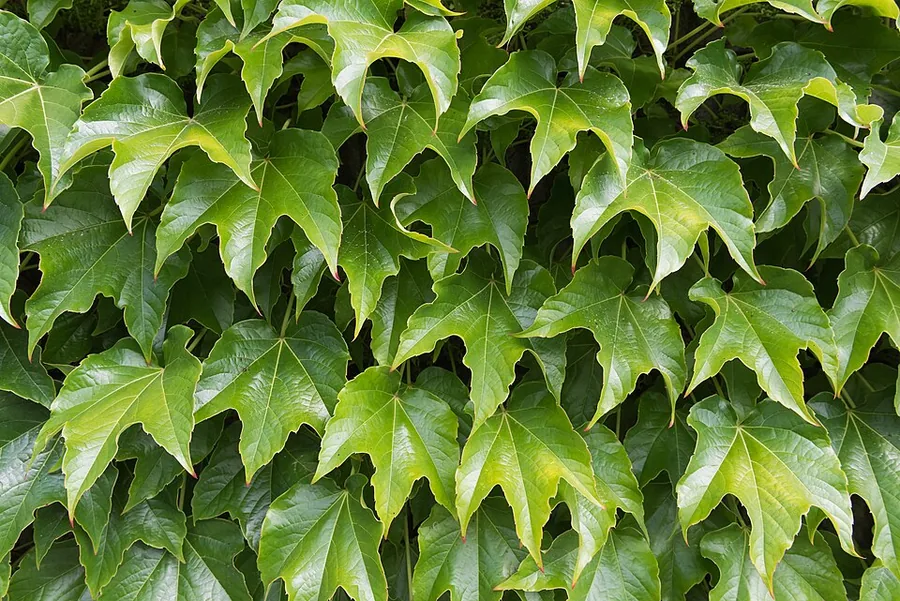
Boston ivy produces the familiar curtains of green that turn deep crimson-red to purple as autumn temperatures drop and chlorophyll breaks down. It is a member of the grape family rather than the true ivies, and its native range lies in eastern Asia. The species is durable and fast growing, hardy through cold to USDA zone 4 and tolerant of heat approaching 100°F (38°C), which is why it succeeds across a wide climatic band.
Its climbing habit is the defining trait. Rather than twining, it anchors with adhesive disk-tipped holdfasts that secrete a cement-like bond onto almost any substrate, allowing a single plant to cover an entire wall unaided. That same adhesion is the liability: because the bond penetrates paint, shingles, and mortar, it cannot be removed cleanly, so the vine belongs on masonry, stone, a fence, or a trellis rather than wood siding.
After establishment the plant needs little intervention. It performs in full sun or deep shade, draws minimal water once its roots are set, and requires almost no supplemental feeding. The principal task is restraining its vigorous growth with an annual hard prune so the canopy stays clear of windows, gutters, and roofing.
Care
The short version: site it in average, well-drained soil in sun or shade, water it through the establishment season and rarely afterward, and prune it hard each late winter so its fast growth stays clear of walls and roof.
Light
Boston ivy adapts to the full light gradient, from full sun to full shade. Sun drives the most intense fall color because higher light supports the pigment production behind it, whereas deep shade still lets the vine fill in but yields a more muted autumn display.
Water
Irrigate young plants through establishment, letting the top half of the soil dry between waterings to encourage deep rooting. Once established the vine is very drought tolerant and adapts to most conditions, so a thorough soak every 7 to 14 days suffices during dry weather.
Soil
Almost any well-drained soil serves, including clay, sandy, and rocky ground, because the species is not particular about texture. It tolerates a broad pH range from 5.5 to 7.5, part of the reason it establishes across so many sites.
Temperature
This is a genuinely hardy vine, enduring cold to -29°F (-34°C) and heat to 100°F (38°C). That tolerance covers USDA zones 4 through 8 without supplemental protection.
Humidity
Ambient outdoor humidity suits it, so no measurement is warranted. Air movement matters more than atmospheric moisture, since stagnant air around crowded growth is what favors leaf spot and mildew.
Feeding
Supplemental feeding is rarely warranted because the vine is already vigorous and draws what it needs from average soil. Should growth lag, a single balanced general-purpose feed in spring meets the requirement.
Pruning
Apply a hard prune in late winter or early spring to manage the fast growth before the season's flush. Cut the canopy back from windows, gutters, roofs, and wood siding while the plant is still dormant.
Repotting
Most plants are grown directly in the ground rather than containers. For a container specimen, repot every 2 to 3 years, or sooner once roots circle the pot, growth stalls, or water runs straight through.
Size & spacing
Given adequate support, it attains 30 to 50 feet (9 to 15 m) in height and spreads 5 to 10 feet (1.5 to 3 m) wide. Account for that mature reach and the structure it will cover when siting the plant.
When to plant
As a woody, perennial vine, Boston ivy carries no seed-starting urgency. Plant young specimens in spring or fall while the soil remains workable, allow the vine to fill its support over successive seasons, and expect inconspicuous June-to-July flowers ahead of the crimson-to-purple foliage that develops in autumn.
Northern hemisphere
Southern hemisphere
Typical months for a temperate climate: start earlier in warm zones, later where spring frosts linger.
- Plant: Spring or fall
- Harvest: June to July (flowers inconspicuous); brilliant crimson-red to purple fall foliage
Hardiness
USDA hardiness zones: 4–8
Temperature: down to -34°C
Troubleshooting
Nearly all problems with Boston ivy trace to one of two systems: the structure it grips or the foliage it carries. Reading the early indicators lets you redirect the vine or treat the foliage before damage advances. Match your observation below, then intervene while the action still changes the outcome.
Adhesive holdfasts lifting paint and shingles from the wall
The vine attaches with adhesive disk-tipped holdfasts that form a permanent bond, which is why removal pulls paint with it and leaves residue on the surface. Because the canopy is dense, it holds moisture against the wall and forces growth into seams, where it works under shingles and into mortar joints. Direct it onto masonry, a rock wall, a fence, or a sturdy trellis, and when removal is necessary, sever the stems at the base so the holdfasts desiccate and lose their grip before you lift them.
Fix:
- Do not grow on wood, shingle, or painted surfaces; redirect onto masonry, rock walls, fences, or sturdy trellises
- Cut vines at the base and allow holdfasts to dry and weaken before gentle removal
- Scrape or sand off remaining residue and refinish damaged surfaces
Foliar spotting, powdery film, and chewing damage
Stagnant air around crowded, humid growth is what lets fungal leaf spot and powdery mildew establish, producing the dark lesions and white surface film you see on the leaves. The skeletonizing comes from Japanese beetles, scale, and leafhoppers, which feed on the foliage through the warm months. Opening the planting restores airflow that suppresses the fungi, base watering keeps spores from spreading on wet leaves, hand removal thins the beetles, and horticultural oil smothers persistent scale.
Fix:
- Improve air circulation and avoid overhead watering to reduce fungal disease
- Hand-pick Japanese beetles and treat scale or heavy infestations with horticultural oil or an appropriate insecticide
- Remove and dispose of heavily diseased foliage
Toxicity
This is not a plant to ingest. Both the foliage and the blue-black berries contain insoluble calcium oxalate crystals and oxalic acid, compounds whose needle-like crystals mechanically irritate the mouth and inflame the gut. Keep pets, livestock, and children from chewing the leaves or eating the berries, which carry the higher concentration of risk.
Toxic to
Cats · Dogs · Horses · Rabbits · Livestock · Birds · People
Cats Mild
The insoluble oxalate crystals penetrate the oral lining the instant a cat bites a leaf or berry, which explains the immediate drooling and face pawing, followed by an irritated stomach with vomiting or loose stool.
Dogs Mild
In a dog, chewing the foliage or berries triggers drooling and a refusal to eat as the crystals irritate the mouth, and the gut irritation usually surfaces as vomiting or diarrhea shortly after.
Horses Mild
The same crystals abrade a horse's mouth and digestive tract, so grazing the vine brings on drooling, oral discomfort, and the dull, off-feed appearance that signals gut irritation.
Rabbits Mild
Keep it out of reach, because the oxalates inflame a rabbit's sensitive mouth and gut, leaving the animal drooling, reluctant to eat, and contending with a sore digestive tract.
Livestock Mild
Cattle, goats, and sheep seldom select it, yet a mouthful of leaves or berries delivers enough oxalate to irritate the mouth and gut, producing salivation and a loss of appetite.
Birds Caution
The blue-black berries concentrate the greatest risk, so treat the plant as one to keep caged birds away from rather than an acceptable browse.
People Caution
No part of this plant is edible. Ingesting leaves or berries irritates the mouth and stomach through the oxalate content, so keep curious children away from the foliage and fruit.
Keep pets and children from chewing the foliage or eating the berries, which are the higher-risk part.
Helpline numbers

United States
ASPCA Animal Poison Control: (888) 426-4435 (fee applies)
Poison Control: (800) 222-1222



Canada
Poison Centres: 1-844-764-7669
Varieties
Several named selections substitute distinct leaf forms and colors for the standard green. The following are the ones encountered most often in the trade.
Veitchii
Bears smaller leaves that emerge purple to bronze in spring and develop red coloration in fall.
Fenway Park
Identified by golden chartreuse to lime-yellow foliage that resolves into a multicolored autumn display.
Lowii
Distinguished by small, curly, deeply lobed leaves that develop crimson color once fall arrives.
How to propagate
Boston ivy propagates readily, and three methods are available, each suited to a different combination of patience and season.
Stem cuttingsEasy
Softwood cuttings in early summer or hardwood cuttings in late fall to winter · 4 to 8 weeks to root
Cuttings give the fastest increase because they carry the parent's growth potential intact. Take softwood material in early summer or hardwood material from late fall into winter, and expect rooting in 4 to 8 weeks. A stem already in contact with the soil can be pinned and left to root in place, since the same adventitious response applies.
LayeringEasy
Spring through summer · Several weeks to a few months
Layering is the most reliable method here because the stem keeps drawing on the parent while it forms roots. Pin a low stem to the soil any time from spring through summer, and it roots over several weeks to a few months before you sever the connection. The maintained supply of water and nutrients is what makes the technique so dependable.
SeedModerate
Sow after cold stratification in late winter or spring · Several weeks to germinate
Seed demands more time because the embryo holds a dormancy that only cold will release. Clean the seed from the berries, apply a cold stratification period, then sow in late winter or spring and expect germination over several weeks. Without that chilling the seed simply will not break dormancy, so the cold treatment is non-negotiable.
Myths
Boston ivy is a true ivy.
The common name is a misnomer, because this species is no ivy. Boston ivy is classified in the grape family, Vitaceae, placing it taxonomically far nearer to grapes than to the true ivies of the genus Hedera.