Houseplant · Droseraceae
Venus Flytrap
Dionaea muscipula
Supply full sun, mineral-free water, and a cold winter dormancy, and Dionaea muscipula will capture its own prey for years.
Full sun
Every 1–3 days
USDA 7–10
2–5 in · 5–13 cm
Overview
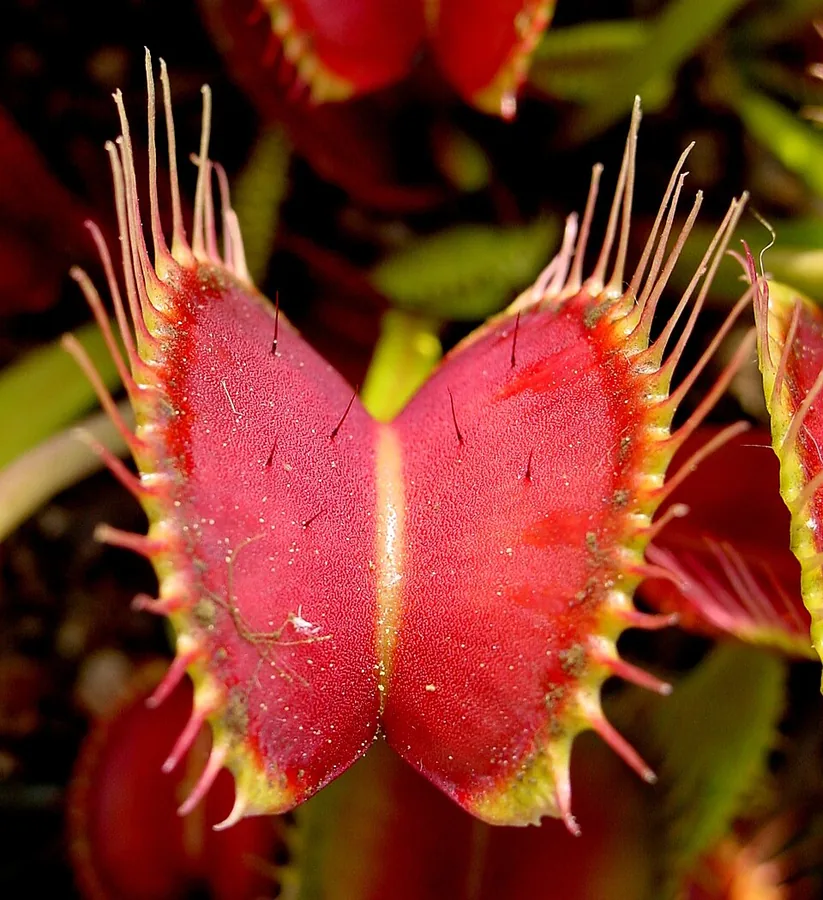
Dionaea muscipula is the familiar carnivore whose hinged traps close on a visiting insect. Its native ground is a narrow band of Carolina bog where the substrate is so nutrient-poor that trapping prey became the plant's route to nitrogen. That adaptation explains its reputation for difficulty, because the standard houseplant regimen of rich soil and mineral water works directly against a species built for lean, acidic conditions.
The plant is small, spanning only a few inches, and forms a low rosette of traps rather than an upright leafy stem. It is a true perennial but not a continuous grower. Active growth runs through spring and summer, followed by an obligatory cold rest, and denying that rest is the single most frequent cause of decline.
Meeting a short list of conditions carries the rest. Strong light, water free of dissolved minerals, a lean acidic medium, and an annual cold dormancy constitute the full requirement. Because the plant captures and digests its own prey, the most useful intervention is restraint, so the least handling produces the best results.
Care
The short version: give it full sun, water only with distilled, reverse-osmosis, or rainwater, grow it in a lean peat-and-sand mix, withhold all fertilizer and meat, and provide a cold dormancy of 3 to 4 months each winter.
Light
This species demands full, direct sun, at least 6 hours daily and preferably longer, because its compact form and red trap pigment develop only under high intensity. Under weak light the petioles elongate and the traps stay small and green, so a south-facing window or an outdoor position in summer serves far better than any shaded interior.
Water
Irrigate with only distilled, reverse-osmosis, or rainwater, never tap or bottled mineral water, since dissolved salts accumulate in the substrate and prove lethal to a plant adapted to mineral-poor bog. Stand the pot in a tray holding about 1 to 2 cm of water through the growing season to keep the medium evenly damp. During dormancy, reduce it so the mix stays barely moist rather than saturated.
Soil
Use a lean, acidic carnivorous medium of sphagnum peat with perlite or silica sand, with no added nutrients. Ordinary potting soil, compost, or any fertilized mix scorches the roots and induces rot, because the species cannot process that nutrient load. The correct blend registers a strongly acidic pH of 3.5 to 5.0.
Temperature
The plant tolerates a broad annual range, roughly 41°F to 95°F (5°C to 35°C). Summer warmth drives active growth, but a genuine cold interval in winter is physiologically required for rest, so maintaining warm conditions year-round is counterproductive.
Humidity
Average ambient humidity of 50% to 70% is adequate, and the permanently damp tray sustains sufficient moisture at the plant's surface. Misting and enclosure in a terrarium are unnecessary and can promote fungal growth.
Feeding
Apply no fertilizer at any point. The plant meets its nutrient demand by capturing insects, and soil fertilizer burns the roots and kills it. Trapped prey supplies everything the plant requires.
Pruning
Remove blackened or dead traps and spent leaves at the base with clean scissors to limit mold. On young or stressed specimens, also cut the tall flower stalk in spring, since flowering diverts energy the small rosette cannot afford.
Repotting
Repot every 1 to 2 years in early spring into fresh carnivorous medium. Do so when the rhizomes crowd the pot margin, the medium has decomposed and compacted, or multiple offsets have accumulated, and take the opportunity to divide.
Size & spacing
This is a diminutive plant, reaching only 2 to 5 inches (5 to 13 cm) in height with a comparable spread. A single specimen occupies one small pot, so spacing is relevant only when several are combined in a shared bog planter.
Troubleshooting
Nearly every disorder in this plant traces to one of four cultural errors: unsuitable water, inadequate light, an overly rich medium, or a missing dormancy. The diagnostics below distinguish among them by their characteristic signs. Corrected early, the plant generally recovers fully.
Abrupt collapse and a softening, decaying rhizome
A rotting rhizome, soft and brown on inspection, almost always follows planting in ordinary soil or exposure to fertilizer, both of which overload a plant adapted to nutrient-poor ground. Repot without delay into a lean sphagnum peat and perlite or sand mix, excise the decayed tissue, and return to mineral-free water. Firm white rhizome tissue that survives retains the capacity to regenerate.
Fix:
- Repot into nutrient-poor sphagnum peat and perlite/sand mix
- Resume mineral-free water only
- Remove rotted tissue; healthy white rhizome may still regrow
Progressive multi-year decline ending in death
A specimen held warm and in active growth year-round declines because it is denied the winter dormancy its temperate origin demands. Supply a cold rest of 3 to 4 months at roughly 35°F to 50°F (2°C to 10°C) with reduced light and water. In mild zones the dormancy can run outdoors; in colder climates an unheated space or a refrigerator delivers the required chilling.
Fix:
- Provide a 3-4 month cold dormancy at roughly 2-10°C (35-50°F) with reduced light and watering
- Overwinter outdoors in mild zones or in an unheated cold space/refrigerator in colder climates
Blackened traps and dieback through the foliage
The leading cause is salt accumulation in the media from tap or bottled water, which the roots cannot tolerate and which shows as a whitish crust alongside weak new leaves. Change to distilled, reverse-osmosis, or rainwater and leach the pot to carry the dissolved salts out. Set this apart from ordinary senescence, where a few older traps blacken because each one dies after several catches while the plant otherwise grows well.
Fix:
- Switch immediately to distilled, reverse-osmosis, or rainwater
- Flush the media with mineral-free water to leach out salts
- Trim off fully blackened traps at the base
- Stop hand-feeding and let the plant catch its own insects
Etiolated growth with undersized traps that seldom seal
This etiolation signals a light deficit, because a sun-demanding plant starved of intensity elongates its petioles and produces undersized traps that fail to develop the red interior pigment. Relocate it to full direct sun, a minimum of 6 hours daily. Harden it off across a week first, since tissue grown in low light scorches when moved abruptly into strong sun.
Fix:
- Move to full direct sun (a minimum of 6+ hours, ideally outdoors or a very bright sunny window/grow light)
- Acclimate gradually over a week to avoid scorch
Toxicity
The Venus flytrap poses no toxicity to people or animals. The ASPCA records it as non-toxic to cats and dogs, and the traps are structurally incapable of injuring anything larger than an insect. The only party at risk is the plant, which loses stored energy each time a trap is triggered without reason.
Safe for
People · Cats · Dogs · Horses · Rabbits · Livestock · Birds
Cats Safe
The ASPCA classifies the Venus flytrap as non-toxic to cats. The traps themselves close only on insect-scale prey and lack the size or force to pinch a paw or a probing nose.
Dogs Safe
No toxic compounds occur in the foliage or traps, so the plant is safe for dogs. A dog that investigates it by mouth may trigger a closing trap, a harmless reflex that causes no injury.
Horses Safe
The species contains no toxins, so an accidental mouthful presents no hazard to a horse. A bog plant only a few inches across also falls well outside anything a horse would graze.
Rabbits Safe
A flytrap holds nothing that would poison a rabbit, and its traps are too insubstantial to cause harm. The practical concern is the reverse, since a rabbit can quickly strip a slow-growing specimen.
Livestock Safe
Cattle, goats, and sheep face no risk of poisoning from this plant. It is a horticultural curiosity with no place in forage rather than a pasture hazard.
Birds Safe
Birds encounter no danger from a flytrap. The trapping mechanism responds to insects rather than feathers, and no part of the plant is toxic.
People Safe
The plant is safe to handle for adults and children alike. A trap closing on a fingertip exerts only a light pressure that cannot break skin, so the sole cost of triggering one deliberately is the energy the plant expends.
Touching the trigger hairs makes traps close; repeatedly poking traps for fun wastes the plant's energy and should be avoided.
Varieties
Beyond the wild green-and-red form, selection has produced cultivars distinguished by pigmentation, trap dimensions, and marginal tooth structure. Three are worth noting.
'Akai Ryu' (Red Dragon)
The pigment extends throughout the plant, giving a deep maroon-red across both foliage and traps rather than the standard green leaves with red-lined jaws.
'B52'
Selected for vigor, 'B52' develops some of the largest traps of any flytrap in cultivation.
'Dente'
The marginal projections on 'Dente' are short, triangular tooth-like spines, unlike the long bristle teeth typical of the species.
How to propagate
Three methods are available: dividing an established clump, rooting a leaf, or raising plants from seed. Division is the fastest and most dependable, while seed is the slowest and demands several years to maturity.
DivisionModerate
Early spring, during or just after dormancy when repotting · Several weeks to a few months
Division is the most reliable method, best performed in early spring, during or just after dormancy while the plant is already out of its pot for repotting. Separate the offsets so each retains its own roots and growing point, then set them into carnivorous mix. Establishment follows over several weeks to a few months.
Leaf cuttingsModerate
Spring to early summer during active growth · About 1-3 months for plantlets to form
Leaf cuttings work best in spring or early summer during vigorous growth. Detach a whole leaf together with a portion of the white rhizome base, lay it flat against damp media, and hold it in bright light. Plantlets differentiate from the base over roughly 1 to 3 months.
SeedDemanding
Sow after cold-moist stratification in late winter to spring · 3-5 years to reach mature size
Seed is the slowest route and the least practical for most growers. Sow in late winter or spring following a cold-moist stratification that breaks seed dormancy. Germination is dependable, but the seedlings need 3 to 5 years to reach full trap size, which is why division is usually preferred.
Myths
A flytrap should be fed scraps of raw meat such as beef or poultry.
Mammalian meat is too fatty and rich for a flytrap to process, so it putrefies within the trap and blackens it. The plant is adapted to digest insects and spiders, prey it captures perfectly well on its own.
The flytrap is a tropical species requiring year-round warmth.
The species is not tropical but a temperate bog plant native to the Carolinas. It requires a cold winter dormancy of 3 to 4 months to persist beyond a season or two.
Ordinary tap water is suitable for irrigating a flytrap.
The minerals and salts carried by tap and bottled water accumulate in the media and progressively poison the roots. Use only distilled, reverse-osmosis, or rainwater, and nothing else.
A flytrap requires regular manual feeding to survive.
Under full sun a flytrap photosynthesizes and captures ample insects without intervention. Hand-feeding is optional and never required, and excessive triggering only exhausts the traps.