Houseplant · Droseraceae
Cape Sundew
Drosera capensis
Give it bright sun and mineral-free water, and Drosera capensis holds its glistening, insect-catching dew through the year.
Full sun
Every 1–3 days
41–86°F · 5–30°C
180–365 days
Overview
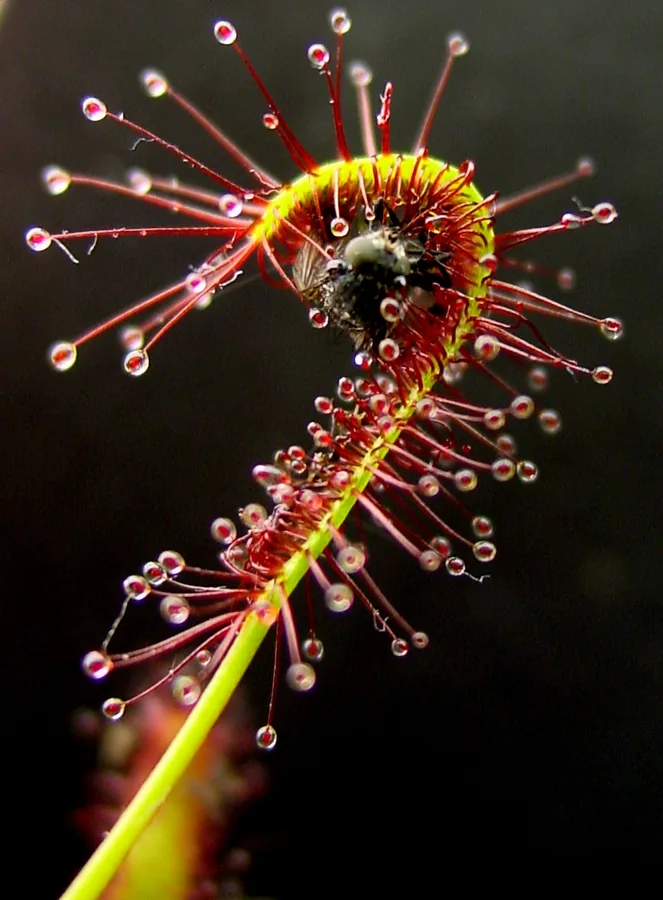
Drosera capensis is a carnivorous perennial from the bogs of South Africa, and its trapping habit is a direct answer to poor ground: it supplements what the soil cannot give by digesting insects. Each leaf is edged with red dew-tipped tentacles that glisten like nectar, a lure that draws gnats and flies onto mucilage where they stick and break down over time. The species sits in the family Droseraceae and keeps a compact rosette only a few inches across.
The same adaptation explains its demands. Having evolved in nutrient-poor, acidic ground, its roots are tuned to lean conditions and cannot process the salts in ordinary potting soil or fertilizer, which scorch them. Irrigation follows the same logic: tap and mineral water deposit dissolved salts that accumulate in the mix and poison the plant, so distilled, reverse-osmosis, or rainwater is a requirement rather than a refinement.
Meet those two conditions and Drosera capensis is among the more tractable carnivorous plants in cultivation. It performs on a bright windowsill through all seasons, and the red pigment in its tentacles intensifies under strong light. It also self-seeds freely, so a single plant tends to yield a succession of seedlings.
Care
The short version: supply the strongest light available to drive red coloration and compact growth, keep the pot standing in mineral-free water so the peat mix stays saturated, and never fertilize the roots or use anything but distilled, RO, or rainwater.
Light
Position it in the brightest location available, ideally several hours of direct sun on a south-facing sill. Light intensity governs two things at once here: it drives the red pigmentation of the tentacles and keeps internodes short so the rosette stays compact, while insufficient light produces pale, etiolated growth. A strong grow light substitutes effectively where window light is limited.
Water
Water quality is the decisive cultural factor. Use only distilled, reverse-osmosis, or rainwater, because dissolved salts in tap and mineral water accumulate in the medium and are lethal to carnivorous plants. Stand the pot in a tray holding 1 to 3 cm of that mineral-free water to keep the peat mix continuously saturated, reducing the standing level only slightly in winter and never allowing it to dry.
Soil
Grow it in a lean, acidic carnivorous medium, roughly equal parts peat moss or live sphagnum with sand or perlite, held at a pH of 4.0 to 5.5. Standard potting soil, compost, and any fertilized mix deliver a nutrient load the roots cannot tolerate and will burn them.
Temperature
The species tolerates a broad thermal range, roughly 41°F to 86°F (5°C to 30°C). Ordinary room temperature suits it year-round, and unlike temperate carnivorous plants it does not require a cold winter dormancy to remain healthy.
Humidity
It favors elevated humidity in the range of 50% to 80%, which the standing water tray helps maintain at the leaf surface. It adapts to average indoor air better than most carnivorous plants, though markedly dry air suppresses mucilage output and dulls the dew.
Feeding
Do not fertilize the medium. The roots are adapted to nutrient-poor bogs and root feeding scorches them, so the plant meets its nitrogen demand instead by digesting the gnats and flies captured on its dew. Under indoor conditions it generally traps sufficient prey without supplementation.
Pruning
Maintenance pruning is minimal. Cut away fully blackened or dead leaves and spent flower stalks at the base with clean scissors to keep the plant presentable. Leave the mucilage intact, since it is the functional trapping surface and wiping it off disables prey capture.
Repotting
Repot every 1 to 2 years, preferably in spring, into fresh carnivorous mix as the medium decomposes and its structure fails. Advance the schedule when roots circle or exit the pot, multiple rosettes crowd the container, or the old mix has broken down and stays waterlogged.
Size & spacing
This is a small plant. Mature height reaches only 2 to 14 inches (5 to 35 cm), with a spread of 3 to 6 inches (8 to 15 cm), so a single specimen occupies little bench or sill space and accommodates easily in bright indoor positions.
Troubleshooting
Nearly every disorder in this species reduces to one of two inputs: water quality or light. The leaves record both, so a quick read of new growth usually identifies the cause. Match the symptom below and correct the underlying condition before it compounds.
Tentacles stop secreting mucilage
When the tentacles run dry and dull, the cause is usually the wrong water, since the salts in tap and mineral water accumulate in the medium and poison a carnivorous plant. Low light or very dry air can also suppress mucilage secretion. Change to distilled, reverse-osmosis, or rainwater, flush the medium to leach out the accumulated salts, then raise light and humidity so newly formed leaves resume glistening.
Fix:
- Switch immediately to distilled, RO, or rainwater
- Flush the mix with mineral-free water to leach out salts
- Move to brighter light and raise humidity
Leaves blacken and die back
Blackening most often reflects mineral accumulation from improper water, although transplant shock and the plant's normal leaf turnover produce the same look. The diagnostic is distribution: if only older leaves blacken while new growth emerges healthy, the loss is routine senescence. Correct the water source, remove the dead tissue at the base, and hold stable wet, bright conditions through recovery.
Fix:
- Correct the water source to mineral-free water
- Remove blackened leaves at the base
- Maintain stable wet conditions and bright light during recovery
Pale, drawn growth with fading red
Green, elongated growth is a clear sign of inadequate light. Under full sun the tentacles and leaf blades develop deep red pigment and the rosette stays tight; without it, the plant stretches and loses color. Relocate it to a sunnier window or under strong grow lights, increasing exposure over several days so the foliage acclimates without scorching.
Fix:
- Move to a sunnier window or add strong grow lights
- Acclimate gradually to avoid scorching
Toxicity
For households with pets or children, the record is clear: Drosera capensis is not toxic to anyone. The dew is a mucilage with no irritant compounds, so brief contact with skin or fur is harmless. The only practical hazard is the standing water tray, which a pet could overturn.
Safe for
People · Cats · Dogs · Horses · Rabbits · Livestock · Birds
Cats Safe
A cat that sniffs or nibbles a sundew is unharmed, as the plant contains no toxin. The mucilage may cling briefly to the whiskers, but it rinses away and causes no irritation.
Dogs Safe
A dog faces no toxic risk from this plant. Chewing a leaf yields nothing beyond a trace of harmless sticky residue on the muzzle.
Horses Safe
The plant holds no compound that would affect a horse, and its small stature makes it an improbable mouthful regardless.
Rabbits Safe
A rabbit is safe in the presence of a sundew. A nibbled leaf causes no poisoning, only an incidental smear of dew on the fur.
Livestock Safe
Goats, sheep, and cattle incur no risk from the plant. The dew is adhesive rather than toxic, and the diminutive rosette offers negligible forage.
Birds Safe
Birds are unaffected by a sundew. The glistening tentacles function to trap gnats and flies and pose no threat to anything larger.
People Safe
The plant is safe to handle, and the dew is a simple mucilage that wipes from the skin. It should remain on the leaves, however, since it is the mechanism by which the plant feeds.
The dew is a harmless sticky mucilage; it may briefly cling to skin or fur but causes no irritation. Avoid wiping it off the plant, as it is the trapping mechanism.
Varieties
Drosera capensis is offered in a small set of readily available forms that differ mainly in leaf dimensions and pigmentation. The three below are the ones most often grown.
Drosera capensis 'Typical'
The most widely cultivated form bears narrow green strap-like leaves tipped with red dew, and its undemanding nature makes it the usual entry point for growers.
Drosera capensis 'Alba'
This all-green form has lost its red pigment entirely, so the tentacles stay pale and the flowers open white.
Drosera capensis 'Red'/'Wide Leaf'
Grown under bright light, this form develops broader leaves flushed a strong, uniform red across the entire blade.
How to propagate
Drosera capensis propagates with unusual ease by three routes, reflecting its vigor: leaf cuttings, its abundant self-set seed, and division of an established clump. Each works reliably during active growth.
Leaf cuttingsEasy
Spring to summer during active growth · 4-10 weeks for plantlets to form, several months to reach size
Leaf cuttings taken in spring or summer, during active growth, root readily. Lay a healthy leaf on damp mineral-free carnivorous mix or float it on mineral-free water, and adventitious plantlets differentiate along the lamina within 4 to 10 weeks, then require several further months to reach full size.
SeedEasy
Spring; surface-sow on damp peat mix in light · 2-6 weeks to germinate, several months to a mature rosette
Because Drosera capensis self-pollinates and sets seed abundantly, seed is the simplest method. Surface-sow on damp peat mix in spring and leave it exposed, since the seed is light-dependent for germination. Emergence takes 2 to 6 weeks without stratification, followed by a mature rosette a few months later.
DivisionEasy
Spring at repotting · A few weeks to re-establish
An established clump can be divided at the spring repotting. Separate the offset rosettes with their root systems intact, pot each in fresh carnivorous mix, and they re-establish within a few weeks.
Myths
Sundews must be hand-fed insects or they will starve.
A sundew photosynthesizes its own carbohydrate like any green plant and captures ample small prey unaided; the insects supply nitrogen, not energy. Feeding it by hand is optional, never a requirement, and an indoor specimen typically traps all the gnats it needs.
You should mist or wipe the leaves to remove the sticky dew.
The dew is the plant's prey-trapping mucilage, so removing it disables the very organ that feeds the plant. Misting with tap water does double harm, because it also deposits the salts that poison carnivorous plants.
Carnivorous plants need rich soil and fertilizer to thrive.
Sundews are adapted to nutrient-poor, acidic bogs, and their roots have no capacity for a high nutrient load. Ordinary soil and fertilizer burn the roots and kill the plant, which is precisely why a lean peat-and-sand medium is the only safe substrate.