Houseplant · Araliaceae
Umbrella Tree
Heptapleurum arboricola
Meet its two core needs, bright indirect light and a dry-down between waterings, and this Schefflera holds up well as an indoor plant.
Bright indirect
USDA 10–12
3–8 ft · 0.9–2.4 m
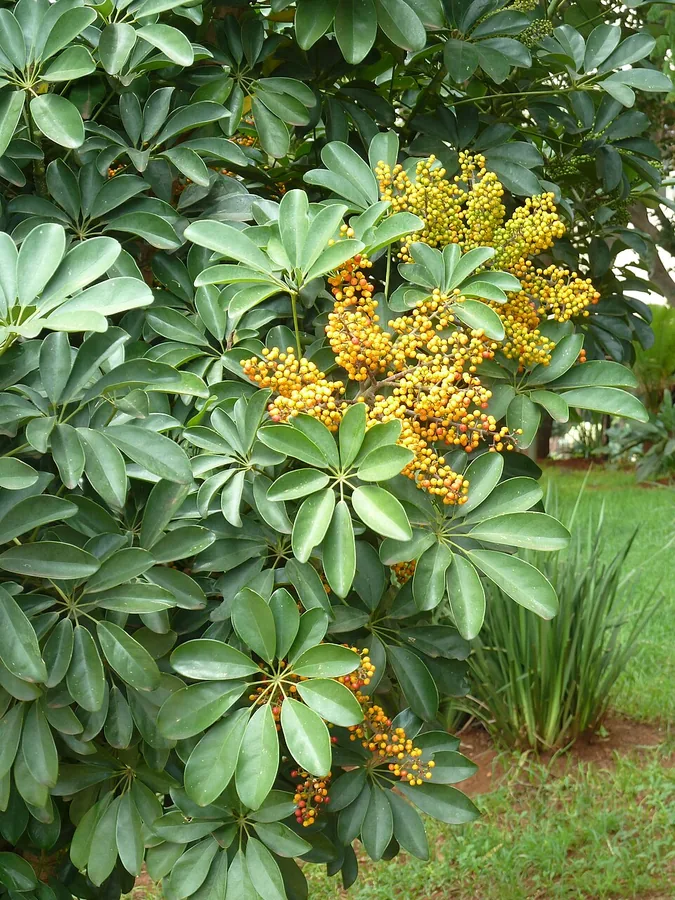
Overview
The common name traces to the leaf arrangement: leaflets radiate palmately from a single stalk, echoing the ribs of an umbrella. A member of the ivy family, Araliaceae, it originates in Taiwan and Hainan, where it develops into a shrub or modest tree. Under interior conditions it stays compact while retaining the glossy, palmate starry leaflets that define it.
Its reputation for easy culture rests on real tolerance. It accepts a broad light range, withstands an occasional lapse in watering, and responds well to hard pruning, so a grower can maintain a bushy form or train a mature specimen into a small indoor tree. The critical limit is drainage: standing water at the roots is the single most reliable way to kill it.
One horticultural caveat separates it from a truly carefree subject. All tissues contain insoluble calcium oxalate crystals, the toxic principle typical of the Araliaceae, which makes the plant toxic to cats and dogs and inedible to people. Site it beyond the reach of pets and young children, and it performs reliably for years.
Care
The short version: provide bright indirect light, water only after the top half of the soil has dried, and maintain temperatures above 60°F (15.6°C). Avoid a waterlogged saucer, prune to shape, and the canopy stays dense and green.
Light
Supply bright indirect light, roughly the curtain-filtered exposure of an east, west, or south window for a few hours daily. It tolerates partial shade, but insufficient light drives etiolation, producing weak, elongated stems, whereas strong direct sun scorches the foliage.
Water
Irrigate thoroughly, then withhold water until the top half of the profile has dried. Persistent saturation is the principal hazard, so drain the saucer after each watering. From fall into late winter the plant's uptake falls sharply, so reduce frequency accordingly.
Soil
Use a peaty, well-drained potting medium high in organic matter, in a container with functional drainage. The species is not pH-sensitive, performing across a range of 6.0 to 8.0, and adapts to clay, loam, or sandy substrates.
Temperature
Hold the plant above 60°F (15.6°C) in a thermally stable position, clear of cold drafts, vents, and air conditioning. Chilling disrupts the foliage and is a frequent trigger for leaf abscission.
Humidity
Average indoor humidity is adequate, so no specific target applies. During dry, heated winters the low humidity dries the leaf margins, so a wet-pebble tray or periodic misting checks the browning of leaf tips.
Feeding
Fertilize through the growing season, spring into summer, applying a water-soluble or time-release houseplant product at the labeled rate. Reduce feeding when low light slows growth and nutrient demand drops.
Pruning
The plant sustains hard pruning without harm. Cut immediately above a leaf to restrain size and stimulate branching, and over successive seasons a mature specimen can be trained into a small tree. Because the sap can irritate skin, wear gloves.
Repotting
Repot a root-filled or growth-stalled plant in any season, shifting it into a marginally larger pot of general-purpose medium. There is no urgency; the species performs well somewhat pot-bound.
Size & spacing
Indoors, mature height runs 3 to 8 feet (91 to 244 cm) with a spread of 4 to 8 feet (122 to 244 cm). Allow lateral room for the canopy to develop, and prune to contain it where space is limited.
Troubleshooting
The overwhelming majority of umbrella tree disorders stem from watering, light, or humidity, and the foliage registers the fault early. Interpret the leaves and stems, locate the matching case below, and correct the underlying cause before it advances.
Wilting and yellowing over saturated soil
Wilting despite wet soil points to root rot, an oxygen-starved root system compromised by overwatering or impeded drainage. Remove the plant, excise the brown, softened, malodorous roots, and repot into fresh, free-draining medium in a container with drainage holes. Thereafter let the top half of the soil dry and keep the saucer clear.
Fix:
- Allow the soil to dry appropriately between waterings
- Repot into fresh, well-drained potting mix and a pot with drainage holes
- Remove rotted roots and badly affected growth
Progressive leaf drop
Leaf drop in an umbrella tree most often reflects an unstable water regime, alternating saturation and drought, though chilling and abrupt relocation contribute. Stabilize the routine, allow the top half of the soil to dry before rewatering, and hold the plant above 60°F (15.6°C) in one consistently lit position. Foliage generally regenerates once conditions stabilize.
Fix:
- Adjust watering so the top half of the soil dries before rewatering
- Move the plant away from cold drafts, vents and air conditioners
- Keep temperatures above about 15.6°C (60°F)
- Give the plant a stable spot in bright indirect light and avoid frequent moves
Stippled foliage with fine webbing
Stippled, dust-toned leaves bearing fine webbing on the undersides confirm spider mites, which proliferate in hot, dry conditions. Rinse the canopy, wipe the leaves with a damp sponge, and apply insecticidal soap or horticultural oil. Elevated humidity makes the environment less favorable to the mites.
Fix:
- Rinse foliage and wipe leaves with a damp sponge
- Treat with insecticidal soap or horticultural oil
- Raise humidity to discourage mites
Cottony masses, brown scale, and honeydew
Cottony deposits in the leaf axils identify mealybugs, and the brown, shell-like nodes along the stems identify scale, both frequently accompanied by sticky honeydew. Treat individual insects with an alcohol-charged cotton swab, follow with insecticidal soap or horticultural oil, isolate the plant, and repeat until no new colonies emerge.
Fix:
- Dab insects with a cotton swab dipped in alcohol
- Treat with insecticidal soap or horticultural oil
- Repeat treatments and isolate the plant until cleared
Deformed, scarred new growth
Distorted or scarred new leaves indicate aphids colonizing the soft tips or thrips abrading the surface. Dislodge aphids with a water spray, apply insecticidal soap or horticultural oil, and remove severely deformed tissue. Early intervention, before populations expand, limits the damage.
Fix:
- Rinse off aphids with water
- Treat with insecticidal soap or horticultural oil
- Remove heavily infested growth
Elongated stems with sparse, pale foliage
Elongated stems and chlorotic leaves indicate inadequate light and the etiolation it causes. Relocate the plant to a brighter window with curtain-filtered sun for a few hours daily, then prune the drawn stems just above a leaf to redirect growth into a denser, branched habit.
Fix:
- Move to a brighter spot with bright indirect light (an east, west or south window with curtain-filtered sun for 3-4 hours daily)
- Prune leggy stems just above a leaf to encourage bushier regrowth
Marginal leaf browning in dry air
Browning tips and sporadic leaf loss usually signal low humidity, most pronounced in winter when heating dries indoor air. Set the container on a tray of wet pebbles with the base above the waterline, and mist the foliage or cluster the plant with others to raise local humidity.
Fix:
- Raise humidity by setting the container on a tray of wet pebbles (pot not sitting in water)
- Mist the foliage or group with other plants
Toxicity
This is the toxic Schefflera, distinct from the unrelated umbrella pine. All plant tissue holds insoluble calcium oxalate crystals, which the ASPCA identifies as toxic to cats and dogs; on chewing, the crystals produce oral burning, drooling, and vomiting. No part is edible, and the sap can irritate skin, so keep the plant away from pets and children and glove up before pruning.
Toxic to
Cats · Dogs · Horses · Rabbits · Livestock · Birds · People
Cats Moderate
The ASPCA classifies this plant as toxic to cats. A bitten leaf releases crystals that burn the mouth at once, followed by pronounced drooling, pawing at the muzzle, vomiting, and impaired swallowing.
Dogs Moderate
In dogs the response mirrors the ASPCA's feline listing. Chewing any portion inflames the mouth and tongue and provokes drooling and vomiting, all attributable to the same sharp oxalate crystals.
Horses Caution
The plant is not a conventional pasture hazard, yet the calcium oxalate crystals would irritate a grazing horse's mouth and can induce drooling. Position it well beyond reach as a precaution.
Rabbits Caution
A rabbit should not be permitted to browse it. The same irritant crystals inflame the mouth and disturb the digestive tract, so it must not be offered or left accessible.
Livestock Caution
Goats, sheep, and cattle would experience the oral burning and gastric upset the oxalate crystals cause. Encounters with the plant are rare on the farm, but it warrants exclusion regardless.
Birds Caution
A bird that samples a leaf can sustain oral irritation and burning from the crystals. Keep companion birds away from the foliage.
People Caution
No part of the plant is edible. Chewing inflames the mouth and throat, and the sap can leave sensitive skin irritated, so wear gloves when pruning and keep the leaves from small children.
The sap can irritate sensitive skin; wear gloves when pruning or handling
Helpline numbers

United States
ASPCA Animal Poison Control: (888) 426-4435 (fee applies)
Poison Control: (800) 222-1222



Canada
Poison Centres: 1-844-764-7669
Varieties
The dwarf form dominates the houseplant trade, and the named cultivars below are distinguished chiefly by their variegation or by a more compact growth habit.
'Gold Capella'
A gold-variegated selection of the dwarf umbrella tree, its leaflets splashed and margined in yellow.
'Trinette'
A widely grown variegated dwarf umbrella tree bearing leaflets marbled in creamy yellow and green.
'Variegata'
A variegated clone retaining the characteristic starry leaves, here marked in pale and deep green.
'Compacta'
A denser, slower-growing dwarf umbrella tree that remains shorter and more compact, suited to confined spaces.
How to propagate
Umbrella trees propagate readily, and the appropriate method depends largely on the source material you have to work with.
Stem cuttingsEasy
Spring to summer · Several weeks to root
The most dependable method. Take a tip or stem cutting in spring or summer, insert it into a moist potting medium, and roots typically form over several weeks. Maintain warmth and shield the cutting from direct sun during establishment.
Air layeringModerate
Spring to summer · Several weeks
An effective technique for reducing the height of a tall, leggy specimen. In spring or summer, wound the stem, enclose it in a moisture-retentive wrap, and after several weeks roots develop at the site, at which point the new plant is severed below them.
SeedModerate
When fresh seed is available · Slow
Feasible but slow. Sow fresh seed as it becomes available; germination and early development proceed gradually relative to a rooted cutting, so results demand patience.
Myths
The umbrella tree is safe to keep around cats and dogs.
The ASPCA classifies it as toxic to both species. Leaf and stem tissue is charged with sharp insoluble calcium oxalate crystals, so ingestion produces oral burning, copious drooling, and vomiting. Keep this plant out of reach of cats and dogs.
All umbrella trees behave identically when grown outdoors in warm regions.
The shared common name masks divergent regulatory status. Schefflera actinophylla, the larger umbrella tree, is a non-native species classified under Florida Invasive Species Council Category I, whereas Heptapleurum arboricola, the dwarf umbrella tree grown indoors, is naturalized yet carries no such invasive designation.