Houseplant · Araliaceae
English Ivy
Hedera helix
Shade-adapted, vigorous, and fast to fill a pot, English ivy trails or climbs wherever it is directed.
Bright indirect
50–70°F · 10–21°C
USDA 4–13
20–79 ft · 6–24 m
Overview
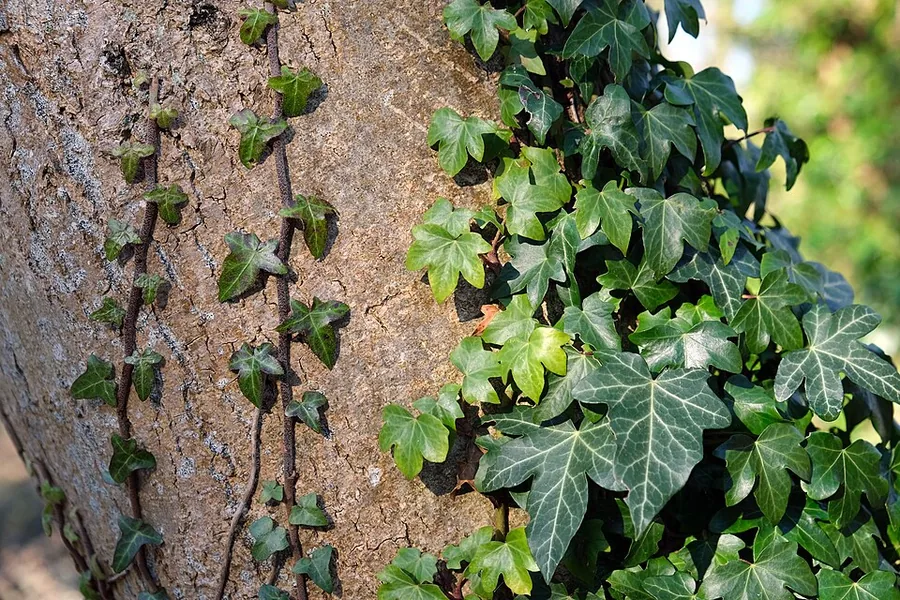
English ivy is the evergreen vine of the aralia family seen spilling from hanging baskets and ascending brick walls. Native to Europe, it has colonized woodland and old masonry there for centuries, which explains both its shade tolerance and its climbing habit. Confined to a pot indoors it stays manageable, producing long, leafy stems that drape from a shelf or wrap a trellis.
Its reputation for being easy rests on a wide tolerance range. Bright indirect light suits it best, but its woodland origins let it accept low light and partial shade, and a fast growth rate fills a pot within a season. The same plasticity is why it trains readily up a moss pole or into topiary and recovers quickly from hard pruning.
That vigor becomes a liability outside cultivation. English ivy is toxic to pets and an invasive weed across much of the US, where its dense growth overruns native plants and its aerial roots carry it into siding and gutters. Kept as a houseplant, off structures, and out of reach, it remains a handsome, low-maintenance subject.
Care
The short version: bright indirect light though it accepts shade, water only after the top half inch has dried, hold it cool with moderate humidity, and prune at will to manage its size.
Light
English ivy performs best in bright, indirect light, which sustains the contrast in variegated forms. Its woodland background lets it accept medium light, low light, and partial shade, so it holds up where less adaptable plants fail. Deep shade slows growth and dulls the variegation, since reduced light limits both photosynthesis and pigment expression, though it survives.
Water
Water thoroughly, then withhold until the top half inch (about 3 cm) of soil has dried, which lets oxygen back into the root zone. Standing water excludes that oxygen and induces root rot, so the pot should never sit in a filled saucer. Erring slightly dry is safer than keeping the medium saturated.
Soil
A quality houseplant mix with excellent drainage matters because chronic saturation is the principal cause of failure indoors. In the open ground its tolerance widens considerably, taking clay, loam, sand, and even rocky soils without difficulty.
Temperature
Ivy favors the cool range of 50°F to 70°F (10°C to 21°C), which most homes provide. Hot, stuffy rooms stress it and, by lowering relative humidity, create exactly the conditions in which spider mites proliferate.
Humidity
Average household humidity supports ivy adequately. A little added atmospheric moisture benefits it, and higher humidity suppresses spider mites, since the pests favor dry air, so a pebble tray or occasional misting earns its keep in heated winter rooms.
Feeding
Apply a foliage houseplant fertilizer monthly through active growth, when the plant can convert the nutrients into new tissue. Suspend feeding when growth slows in summer heat or cold, because a dormant plant cannot use the supply and surplus salts accumulate.
Pruning
Prune as hard and as often as needed, since ivy recovers quickly from cuts. Pinching and trimming maintains density and prevents legginess, and stems can be pinned to a trellis or topiary frame to direct the form.
Repotting
Ivy tolerates being slightly pot-bound, so repot only when it becomes top-heavy, fills the pot with roots, or dries out too fast after watering. Step up by no more than an inch in diameter, because excess unrooted mix stays wet and predisposes the roots to rot.
Size & spacing
Indoors the trailing stems are easily restrained, but unchecked outdoors the vine climbs from 20 to 80 feet (6 to 24 m) and spreads 3 to 49 feet (90 cm to 15 m). That potential reach is precisely what drives it into trees and structures and the reason it must be contained.
Troubleshooting
English ivy is durable, so most decline traces to one of two stress mechanisms. Dry indoor air both favors spider mites and draws moisture from the leaf margins, while outdoors cold sun and wind scorch the evergreen foliage. Match the symptom below and correct the underlying condition before the damage progresses.
Speckled, bleached leaves with faint webbing
That stippled, bleached look comes from spider mites piercing cells and draining their contents, and they are the dominant pest on indoor ivy. Warm, dry, low-humidity air lets their populations build fast, so tap a leaf over white paper and look for the moving specks that confirm them. A forceful water spray dislodges them, insecticidal soap on the undersides clears the rest, and cooler, more humid air keeps numbers down.
Fix:
- Spray plants forcefully with water, including leaf undersides, to dislodge mites
- Treat with insecticidal soap, repeating as needed
- Dunk foliage upside-down in an insecticidal soap solution to wash pests off
Browning, dried-out, or scorched leaves
On outdoor plants this points to winter scorch: cold sun and wind drive transpiration from the evergreen leaves faster than frozen or sluggish roots can resupply water, and the tissue dries out. Indoors the same water deficit shows up as edge browning when heated, low-humidity air and a too-dry rootball outpace uptake. Shelter outdoor plants from direct winter sun and wind, and indoors lift humidity with a wet pebble tray while keeping the soil from drying out completely.
Fix:
- Site plants out of harsh winter sun and drying wind
- Raise humidity with a wet pebble tray and avoid letting soil dry out completely
Toxicity
Site English ivy as a plant to keep away from animals and people rather than to share. All tissues contain triterpenoid saponins, the berries presenting the greatest ingestion risk, and the cell sap acts as a contact irritant. It is toxic to cats, dogs, horses, and other animals, and no part is edible, so position it clear of pets and children and use gloves for pruning.
Toxic to
Cats · Dogs · Horses · Rabbits · Livestock · Birds · People
Cats Moderate
In cats the saponins produce hypersalivation, vomiting, and diarrhea, frequently with abdominal pain. Because the foliage concentrates more toxin than the berries, leaf-chewing is the main route of exposure.
Dogs Moderate
Dogs that ingest the foliage show pronounced drooling, vomiting, and loose stools within a short window. Puppies that strip and swallow a length of trailing stem take in the largest dose and react most severely.
Horses Moderate
In the equine gut the saponins act as irritants, giving rise to salivation, colic-like pain, and loose manure. Excluding clippings and climbing stems from paddocks removes the exposure.
Rabbits Toxic
For rabbits neither foliage nor berries are safe, and ingestion leads to drooling, appetite loss, and gastrointestinal upset. No part should be offered as forage.
Livestock Toxic
In cattle, goats, and sheep the same saponins cause digestive disturbance and, with heavier intake, more serious effects. Removing ivy from pastures and fence lines before stock can browse it is the reliable control.
Birds Caution
Wild birds consume the ripe berries and disperse the seed without ill effect, yet the raw foliage carries the toxin, so pet birds warrant caution and cuttings should stay out of the cage.
People Caution
No part of ivy is edible, and the berries pose the greatest ingestion hazard, producing oral burning, vomiting, and cramping. The sap is a recognized contact dermatitis agent, which is why gloves are advised for pruning.
Wear gloves when pruning or removing ivy, as the cell sap can cause skin redness, itching and blisters.
Helpline numbers

United States
ASPCA Animal Poison Control: (888) 426-4435 (fee applies)
Poison Control: (800) 222-1222



Canada
Poison Centres: 1-844-764-7669
Varieties
Almost all ivy offered for indoor use is a named cultivar selected for leaf form or coloration, and a few are encountered repeatedly.
'Gold Child'
A cream-yellow to gold leaf margin carries enough reflectance to read in shade, where an all-green ivy would recede visually.
'Needlepoint'
Its narrow, bird's-foot lobing gives a fine-textured habit that responds well to the close clipping topiary work demands.
'Glacier'
Silvery-white variegation over a gray-green ground produces the cool, frosted coloration the cultivar is named for.
'Baltica'
Selected for cold hardiness and durability, it is the form most often used outdoors to stabilize soil and limit erosion on slopes.
How to propagate
English ivy propagates with little effort, rooting from cuttings held in water or by layering wherever a stem node contacts moist soil.
Stem cuttingsEasy
Any time during active growth · Roots typically form in a few weeks
Few houseplants root as readily as ivy from cuttings. Take a stem or tip cutting during active growth, when the tissue is primed to form adventitious roots, and stand it in water, where roots emerge within a few weeks. Once a small root cluster has developed, transfer the cutting to fresh potting mix.
LayeringEasy
During the growing season · Several weeks to a few months
Trailing stems root naturally at the nodes wherever they meet moist soil, the same mechanism that lets the plant spread as groundcover. Pin a stem to the soil during the growing season and leave it, and over the next several weeks to a few months it forms its own roots. Sever the rooted segment from the parent and relocate it as needed.
Myths
Only the berries are dangerous, so the leaves are safe to handle and have around pets.
Both organs contain the same triterpenoid saponins, and the ASPCA in fact rates the foliage as the more toxic part for animals that browse it. Berries carry the higher risk in a human ingestion, but no tissue of the plant qualifies as harmless.
English ivy is just a harmless ornamental groundcover.
It is in fact a documented invasive species through much of the US and a listed noxious weed in Oregon. Unchecked it outcompetes and smothers native vegetation and climbs into siding and gutters, so local regulations should be checked before planting.