Vegetable · Brassicaceae
Turnip
Brassica rapa subsp. rapa
Grown cool, watered evenly, and lifted young, the turnip converts a short season into crisp roots and abundant greens.
Full sun
Every 3–7 days
41–77°F · 5–25°C
40–60 days
Overview
Turnip is a cool-season root in the brassica family, sharing its lineage with cabbage and mustard. Long cultivated for both the enlarged root and the leafy tops, it earns its place by maturing fast on little input. A spring or late-summer sowing puts greens on the plate in about a month, with roots following soon after, because growth accelerates in the temperature band the plant prefers.
The species is a biennial by physiology, laying down reserves in the root through the first year and flowering in the second, yet gardeners crop it as a fast annual and lift it well before bolting. Root quality peaks when sizing occurs in cool weather, since warmth drives fibre and pungency rather than tender storage tissue, which is precisely why midsummer is the interval to design around. Placing sowings in the cool shoulders of the season aligns bulking with the conditions that keep the flesh mild.
Success rests on timing and thinning more than on any elaborate care. Given loose, evenly moist ground, the roots develop crisp and mild, whereas alternating drought and flooding, or leaving roots in warm soil past maturity, shifts the plant toward woody, sharp-flavored roots. The mechanism is simple: stress and heat during sizing coarsen the tissue and concentrate the compounds behind that sharp taste.
Care
The short version: full sun and loose, rock-free soil, with about an inch of water a week to hold moisture even and keep the flesh tender. Sow direct in cool weather, thin the seedlings so each root has room to size, and lift them young, before heat or a hard frost degrades quality.
Light
Turnip yields best in full sun and tolerates light partial shade. Foliage remains leafy under some shade, but the roots size faster and fuller under a long run of direct light, since photosynthesis drives the reserves stored in the root.
Water
Supply about 1 inch (2.5 cm) of water a week and keep it even, because consistent moisture is what holds the roots tender and mild. A swing from drought to a heavy soaking ruptures the sizing tissue and leaves roots pithy, cracked, or harsh-flavored.
Soil
Grow in loose, well-drained loam cleared of stones and free of fresh manure, both of which fork and scar the developing root. A pH of 6.0 to 7.5 suits the crop, and holding the ground near neutral also suppresses clubroot.
Temperature
This is a cool-weather crop performing best from about 41°F to 77°F (5°C to 25°C). Heat during sizing drives fibre and pungency, turning roots woody and sharp, so target sowings at spring and fall rather than midsummer.
Humidity
Ambient outdoor air meets the crop's needs, so no humidity target applies. Even soil moisture matters far more to root quality than any condition in the air.
Feeding
Incorporate a balanced granular feed such as 10-10-10 into the bed before sowing, guided by a soil test. Restrain nitrogen, because a surplus drives leafy top growth at the expense of the roots the crop is grown for.
Pruning
No pruning is required. Thin the seedlings to 3 to 6 inches (8 to 15 cm) apart once they stand a few inches tall, and pick the outer greens at 4 to 6 inches while leaving the growing point intact so the tops regenerate.
Size & spacing
Plants reach about 12 to 18 inches (30 to 45 cm) tall and 6 to 12 inches (15 to 30 cm) wide. Thin to 3 to 6 inches (8 to 15 cm) between plants in rows 18 to 30 inches (45 to 75 cm) apart so each root has the volume it needs to swell.
When to plant
Turnip is adapted to cool weather and stalls in heat, so timing governs the outcome. Direct-sow in early spring once the ground can be worked, then sow again in late summer for a fall crop. Lift the roots young, ahead of summer heat or a hard freeze, since a light fall frost only converts starch to sugar and sweetens them.
Northern hemisphere
Southern hemisphere
Typical months for a temperate climate: start earlier in warm zones, later where spring frosts linger.
- Plant: direct sow in early spring as soon as soil can be worked (around mid-April in the Upper Midwest), and again in late summer (around August 1) for a fall crop
- Harvest: harvest roots at about 2-3 inches in diameter before hot weather or hard freezes; flavor sweetens after light fall frost; greens harvestable at 4-6 inches tall
Hardiness
USDA hardiness zones: 2–9
Temperature: down to -46°C
Troubleshooting
Turnip problems concentrate on the foliage or in the root, and the brassica pests inflict the most damage on young seedlings whose small leaf area cannot absorb the loss. Identified early, most yield to a row cover or a shift in sowing date. Match the description below to what the plant shows, then act while the stand is still small.
Seedlings flagging and toppling above tunnel-riddled roots
A seedling that wilts and drops without an obvious cause has usually lost root function underground. Lift it and inspect for winding brown tunnels and small white legless larvae, the signature of the cabbage root maggot, whose parent fly lays eggs at the soil line; wireworms produce comparable galleries in ground recently converted from sod. Because no rescue is possible once the root is bored, destroy the affected plants, re-sow beneath a row cover sealed at the edges to block egg-laying, and stagger sowing dates so the crop clears the peak flight.
Fix:
- Remove and destroy infested plants and roots
- Re-sow under floating row cover sealed at the edges
- Delay or stagger sowing to miss peak fly egg-laying
Undersized, chlorotic plants over distorted club-shaped roots
Stunting, yellowing, and midday wilt signal that the root system can no longer move water, and lifting a plant confirms clubroot, caused by the soilborne organism Plasmodiophora brassicae. The pathogen forces the root into irregular club-like galls rather than a clean round bulb, so a diseased plant cannot recover and must be removed with its surrounding soil and kept out of the compost, where the resting spores would persist. Because those spores survive for years, halt brassica cropping in that bed and lime the soil toward neutral, since higher pH suppresses infection before the family returns.
Fix:
- Remove and discard infected plants with surrounding soil (do not compost)
- Stop growing brassicas in that bed for several years
- Raise soil pH toward neutral with lime before replanting brassicas
Pinhole pitting scattered over seedling foliage
The scatter of small round pits reads as feeding by flea beetles, shiny black insects that spring away when disturbed. Seedlings take the heaviest hit because their limited leaf area cannot absorb the loss, which is why spring and fall sowings suffer most. A floating row cover placed at sowing physically excludes the adults, steady water pushes fast growth that outpaces the injury, and clearing weedy mustards removes the alternate hosts that carry the population.
Fix:
- Cover new sowings with floating row cover at seeding
- Keep plants growing fast with steady water so they outgrow damage
- Remove nearby weedy mustards that host the beetles
Root flesh gone fibrous, spongy, or harshly pungent
A cut root that shows spongy white pith and stringy fiber in place of crisp dense flesh points to a physiological disorder, not a pathogen. This is heat and timing: roots that bulk in warm soil, sit past maturity, or endure a drought-then-deluge swing lay down coarse fiber and pungent flavor compounds instead of tender tissue. Harvest what remains at 2 to 3 inches (5 to 8 cm) across before quality slips further, cook any still-tender tops as greens, and schedule a late-summer sowing so the following roots mature under cool fall conditions.
Fix:
- Harvest remaining roots promptly at 2-3 inches diameter
- Use affected roots' tops as cooking greens if still tender
- Re-sow in late summer so roots mature in cool fall weather
Toxicity
Turnip is food through and through and safe for people and pets alike. Both root and greens are eaten with no special handling, and the plant carries no listing as toxic to cats or dogs. The lone qualification concerns grazing livestock, where weeks of heavy raw brassica forage can produce a mild goitrogenic effect that never arises at garden scale.
Safe for
People · Cats · Dogs · Horses · Rabbits · Livestock · Birds
Cats None
Turnip carries no toxin for cats, so a taste of cooked root or a scrap of green poses no risk. As obligate carnivores, most cats show little appetite for it.
Dogs None
Nothing in turnip harms dogs, and plain cooked root works as an occasional treat. Keep servings modest, since a large dose of any vegetable can loosen the stool.
Horses None
Horses can take both the root and the foliage without hazard. Slice large roots into pieces so a whole one cannot lodge in the throat.
Rabbits None
The leafy tops and a small portion of root suit rabbits with no toxicity concern. Add the greens gradually, as with any new fresh forage, to let the gut adjust.
Livestock None
Turnip roots and tops serve as sound, non-poisonous forage. The single qualification is sustained grazing, where weeks of heavy raw brassica intake can depress thyroid activity and cause mild bloat, an effect that does not surface at the volumes a home garden yields.
Birds None
Chickens and other backyard birds readily peck at turnip greens and chopped root, all of which is safe fare for them.
People None
Turnip is an edible crop from root to leaf. Roast or mash the roots and cook the greens as you would any cooking green, with no part requiring avoidance.
No special handling needed. Like other brassicas, very large raw quantities can cause gas, and goitrogenic compounds in brassica forage are mainly a concern for livestock grazed heavily on it, not for household pets or people eating normal amounts.
Varieties
Turnip cultivars fall into root types, greens types, and the fast salad turnips, each bred toward a different part of the plant. The following are the ones encountered most.
Purple Top White Globe
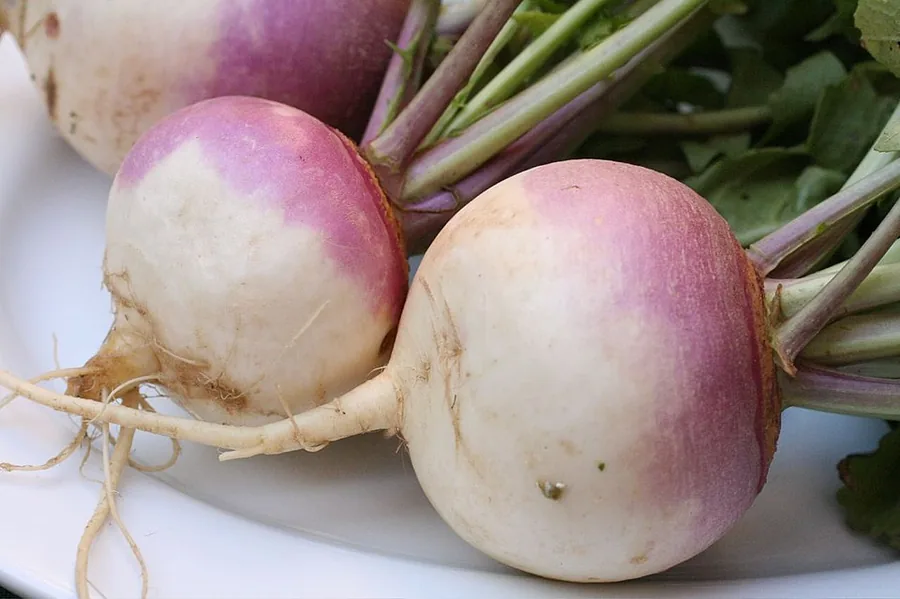
The standard heirloom of the garden, bearing round white roots that colour purple across the shoulders exposed to light, backed by dependable greens.
Hakurei
A fast salad turnip whose small, smooth white roots hold flavour mild and sweet enough to eat raw in a salad without cooking.
Golden Ball
A yellow-fleshed heirloom that reaches size in about 60 days and returns a mild, faintly sweet root for the longer wait.
Seven Top
Selected for a heavy yield of greens rather than a usable root, which stays small and woody and is best left unharvested in the soil.
Just Right
A hybrid that supplies greens in roughly 28 days and finished white roots near 60, so a single sowing delivers both crops.
Companions
Turnips do best next to cool-season plants that share their schedule without sharing their pests, and worst beside their own brassica cousins, which trade flea beetles, root maggots, and clubroot back and forth.
Plant near
peas: Cool-season legume sown on the same early-spring schedule; fixes nitrogen and does not compete heavily with the shallow turnip bed
onions: Alliums make compact, pest-light neighbors in the root bed and are not hosts for brassica pests
Keep apart
cabbage and other brassicas: Closely related cole crops share flea beetles, root maggots, and clubroot; clustering or rotating them in the same bed builds up these pests and diseases
How to propagate
Turnip is raised from seed sown in its final position, because the taproot resents transplanting and checks badly when moved. A packet of seed and a bed of loose soil are the whole requirement.
SeedEasy
Direct sow in early spring as soon as the soil can be worked, and again in late summer (around August 1) for a fall crop; turnips do not transplant well and succession sowings every 10 days extend harvest · Seedlings emerge in about 10 days; greens are cuttable in about 4 weeks and roots reach harvest size in roughly 40-60 days
Because a turnip forms its crop from a taproot that resents disturbance, direct-sow it where it will mature rather than transplanting. Set seed a quarter to half an inch (0.5 to 1 cm) deep, an inch or two apart, in rows 18 to 30 inches (45 to 75 cm) apart, then thin to 3 to 6 inches (8 to 15 cm) so each root has room to size, and use the thinnings as greens. Emergence follows in about 10 days, greens reach cutting size in roughly 4 weeks, and roots finish in 40 to 60 days. Repeating the sowing every 10 days spreads maturity and extends the harvest.
Myths
The turnip and the rutabaga are one identical crop sold under two different labels.
They are distinct species with different requirements. Turnip is Brassica rapa, forming quick, usually white-fleshed roots, whereas rutabaga is Brassica napus, forming larger yellow-fleshed roots that demand a longer season and wider spacing. Sow and space each according to its own crop, not as interchangeable ones.
Every turnip root must be lifted ahead of the very first frost or the crop is lost.
A light fall frost has the reverse effect and sweetens the roots as starches convert to sugars. Only a hard freeze damages roots held in the soil, so the correct threshold is to harvest ahead of a hard freeze rather than ahead of the first light one.
Turnips are only a fall crop.
As a cool-season crop, the turnip offers two sowing windows: early spring once the soil can be worked, and late summer for a fall harvest. The one interval to avoid is bulking the roots through the heat of midsummer, which degrades their texture and flavour.