Tree · Magnoliaceae
Tulip Tree
Liriodendron tulipifera
A fast, towering shade tree of the magnolia family that carries tulip-shaped flowers high in its canopy and colors gold in fall.
Full sun
Every 7–14 days
USDA 4–9
60–120 ft · 18.3–36.6 m
Overview
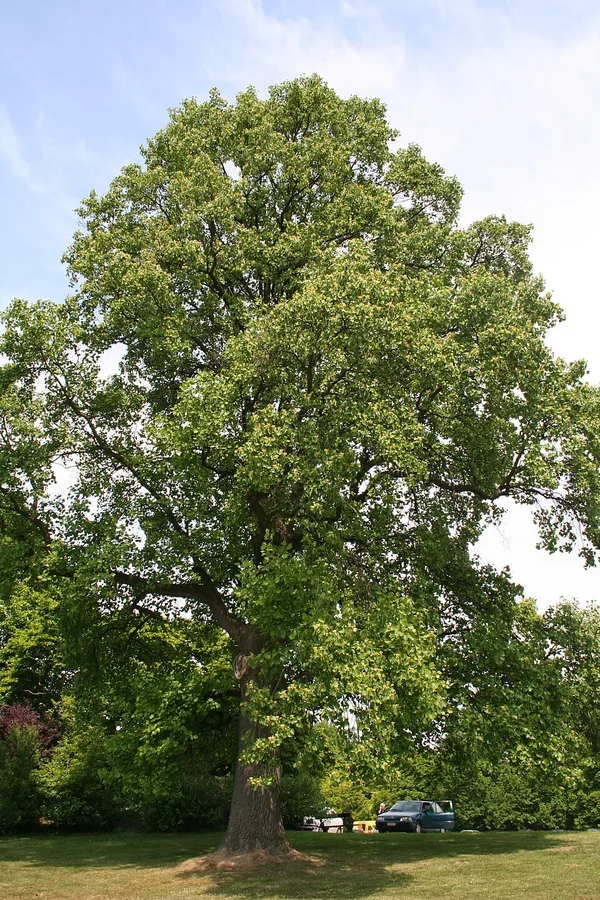
As one of the tallest hardwoods across eastern North America, the tulip tree is a member of the magnolia family, a lineage that explains both its early-summer flower and its non-poplar wood. Mature specimens reach 60 to 120 feet (18 to 37 m). The four-lobed leaf, notched into a shape close to a cat's silhouette, turns a clear yellow in autumn. In late spring the tree raises cup-shaped greenish-yellow flowers marked with an orange band, the structures that give it its common name, though their height in the canopy keeps them out of easy view.
The common names tulip poplar and yellow poplar mislead on two counts, since the tree is neither a poplar nor a true Tulipa tulip. Its fast, straight growth lays down soft, even-grained wood long prized for products from canoes to crates. That same rapid growth leaves the wood brittle, which is why limbs fail under wind, ice, or snow load.
Scale this tree to the site. A shallow root system paired with a crown that spreads 30 to 60 feet (9 to 18 m) means it performs best in open ground away from foundations, pavement, and confined beds, where roots can run and limbs clear structures. Supplied with space and deep, moist soil, it matures into a long-lived landmark that outlasts the person who planted it.
Care
The short version: site it in full sun, in deep, moist, fertile, slightly acidic soil, with generous open room for a very large tree. Water young trees through drought, prune the brittle wood in late winter to build sound structure, and keep it clear of anything a failing limb could strike.
Light
Site the tree in full sun, the light level that drives straight growth and reliable flowering; a young tree tolerates partial shade. Under heavy shade it stretches toward the light and the crown thins, so an open exposure repays the choice.
Water
Provide deep, moist, fertile soil, because the tree has limited drought tolerance. Under a hot, dry summer it responds by shedding its inner leaves and dropping foliage early, so water young and establishing trees deeply during dry spells. An established tree on good ground largely regulates itself.
Soil
Plant into deep, rich, well-drained loam with ample organic matter. The species favors mildly acidic ground, near a pH of 5.0 to 6.5, yet tolerates a wider range. It will not accept compacted or confined soil, since restricted rooting undercuts a tree that already roots shallowly, so avoid cramped or paved sites.
Temperature
The tree is markedly cold hardy, rated across USDA zones 4 to 9 and tolerant from roughly -29°F to 100°F (-34°C to 38°C). That envelope matches most of the temperate range it occupies as a native of eastern North America.
Humidity
Outdoors, ambient humidity tracks the weather, so it is not a variable you manage. The species grows through humid and drier regions alike, which tells you soil moisture governs its health far more than atmospheric moisture.
Feeding
On rich native soil the tree needs no supplemental feeding, since the site already supplies its nutrition. Where soil is poor, incorporate a balanced tree fertilizer in early spring; otherwise let the tree draw on the ground.
Pruning
Prune in late winter, removing dead, weak, or crossing limbs while the tree is dormant. Because the wood is brittle and fails readily, sound early structure is the main defense against limb breakage later. Keep cuts modest and correctly timed.
Repotting
Repotting does not apply here, as the tree is not a container subject. It grows in open ground as a large landscape and forest shade tree, so once established in its permanent position no repotting arises.
Size & spacing
Plan for a mature height of 60 to 120 feet (18 to 37 m) and a crown spread of 30 to 60 feet (9 to 18 m), and space accordingly. Set it well clear of buildings, power lines, and pavement, since a tree of this scale crowded into a tight site invites structural and rooting problems.
When to plant
Plant in spring or fall, once the soil is workable, allotting far more room than the young tree suggests it needs. Flowering follows in late spring, May into June, high in the canopy. Because growth is fast from the outset, correct siting outweighs any fine seasonal timing.
Northern hemisphere
Southern hemisphere
Typical months for a temperate climate: start earlier in warm zones, later where spring frosts linger.
- Plant: Spring or fall, after the soil can be worked; give ample room for a very large mature canopy.
- Harvest: Cup-shaped greenish-yellow flowers with an orange band bloom in late spring (May to June), often high in the canopy.
Hardiness
USDA hardiness zones: 4–9
Temperature: down to -34°C
Troubleshooting
Most tulip tree disorders register on the foliage, driven either by sap-feeding insects or by summer drought. Given the tree's size, much of that injury is cosmetic, but reading the early signs tells you whether intervention is warranted. Match the symptom below, then judge the response.
Sticky, sooty-black foliage with early leaf drop
This pattern traces to tuliptree scale or tuliptree aphid, sap feeders whose honeydew falls onto the leaves beneath and hosts black sooty mold. Manage scale with dormant oil in early spring, or treat the crawlers from mid-August into September; manage aphids with horticultural oil or insecticidal soap. Lady beetles and lacewings commonly suppress aphid numbers on their own by early summer.
Fix:
- Apply dormant horticultural oil in early spring to scale-infested twigs.
- Treat scale crawlers with an appropriate insecticide from mid-August through mid-September, or use a systemic soil application in early spring with adequate soil moisture.
- For aphids, use horticultural oil or insecticidal soap; natural enemies such as lady beetles, lacewings, and parasitoids often reduce aphid populations by early summer.
Crescent leaf notches with a scorched appearance
The agent is the yellowpoplar weevil, a small black beetle that cuts half-moon notches and drops motionless when a leaf is disturbed. On an established tree the injury is largely cosmetic and does not justify spraying. Sustain the tree with water through drought and reserve treatment for young or small trees under heavy pressure.
Fix:
- Damage is largely aesthetic on established trees; tolerate light feeding.
- Maintain tree vigor and adequate soil moisture so the tree can recover from heavy summer feeding.
- Treat only severe infestations on small or young trees following extension guidance.
Early yellowing and leaf fall in hot, dry weather
A tulip tree drops its older, inner leaves first under drought stress, so dry soil during a hot spell is the primary cause. Before assigning it to weather, examine the remaining foliage for honeydew, scale, and aphids, any of which can accelerate the yellowing. Water deeply and slowly through extended dry periods and mulch the root zone to conserve moisture, and the tree recovers.
Fix:
- Provide deep, slow watering during prolonged dry spells, especially for young trees.
- Mulch over the root zone to conserve soil moisture.
- Address any aphid or scale honeydew that is worsening leaf decline.
Toxicity
For pet owners the verdict is straightforward: the tulip tree is non-toxic. The ASPCA lists it as safe for dogs, cats, and horses, and its placement in the magnolia family, apart from the true Tulipa tulips, means it lacks the bulb toxins responsible for garden-tulip poisoning. No part of the tree warrants keeping pets, livestock, or children away.
Safe for
People · Cats · Dogs · Horses · Rabbits · Livestock · Birds
Cats None
Classified non-toxic to cats by the ASPCA, the tree poses no risk if a cat mouths a fallen leaf.
Dogs None
Dogs are unaffected. The tulip name notwithstanding, this is not a true tulip and contains none of the bulb toxins that make true tulips hazardous.
Horses None
Horses may graze near the tree without harm, since the ASPCA rates it non-toxic to them as well.
Rabbits Safe
The leaves and twigs of this magnolia relative present no danger to rabbits.
Livestock Safe
Cattle, goats, and sheep carry no known poisoning risk from browsing the foliage.
Birds Safe
Birds nest and forage in these trees without hazard, and the flowers, seeds, and bark are equally safe.
People Safe
The tree holds nothing toxic to people, though no part of it is cultivated as food.
No special handling precautions for toxicity; this is a very large landscape tree rather than a household plant.
Varieties
The straight species accounts for most planted stock, but a few named cultivars address its considerable size or add foliar color. The three below are the most widely available.
'Fastigiatum' (also 'Arnold')
A columnar, narrowly upright form, it suits confined sites that the broad-crowned species would overwhelm.
'Aureomarginatum' (Aureo-marginatum)
Its variegated leaves carry a yellow to greenish-yellow margin surrounding a green center.
'Little Volunteer'
A dwarf selection, it holds a far more compact habit with smaller leaves and a much reduced ultimate size.
How to propagate
Propagation is the tree's least tractable stage, which is why nursery stock predominates. Seed is slow and erratic, and named cultivars must be grafted to hold their traits.
SeedDemanding
Sow stratified seed in fall to early spring · Several years to a sapling
Seed propagation demands patience. The seed sits within the cone-like samara clusters, and because a large fraction is not viable, sow well beyond your target and expect uneven, staggered germination. Sow stratified seed from fall into early spring, then allow several years for a seedling to reach sapling size.
GraftingDemanding
Late winter to early spring · 1-2 seasons to establish a graft
Named cultivars do not reproduce true from seed, so nurseries propagate them by grafting, typically from late winter into early spring. A graft requires roughly one to two seasons to establish a working union. Softwood cuttings remain a theoretical route only, given how poorly they root.
Myths
The tulip poplar is a true poplar and is toxic to pets in the way garden tulips are.
Both common names, tulip poplar and yellow poplar, misdescribe the tree. Liriodendron tulipifera is classified in the magnolia family, separate from the poplars and from the Tulipa tulips that arise from toxic bulbs. The ASPCA lists it as non-toxic to dogs, cats, and horses, so the bulb toxicity its name implies simply does not apply.