Tree · Magnoliaceae
Star Magnolia
Magnolia stellata
Star magnolia flowers ahead of nearly every hardy tree, opening fragrant white stars on bare wood before the foliage breaks.
Full sun
Every 5–10 days
USDA 4–8
15–20 ft · 4.6–6.1 m
Overview
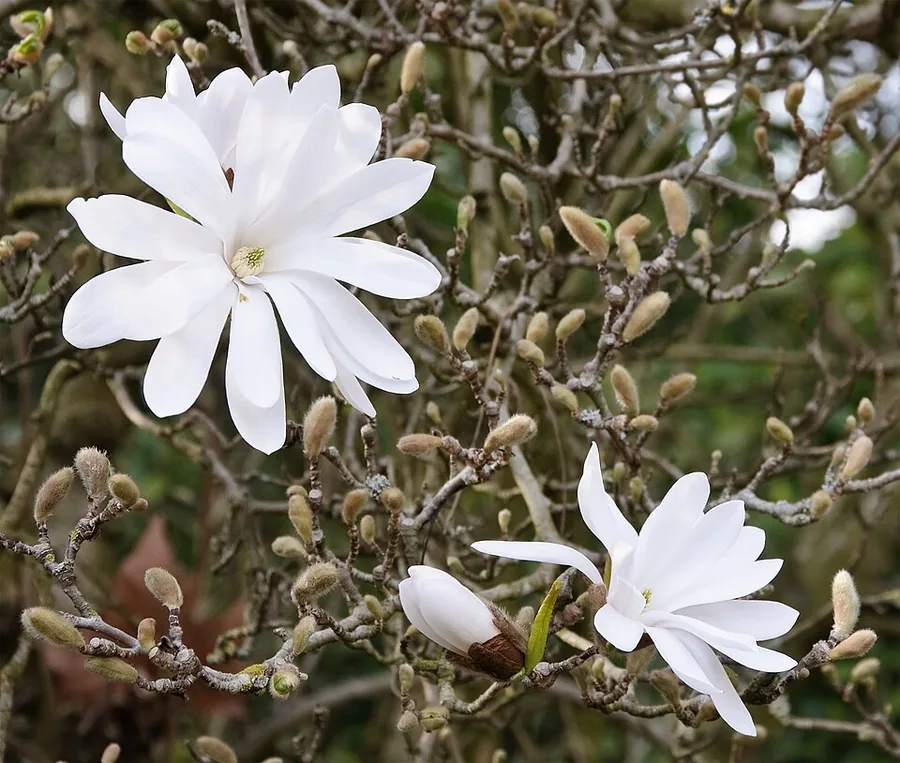
Magnolia stellata is a small, slow-growing deciduous tree valued for flowering before nearly anything else in the landscape. Because the buds break ahead of the foliage, the bare branches carry star-shaped white flowers in early spring, often March, on a compact, rounded crown. It is reliably hardy across zones 4 to 8.
The floral display defines the species. Each bloom opens numerous narrow, strap-like tepals into a radial star, and select forms are fragrant. Growth is deliberate, so the plant gains size slowly and, once established, makes few demands on the grower.
That precocious bloom is also the species' vulnerability. Opening so early exposes the tepals to late frost and cold wind, which scorch the flowers overnight, so siting matters: place it where it has shelter from cold wind and morning sun on frozen blooms to slow bud break and spare the display. Sited well, it performs for decades.
Care
The short version: full sun to part shade in moist, acidic, well-drained loam, consistent moisture through summer, and a sheltered position that buffers the very early flowers against late frost.
Light
Flowering is heaviest in full sun, since bud set responds to light, though the tree tolerates partial shade. A degree of shade can delay bud break and shelter the early flowers, so weigh sun against your site's frost risk.
Water
Maintain evenly moist soil, particularly in summer, because the species resists both drought and waterlogging and performs poorly at either extreme. Water deeply during establishment and drought, on the order of every 5 to 10 days as heat and rainfall dictate.
Soil
Grow it in moist, organically rich, well-drained loam held acidic to neutral, ideally pH 6.0 to 7.0. It tolerates clay, but alkaline soil immobilizes iron and induces chlorosis, so keep the root zone on the acidic side.
Temperature
The wood is cold-hardy from -29°F to 100°F (-34°C to 38°C) across zones 4 to 8. The tissue at risk is floral, not woody, so the operative hazard is a spring frost on the open blooms rather than winter cold on the tree.
Humidity
Ambient outdoor humidity is sufficient, and there is no target to meet. Average conditions satisfy it, and supplemental misting serves no purpose.
Feeding
Apply a balanced or acid-forming slow-release fertilizer in early spring. On rich soil the plant seldom needs feeding, so err toward restraint rather than heavy application.
Pruning
In most years pruning is unnecessary, and the tree needs no pruning at all. Where shaping or single-trunk training is intended, cut immediately after flowering, because the plant sets next season's buds soon after bloom and later cuts remove them.
Repotting
As a ground-grown tree it rarely needs repotting. In a nursery container, roots circling the pot, water passing straight through, or stalled growth indicate the young plant is ready for the ground.
Size & spacing
Allow for a mature spread of 10 to 15 feet (3 to 4.5 m) and a height of 15 to 20 feet (4.5 to 6 m). Site it with room to develop that full width clear of walls and paths.
When to plant
Star magnolia is governed by an early phenology. It flowers in early spring, often March, ahead of leaf-out, ranking among the first magnolias to bloom. Establish it in early spring or fall, and choose a sheltered aspect so a late freeze does not catch the open flowers.
Northern hemisphere
Southern hemisphere
Typical months for a temperate climate: start earlier in warm zones, later where spring frosts linger.
- Plant: Early spring or fall; in the north move balled-and-burlapped plants while actively growing, in warmer zones plant from containers in late winter while dormant.
- Harvest: Early spring (often March), before the leaves emerge; one of the earliest magnolias to flower.
Hardiness
USDA hardiness zones: 4–8
Temperature: down to -34°C
Troubleshooting
Star magnolia presents few disorders, and each has a clear cause. Frost injury to the precocious flowers, magnolia scale on the twigs, and interveinal chlorosis in alkaline soil account for nearly all of them. Identify the symptom below, then intervene while treatment still helps.
Sticky, glossy leaves with a black coating and brown twig bumps
The brown, bud-like nodes on the twigs are magnolia scale, insects that feed on sap and excrete honeydew. That sugary honeydew supports the black sooty mold filming the foliage and everything beneath. Prune out and destroy the most heavily infested twigs, apply horticultural oil at the label timing to smother overwintering scale and crawlers, then wash off the mold once the population is suppressed.
Fix:
- Prune out and destroy heavily infested twigs
- Apply horticultural oil to smother overwintering scale and crawlers per label timing
- Wash off sooty mold from foliage once scale is controlled
Interveinal yellowing while the veins remain green
This pattern is iron chlorosis, typically because alkaline soil holds iron in a form the roots cannot absorb, with poor drainage compounding it. Symptoms appear first and most severely on the newest foliage. Test the pH and shift it toward acidic with elemental sulfur or an acidifying fertilizer, apply chelated iron for immediate correction, and mulch to improve drainage and keep the roots cool and evenly moist.
Fix:
- Test soil pH and amend toward acidic with elemental sulfur or acidifying fertilizer
- Apply chelated iron for a temporary correction
- Improve drainage and mulch to keep roots cool and evenly moist
Flowers browning and softening soon after bloom
The cause is frost damage, the most frequent complaint with this early bloomer. Opening before most trees leaf out, the tepals are exposed overnight to a late freeze or cold wind that scorches them, though blooms on sheltered aspects are often spared. The injury is superficial and the tree leafs out normally, so protect small specimens with frost cloth when a freeze is forecast and select a later-blooming cultivar such as Royal Star for frost-prone sites.
Fix:
- Damaged flowers cannot be revived; remove spent blooms for appearance only
- Cover small plants with frost cloth when a late freeze is forecast during bloom
- Wait for the plant to leaf out normally, as frost damage to flowers does not harm overall health
Toxicity
For households with pets or children, the record is reassuring: the ASPCA classifies star magnolia as non-toxic to cats, dogs, and horses, and it carries no toxic principles in any tissue. The only likely effect is a mild gastrointestinal upset if an animal consumes a large quantity of foliage, as with most ornamentals.
Safe for
People · Cats · Dogs · Horses · Rabbits · Livestock · Birds
Cats None
A cat may live with this plant safely, as the ASPCA lists star magnolia as non-toxic, so an exploratory nibble poses no poisoning risk. A large mouthful of any plant material can produce brief queasiness, and nothing more.
Dogs None
Dogs face no toxic hazard, since the leaves, flowers, and bark contain no toxic compounds. The most a persistent chewer risks is transient gastric upset from the fibrous material.
Horses None
Horses may graze nearby without harm, because the ASPCA rates the plant non-toxic to them. Only an unusually large intake of foliage would be likely to cause mild digestive disturbance.
Rabbits Safe
Rabbits may share the space, as no part of the plant is poisonous. The rich, woody leaves are best offered in small quantities so they do not disturb a sensitive gut.
Livestock Safe
Cattle, goats, and sheep can browse it without danger, since the plant contains no toxic principles. An incidental taste is of no consequence.
Birds Safe
Backyard and pet birds are unaffected, as no tissue holds a toxin, and many birds readily shelter within the branches.
People Safe
The plant poses no hazard to adults or children, being non-poisonous, though the flowers and leaves are not food and warrant no consumption.
No special handling precautions for toxicity; as with any plant, ingestion of large amounts of plant material may cause mild stomach upset.
Varieties
Several named selections refine the species, chiefly for larger flowers, pink coloration, or a later bloom that evades frost. The following are the ones worth knowing.
Royal Star
Royal Star is a widely planted selection whose larger, double white flowers open roughly two weeks after the species, placing the bloom past much of the late-frost window.
Centennial
Centennial is a vigorous selection bearing large white flowers faintly flushed with pink, and it attains a greater size than the typical species.
Rosea
Rosea is a pink-flowered form whose buds open rose and fade toward white as the blooms mature.
Waterlily
Waterlily opens pink buds into many-tepaled, strongly fragrant, waterlily-shaped flowers on a plant that blooms slightly later than most.
How to propagate
Star magnolia can be propagated several ways, none of them rapid. Select a method according to whether you need a clone of a named cultivar or can accept the variability and delay of seed.
Stem cuttingsModerate
Early to mid summer · Several weeks to root, then grow on for one to two seasons before planting out
Softwood cuttings taken in early to mid summer are the most reliable means of cloning a named cultivar. Rooting is slow and improves with rooting hormone and consistent humidity, requiring several weeks before roots form. Grow the rooted plant on for one to two seasons before planting out.
SeedDemanding
Fall sowing after cleaning seed · Slow; germination and growth to flowering size take several years
Seed propagation demands patience. Clean the pulp from the seed, sow in fall, and provide cold stratification to break dormancy. Germination is slow, the seedlings do not come true to the parent, and several years pass before they reach flowering size.
LayeringModerate
Spring · One or more growing seasons to root before separating
Layering is the most straightforward method for a home grower. In spring, pin a low branch into the soil and allow it to root over one or more growing seasons before severing it from the parent.
Myths
Star magnolia is toxic to pets and must be kept from cats and dogs.
The ASPCA classifies Magnolia stellata as non-toxic to dogs, cats, and horses, so it presents no poisoning hazard. A pet that ingests a large volume of leaves may develop a mild stomach upset, as with most plants, but the tree itself is safe around animals.
A star magnolia can be pruned at any time to keep it tidy.
The plant sets its flower buds for next spring shortly after bloom, so ill-timed cuts remove that display. Prune only just after flowering when a cut is needed, though the species requires very little pruning in the first place.