Tree · Magnoliaceae
Southern Magnolia
Magnolia grandiflora
A long-lived broadleaf evergreen prized for glossy foliage and lemon-scented white blooms that anchor a landscape for generations.
Full sun
Every 7–14 days
USDA 6–10
60–80 ft · 18.3–24.4 m
Overview
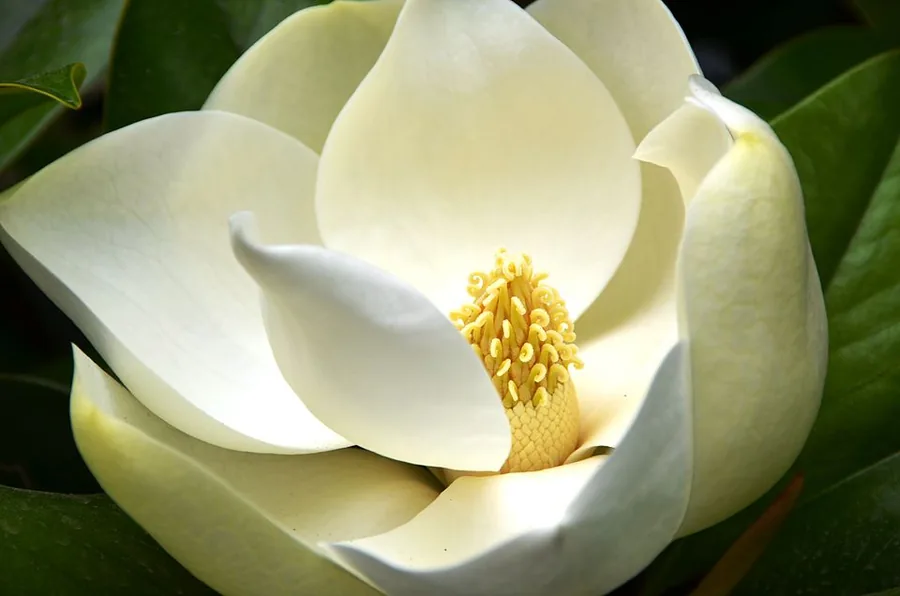
Magnolia grandiflora is the broadleaf evergreen that shapes much of the American South's canopy. It matures into a stately specimen of 60 to 80 feet (18 to 24 m), carrying thick, leathery leaves whose waxy upper surface reads dark green while the underside often wears a rusty-brown felt. From late spring into summer it produces large cup-shaped, lemon-scented white flowers that perfume the surrounding air.
Site selection matters because this is a long-lived tree with a demanding footprint. Its dense evergreen canopy and wide, shallow surface roots, which reportedly extend well past the drip line, intercept the light and moisture that turf beneath it needs, so grass rarely persists there. The tree also sheds leathery leaves, spent flowers, and cone-like fruit through much of the year, producing steady litter. Place it away from lawns and foundations, where that scale and debris cause no conflict.
Given suitable conditions it is largely self-reliant. It performs best in rich, moist, acidic soil and benefits from even moisture while its root system establishes, after which it needs little intervention and faces no serious pests beyond periodic scale. Cold-hardy cultivars have extended its usable range northward, allowing cooler gardens to grow it where the species once failed.
Care
The short version: provide full sun to part shade, rich and consistently moist acidic soil, deep irrigation during dry spells while the tree is young, and minimal pruning limited to dead or crossing wood.
Light
The species flowers and grows most densely in full sun, though its natural shade tolerance lets it accept partial sun and partial shade. Stronger light drives compact growth and heavier bloom, because more energy is available for both. In shade the canopy grows looser and more open as the tree reaches for light.
Water
Keep the soil consistently moist, irrigating deeply during dry spells and especially through establishment, while the deep taproot and heart-root system are still developing. Once established, a thorough soak every 7 to 14 days in dry weather suffices. The species tolerates neither prolonged drought nor standing water, so drainage and steady moisture both matter.
Soil
Plant into rich, organically rich, well-drained loam that retains moisture. The tree is adapted to acidic ground and performs best at a pH of 5.0 to 6.5, where nutrient availability suits it; it accepts clay but resents waterlogged or otherwise extreme soils.
Temperature
It withstands a broad thermal range, roughly -9°F to 100°F (-23°C to 38°C), which corresponds to Zones 6 through 10. At the cold northern limit, a hardy cultivar reduces the risk of winter injury.
Humidity
Ambient outdoor humidity is adequate, so no target is needed. Warm, humid conditions favor algal leaf spot, since the causal alga spreads in moisture, but the damage is cosmetic and tolerable.
Feeding
Apply one feeding in spring using a balanced or acid-forming slow-release fertilizer formulated for acid-loving trees. Keep rates modest, because excess nitrogen forces soft, succulent growth that is more attractive and vulnerable to scale insects.
Pruning
The tree requires little pruning thanks to its naturally sound structure. Remove dead, damaged, or crossing branches in late winter to early spring, and retain the low, sweeping limbs where you prefer them to conceal accumulating leaf litter rather than expose bare trunk.
Repotting
An established in-ground tree is never repotted, and container stock is shifted only rarely. A nursery plant has outgrown its pot when roots circle the rootball, roots emerge from the drainage holes, and water runs straight through instead of soaking in, all signs of a root-bound container.
Size & spacing
Allocate space for a large tree, 60 to 80 feet (18 to 24 m) tall and 30 to 50 feet (9 to 15 m) wide. Provide that full open footprint, clear of buildings and turf, so the spreading canopy and shallow surface roots can develop without conflict.
When to plant
This is an installed specimen rather than a timed crop, so the planting window is set by establishment, not harvest. Set it out in spring or fall, when mild soil temperatures favor root growth before summer or winter stress. From there the calendar tracks its bloom, the large white flowers that open from late spring into summer, concentrated in May and June with sparse flowering afterward.
Northern hemisphere
Southern hemisphere
Typical months for a temperate climate: start earlier in warm zones, later where spring frosts linger.
- Plant: Spring or fall
- Harvest: Late spring to summer (May to June, with sparse continued flowering through summer)
Hardiness
USDA hardiness zones: 6–10
Temperature: down to -23°C
Troubleshooting
A vigorous southern magnolia is largely trouble-free, and the few disorders it develops present on the twigs or foliage, where they are readily diagnosed. Early identification keeps most of them minor. Match the symptom below, then intervene before it advances.
Individual branches wilting and dying back in sequence
Scattered branches that wilt and brown independently usually indicate verticillium wilt, a soilborne fungus that colonizes and occludes the vascular tissue from within. Peeling the bark may reveal dark vascular streaking, though laboratory culture is the only definitive confirmation. No fungicide cures it, so remove the dead wood and sustain the tree with consistent water and fertilization to support its recovery.
Fix:
- Prune out and destroy affected dead branches
- Fertilize and water during dry weather to support recovery
- There is no chemical cure; keep the tree vigorous
Waxy white bumps on the twigs above blackened leaves
The raised, shell-like bumps are magnolia scale, among the few pests of consequence on this tree. The insects feed on the sap and excrete honeydew, and a black sooty mold then colonizes that sugary film on the foliage below. Prune out the most heavily infested twigs, apply horticultural oil in the dormant season to smother overwintering scale, and target the mobile crawlers in late summer.
Fix:
- Prune out and destroy heavily infested twigs
- Apply horticultural oil during the dormant season to smother overwintering scale
- Treat crawlers in late summer when young scales are active
Discrete spots and blotches on the foliage with some leaf drop
Most leaf lesions here are fungal or bacterial, and in warm, humid weather the greenish-gray patches of algal leaf spot appear as the causal alga spreads in moisture. None of it causes lasting injury. Rake and dispose of the fallen leaves to remove the source of infection, open the canopy with light pruning to improve air movement, and forgo sprays, which seldom justify the effort.
Fix:
- Rake up and dispose of infected fallen leaves
- Improve air circulation by spacing and selective pruning
- Chemical control is rarely needed
Toxicity
For households with animals, the assessment is reassuring: southern magnolia is safe. The ASPCA classes magnolia as non-toxic to cats, dogs, and horses, and no part of the tree poisons people, livestock, birds, or rabbits. At most, a large quantity of ingested leaf tissue provokes brief, mild gastrointestinal upset, as coarse plant material commonly does.
Safe for
People · Cats · Dogs · Horses · Rabbits · Livestock · Birds
Cats None
The ASPCA lists magnolia as non-toxic to cats, so a nibbled leaf carries no risk. A cat that consumes a large amount of foliage may drool or vomit once, the usual reaction of the stomach to coarse plant matter.
Dogs None
Dogs can ingest the leaves without any poisoning hazard. The most a large mouthful produces is transient vomiting or loose stool as the fibrous tissue passes through the gut.
Horses None
Horses are likewise unaffected, magnolia being on the ASPCA non-toxic list. The tough, leathery foliage is not preferred browse, and an incidental mouthful causes no harm.
Rabbits Safe
No toxin in the tree threatens a rabbit. Their digestive system tolerates only modest amounts of unfamiliar greenery, so an occasional leaf is best treated as incidental rather than dietary.
Livestock Safe
Cattle, goats, and sheep may graze near a southern magnolia without hazard, since the tree contains nothing poisonous to them. They generally decline the stiff evergreen leaves in any case.
Birds Safe
The tree presents no chemical danger to birds, which frequently shelter and nest within its dense canopy. Some consume the bright red seeds in autumn without ill effect.
People Safe
Southern magnolia is not poisonous to people, and no part is known to injure anyone who handles it. The leaves and flowers are not food, however, so there is no reason to consume them.
As with any plant, ingestion of plant material may cause mild, transient gastrointestinal upset even though the plant is non-toxic.
Varieties
Several named selections improve on the wild type, exchanging some ultimate height for greater cold tolerance, reduced leaf size, or a more compact habit. The following are the selections most worth knowing.
Little Gem
A compact semi-dwarf maturing near 30 feet with reduced leaves and flowers that begins blooming young, suiting sites too small for the full-size species.
Bracken's Brown Beauty
A cold-hardy, compact selection reliable to Zone 6, distinguished by smaller leaves lined beneath with a thick, rusty-brown felt.
Edith Bogue
One of the most site-tolerant selections, valued for resisting cold, wind, and the load of heavy snow.
D.D. Blanchard
A vigorous selection reaching roughly 75 feet on a straight central leader, with dark glossy leaves over rich brown undersides.
How to propagate
Southern magnolia can be propagated sexually from seed or cloned vegetatively, and each route rewards patience. The correct choice depends on whether the goal is to preserve a specific cultivar's traits.
SeedModerate
Sow cleaned seed in fall or after cold stratification · Several months to germinate; years to reach flowering size
Remove the red fleshy aril, then sow the cleaned seed in fall or apply cold stratification to break dormancy first. Germination takes several months, and the seedling needs years to reach flowering size as it invests in a strong taproot. Because seed does not reproduce a named cultivar, reserve it for situations where variable offspring are acceptable.
Air layeringModerate
Spring to summer on actively growing wood · Several months to root
Air-layering is the most reliable clonal method for southern magnolia and preserves cultivar identity. Girdle actively growing wood from spring through summer and allow several months for adventitious roots to form before severing the layer.
Stem cuttingsDemanding
Semi-hardwood cuttings in summer · Several weeks to months under mist
Collect semi-hardwood cuttings in summer, treat the bases with rooting hormone, and hold them under mist to limit water loss. Rooting is slow and erratic in this species, from several weeks to a few months, which is why the technique demands patience.
GraftingDemanding
Late winter to spring · One or more seasons to unite
Grafting from late winter into spring unites a named cultivar's scion with seedling rootstock, transferring the parent's traits to the new tree. The graft union requires one or more seasons to fuse securely, and the operation calls for practiced technique.
Myths
Southern magnolia is poisonous to dogs and cats.
The ASPCA classifies magnolia as non-toxic to dogs, cats, and horses, so a pet that chews a leaf faces no poisoning risk. The likely extent is brief, mild gastrointestinal upset, the ordinary response to any coarse plant material. The tree is safe to plant around pets.