Tree · Magnoliaceae
Saucer Magnolia
Magnolia × soulangeana
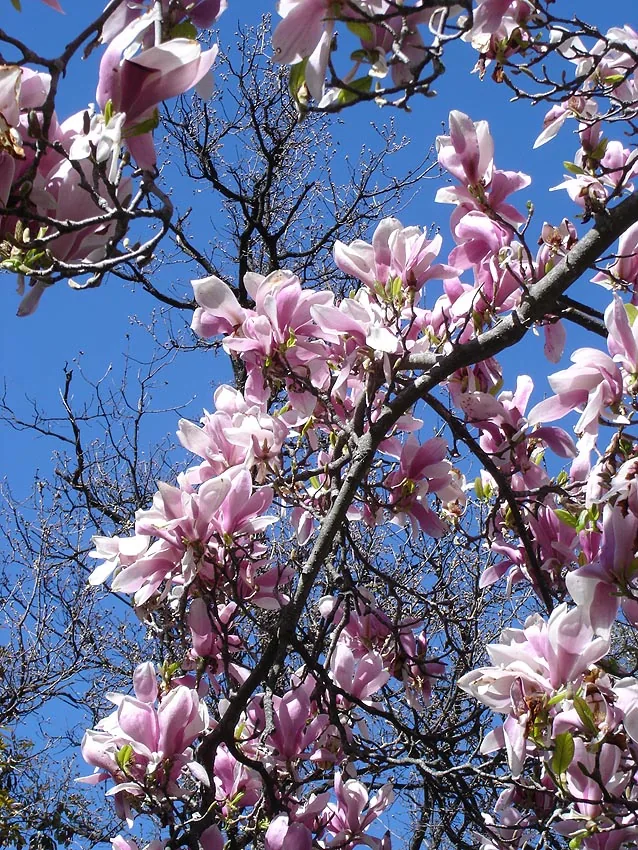
Site it beyond the reach of late frost and the saucer magnolia carries goblet-shaped pink blooms on bare wood before leaf-out.
Full sun
Every 5–10 days
USDA 4–9
20–30 ft · 6.1–9.1 m
Overview
The saucer magnolia opens one of the earliest major displays of the temperate spring. Its goblet-shaped flowers, ranging through pink, purple, and white, expand on bare wood well before the foliage flushes, so the whole crown reads as a mass of cupped color. That precocious, pre-leaf bloom explains its long standing as a garden specimen across cool-temperate regions.
The plant is a hybrid of two Asian magnolias and develops as a multi-stemmed tree or large shrub. At a moderate growth rate it attains 20 to 30 feet (6.1 to 9.1 m) in height, forming a broad, rounded crown that frequently spreads as wide as the tree is tall. That final scale places it firmly in the specimen category, warranting an open setting where the canopy can develop without competition.
The principal limitation is phenological. Because the flowers open so early, a single late frost can scorch a full display overnight, which makes siting a horticultural decision rather than an aesthetic one. Given a sheltered position and acidic, well-drained soil, it becomes a long-lived, low-maintenance tree once established.
Care
The short version: full sun to light shade, moist and acidic well-drained soil, consistent moisture, and a sheltered position that buffers the early bloom against late frost. Prune sparingly and only immediately after flowering, since the tree flowers on old wood.
Light
Site it in full sun to maximize flower initiation, though it tolerates partial shade and partial sun. Greater irradiance drives both heavier flowering and a denser crown, since photosynthate supply governs bud set.
Water
Hold the soil evenly moist through the year, because the species tolerates neither drought nor waterlogging well. Irrigate deeply during establishment and drought, on the order of every 5 to 10 days as evaporative demand and soil texture dictate.
Soil
It performs in moist, acidic, organically rich loam with free drainage. Target a pH of 5.0 to 6.5 and incorporate organic matter, since alkaline or compacted profiles restrict nutrient availability and root extension.
Temperature
Cold and heat hardiness is broad, from roughly -29°F (-34°C) at the low end to 100°F (38°C) at the high end. The limiting factor is not the wood but the early flowers, which late frost readily destroys.
Humidity
Ambient outdoor humidity is adequate, so no target value applies. Root-zone moisture governs performance far more than atmospheric humidity around the canopy.
Feeding
Apply a balanced slow-release fertilizer or compost in early spring, once per season. Avoid late-season nitrogen, which pushes soft growth that fails to harden off before cold and is then injured.
Pruning
Keep pruning minimal and confined to the period just after flowering, removing only dead, damaged, or crossing branches. Because flower buds form on old wood, hard cutting sacrifices the following spring's display.
Repotting
As a landscape tree it is seldom containerized, so repotting rarely applies. Where one is potted, up-size it once roots circle the surface, growth stalls, or water drains through without wetting the profile.
Size & spacing
Expect a mature height of 20 to 30 feet (6 to 9 m) beneath a broad crown that spreads 15 to 25 feet (4.5 to 7.5 m). Allocate that full width of open ground away from structures and neighboring trees so the rounded form expresses fully.
When to plant
The species operates on an early-spring phenology. Flowering runs from late March to mid-April, ahead of leaf expansion, which is precisely why a buffered site matters. Establish it in spring or fall during dormancy, ahead of summer heat, so the root system extends before it carries transpirational demand.
Northern hemisphere
Southern hemisphere
Typical months for a temperate climate: start earlier in warm zones, later where spring frosts linger.
- Plant: Spring or fall while dormant or before heat of summer
- Harvest: Early spring (late March to mid-April), before the leaves emerge
Hardiness
USDA hardiness zones: 4–9
Temperature: down to -34°C
Troubleshooting
A vigorous saucer magnolia is largely trouble-free, and most complaints are cosmetic rather than structural. The flowers are the most exposed tissue, followed by the twigs and the foliage. Match the symptom below to judge whether intervention is warranted or whether the tree self-corrects.
Waxy white mounds on twigs feeding under sticky black mold
The white, waxy mounds on the twigs are magnolia scale (Neolecanium cornuparvum), among the largest scale insects on any host, drawing sap from the shoots. As they feed they excrete honeydew, a sugar solution that supports black sooty mold and attracts wasps and ants. Reduce the population by pruning out the heaviest twigs, then break the life cycle: dormant oil smothers overwintering nymphs in late fall or early spring, and a crawler-timed spray in late summer catches the mobile young stage before it settles.
Fix:
- Prune out and destroy heavily infested twigs
- Treat overwintering nymphs with dormant horticultural oil in late fall or early spring
- Time crawler-stage treatments to late summer when young scales are active
Open blooms collapse to brown mush soon after opening
The cause is late-spring frost rupturing the cells of the exposed, pre-leaf flowers, not a pathogen. A warm microclimate against a south-facing wall raises bud temperature and advances flowering, so the open blooms meet the next cold night with no protection. The damaged tissue cannot recover, yet the vascular wood and dormant leaf buds are untouched, which is why the canopy still flushes on schedule. Leave the live wood intact and remove spent flowers for appearance only.
Fix:
- Accept that frosted blooms cannot be revived; remove spent flowers for appearance only
- Do not prune live wood in response, as the tree itself is unharmed and will leaf out normally
Leaf spotting or sunken lesions on stressed wood
Discrete leaf lesions usually trace to fungal or bacterial leaf spot, whereas sunken, discolored areas on the wood indicate canker, a pathogen that establishes most readily where a tree is already stressed. On a vigorous magnolia both stay minor, so treatment is sanitation rather than rescue. Remove and dispose of fallen infected leaves to cut the inoculum, excise cankered wood with sterilized tools, and open the canopy to lower the leaf-surface moisture that pathogens need.
Fix:
- Rake and dispose of fallen infected leaves
- Prune out cankered or dead wood with sanitized tools
- Improve air circulation and avoid overhead wetting of foliage
Toxicity
For households with pets or children, the assessment is reassuring: the saucer magnolia is safe. The ASPCA classifies magnolia as non-toxic to cats, dogs, and horses, and it presents no poisoning mechanism to other animals or to people. The only plausible effect, a brief and mild digestive upset, follows the ingestion of a large volume of foliage, as with most plants.
Safe for
People · Cats · Dogs · Horses · Rabbits · Livestock · Birds
Cats None
The tissue holds no compound toxic to cats, so a taste of leaf or fallen petal produces no poisoning. Only the mechanical load of a large volume of plant matter would leave a cat briefly queasy.
Dogs None
No toxic principle is present, so a dog stripping a low branch or mouthing a dropped bloom is not at risk. Any effect from a genuine binge comes from bulk fiber, showing as transient stomach upset.
Horses None
The ASPCA classes magnolia as non-toxic to horses, so a horse grazing the foliage encounters no poisoning mechanism.
Rabbits Safe
The leaves carry no toxin for rabbits, so grazing does no harm. Introduce any unfamiliar green in stages, since the hindgut flora needs time to adapt to a new forage.
Livestock Safe
Cattle, goats, and sheep can browse the tree freely, because the leaves, bark, and flowers contain no toxic constituent.
Birds Safe
Birds feeding on the buds, flowers, or seeds meet no toxic compound in any of those parts.
People Safe
No part poses a poisoning risk to people; the flowers are edible and used in some cuisines, so no exclusion of children is warranted.
No special handling precautions needed; as with any plant, ingestion of large amounts of foliage may cause mild, transient stomach upset.
Varieties
Most saucer magnolias in commerce are named cultivars selected for flower color, flower size, or bloom timing. A few recur across nurseries, and those are the selections worth recognizing.
Alexandrina
A vigorous, extensively planted selection bearing large flowers that are deep rose-purple on the exterior and white on the inner face.
Lennei
Its large goblet-form blooms are dark rose-purple outside and white inside, and their slightly later anthesis moves them past part of the frost window.
Brozzonii
Among the largest-flowered forms in cultivation, producing very large white blooms flushed light purple at the base.
Rustica Rubra
A vigorous selection carrying cup-shaped flowers in rosy-red to reddish-purple.
How to propagate
As a hybrid, the saucer magnolia does not reproduce true from seed, so every dependable method is clonal. The available techniques span a wide difficulty range, from a straightforward garden method to a specialized nursery operation.
GraftingDemanding
Late winter to early spring for bench grafting onto seedling rootstock · 1 to 2 growing seasons
Because a named hybrid is heterozygous, seed will not reproduce the cultivar, so it must be propagated vegetatively to stay true. The standard nursery method is bench grafting scion wood onto seedling rootstock in late winter to early spring, after which the graft union and root system need 1 to 2 growing seasons to consolidate.
LayeringModerate
Spring, on low flexible branches · 1 to 2 years to root before separating
This is the most reliable option outside a nursery, since the layer stays attached to the parent for its water and carbohydrate supply while it forms roots. Peg a low, flexible branch into the soil in spring, or air-layer a higher stem, and the resulting plant is genetically identical to the parent cultivar. Allow 1 to 2 years for adequate rooting before severing it.
Stem cuttingsDemanding
Early summer using softwood to semi-hardwood cuttings · Several weeks to root, then a season to establish
Softwood to semi-hardwood cuttings taken in early summer root erratically, since the genus adventitiously roots with difficulty. Auxin rooting hormone and a mist bench raise humidity and hold the odds up. Rooting occupies several weeks, followed by a full season for the young plant to establish.
Myths
Saucer magnolia is poisonous to cats and dogs and must be kept away from pets.
The ASPCA classifies magnolia as non-toxic to dogs, cats, and horses, so there is no toxicological basis for concern. A pet that samples a leaf or petal is unharmed, and no barrier or exclusion is required.
Frosted, browned blooms mean the tree is dying and needs heavy pruning.
Frost injures only the exposed floral tissue, not the vascular wood or dormant buds. The framework survives and flushes on schedule, so hard pruning removes the old wood that carries next season's flower buds and forfeits the bloom, because magnolias flower on old wood.