Tree · Magnoliaceae
Jane Magnolia
Magnolia 'Jane'
A compact tree whose tulip-shaped purple-pink flowers open late enough to clear the spring frost.
Full sun
Every 5–10 days
USDA 4–8
10–15 ft · 3–4.6 m
Overview
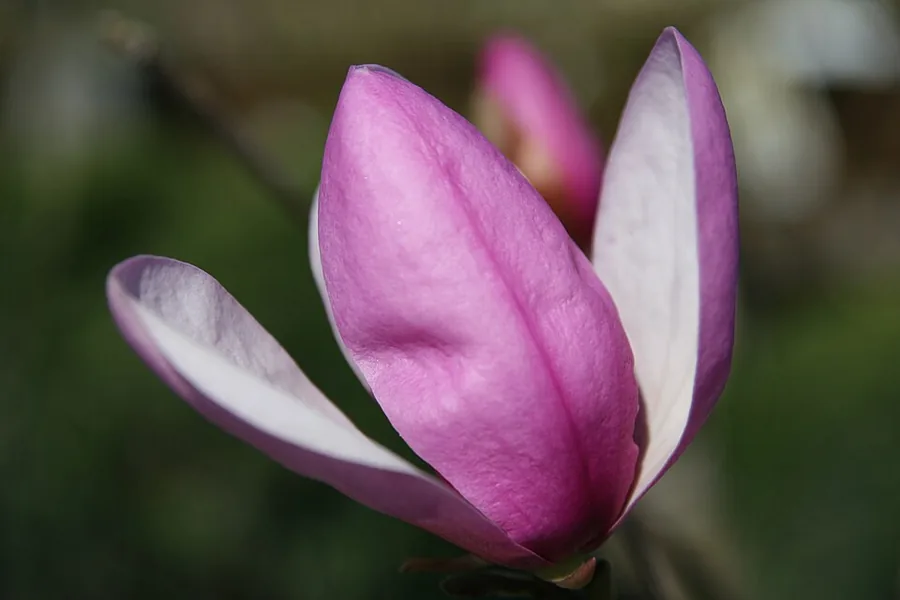
Jane magnolia belongs to the eight Little Girl hybrids developed at the National Arboretum, a cross selected specifically for a delayed bloom period. It matures as a compact tree or large shrub of 10 to 15 feet (3 to 4.5 m), forming a rounded crown scaled to a small landscape. Its tulip-shaped flowers are purple-pink externally and paler within, and they open precociously, ahead of leaf emergence.
The decisive trait is its bloom phenology. Flowering in mid-to-late spring, 2 to 4 weeks behind the star and saucer magnolias, shifts the vulnerable open flowers past the window when late frosts most often destroy earlier-blooming magnolias. A sporadic secondary flush frequently follows in summer.
Cultural demands are modest once the tree is established. Full sun, adequate spacing, and consistent soil moisture during the juvenile phase are the main requirements, and this slow grower then develops into a long-lived, low-maintenance specimen with dependable annual bloom.
Care
The short version: site it in full sun to part shade in rich, moist, slightly acidic soil, irrigate through establishment, mulch to conserve moisture, and prune only immediately after flowering.
Light
Jane magnolia flowers most heavily in full sun, since flower-bud initiation responds to light, though it tolerates partial shade or partial sun. Site it in the open to maximize bloom.
Water
Maintain evenly moist soil, irrigating every 5 to 10 days, and favor the wetter end during establishment or drought when the root system cannot yet draw on reserves. A mulch ring reduces surface evaporation and stabilizes moisture. Once established, the tree tolerates moderate drought.
Soil
Grow it in rich, well-drained loam of acidic to neutral reaction, ideally pH 5.5 to 6.5, which keeps micronutrients available to the roots. It tolerates clay better than many trees, so heavy ground is workable provided drainage is adequate.
Temperature
The species withstands a broad thermal range, from a minimum near -29°F (-34°C) to summer highs around 95°F (35°C). This cold hardiness is what defines its adaptation to USDA zones 4 to 8.
Humidity
Ambient outdoor humidity is sufficient, so no target range applies. Air circulation is the more relevant factor, because stagnant, humid air favors powdery mildew establishment on the foliage.
Feeding
Apply a balanced or acid-forming fertilizer once in early spring to align nutrient release with the flush of new growth. A single seasonal application meets demand, and excess nitrogen encourages soft growth and predisposes the tree to scale.
Pruning
Prune immediately after flowering, because flower buds form on the previous season's wood and later cuts remove next year's bloom. Aside from excising dead or crossing branches, the tree requires little corrective pruning.
Repotting
This is a landscape tree rarely grown in containers, so repotting seldom applies. Where one is potted, roots circling the container, slowed growth, or water draining through too quickly indicate the need to pot up.
Size & spacing
Anticipate a mature height of 10 to 15 feet (3 to 4.5 m) and a spread of 8 to 12 feet (2.4 to 3.7 m). Allocate that spacing at planting so the crown develops fully without competition.
When to plant
Jane magnolia follows a distinct phenological calendar. Establish it in spring or early fall while conditions are mild, then expect flowering in mid-to-late spring, a timing that runs behind most magnolias and generally carries the bloom past frost risk.
Northern hemisphere
Southern hemisphere
Typical months for a temperate climate: start earlier in warm zones, later where spring frosts linger.
- Plant: Spring or early fall
- Harvest: Mid-to-late spring (mid-April to early May), about 2-4 weeks later than star and saucer magnolias; often reblooms sporadically in summer
Hardiness
USDA hardiness zones: 4–8
Temperature: down to -34°C
Troubleshooting
Jane magnolia is largely trouble-free in most seasons, so problems are the exception. When one arises, it typically presents first on the foliage or twigs. Compare your observations with the entries below and intervene before the issue advances.
Waxy bumps along the twigs with sticky leaves and a black film beneath
Those bumps are magnolia scale, a soft scale that feeds on phloem sap under a protective waxy covering. Because it takes in far more sap than it can use, it excretes the surplus sugars as honeydew, and that sugar film is the substrate on which black sooty mold colonizes the leaves below. Prune out the most heavily colonized twigs, target the mobile crawler stage with horticultural oil in summer or treat overwintering scale during dormancy, and conserve the natural predators that keep populations in check.
Fix:
- Prune out and destroy heavily infested twigs
- Apply horticultural oil during dormancy or treat crawlers in summer
- Encourage natural predators
Dark leaf lesions accompanied by twig dieback
Dark leaf spots combined with sunken lesions in the wood indicate leaf spot or canker fungi. Once a canker girdles a branch and dieback begins, excise the affected wood and destroy it, since the pathogen persists in infected tissue. Remove and dispose of fallen diseased foliage to reduce reinfection, and sustain vigor through consistent watering and mulching so the tree can compartmentalize the remaining infection.
Fix:
- Prune out and destroy cankered or dead wood
- Rake and remove fallen diseased leaves
- Maintain plant vigor with proper watering and mulching
A white, powdery colonization across the foliage
The whitish film is powdery mildew, a foliar fungus that establishes on the leaf surface where humid, still air lets its spores germinate. On a vigorous tree it stays a cosmetic disorder rather than a threat to health. Thin congested growth to raise air circulation and lower leaf-surface humidity, remove fallen leaves in autumn to cut the overwintering inoculum, and apply a labeled fungicide only if the infection becomes severe.
Fix:
- Rake and dispose of fallen infected leaves
- Improve air circulation by thinning
- Apply a labeled fungicide if severe
Toxicity
For households with pets or children, the toxicological verdict is straightforward: the tree is safe. The ASPCA lists magnolia as non-toxic to cats, dogs, and horses, with no toxic principle in the leaves, bark, or flowers. Ingesting any plant in quantity can cause transient stomach upset, but nothing in this species is poisonous.
Safe for
People · Cats · Dogs · Horses · Rabbits · Livestock · Birds
Cats None
The ASPCA classifies magnolia as non-toxic to cats, so investigation of a Jane magnolia poses no toxicological concern.
Dogs None
No toxic principle affects dogs, so a chewed leaf or flower will not poison, though ingesting a large volume of any plant material can provoke transient gastrointestinal upset.
Horses None
Horses are unaffected as well, the record confirming magnolia contains no toxic principles relevant to them.
Rabbits Safe
The foliage and blooms present no documented toxic risk to rabbits.
Livestock Safe
Grazing stock such as goats and cattle can browse in the vicinity without toxicological harm.
Birds Safe
Birds that perch in the canopy or consume the fruit incur no harm.
People Safe
The tree is safe around children, since no part of the leaves, bark, or flowers holds a toxic principle.
No special handling precautions are required for toxicity.
Varieties
Jane is one of eight Little Girl hybrids that share its late-blooming, frost-avoiding phenology across a spectrum of flower colors. The following are the cultivars most often encountered.
Ann
Within the Little Girl series, Ann bears slender, upright reddish-purple flowers and ranks among the earliest of the group to open.
Betty
Betty is a Little Girl hybrid distinguished by large blooms that open wide to expose purple-red exteriors over clean white interiors.
Susan
Susan is a Little Girl hybrid noted for fragrant fuchsia-red flowers carried on slightly twisted petals.
Randy
Randy exhibits a more upright habit within the series, with narrow purple-pink flowers held close to the stem.
Judy
Judy is one of the eight National Arboretum Little Girl hybrids and flowers in a deep red-purple.
Pinkie
Pinkie is the Little Girl hybrid recognized for paler pink flowers that open later than its sisters.
Ricki
Ricki is a spreading Little Girl hybrid that flowers in deep purple-red.
How to propagate
As a named hybrid, Jane reproduces true only by vegetative propagation. Three techniques apply, each demanding a different degree of skill and patience.
Stem cuttingsModerate
Early to mid summer using softwood to semi-hardwood growth · Several weeks to root; one or more seasons to establish
Collect softwood to semi-hardwood cuttings in early to mid summer, because a named hybrid comes true only through vegetative cloning. The cuttings require several weeks to root and a season or more to establish. Seed segregates and will not reproduce the parent, which leaves cuttings as the practical route for the home gardener.
GraftingDemanding
Late winter to early spring onto compatible magnolia rootstock · One to several seasons
Nurseries graft Jane onto a compatible magnolia rootstock in late winter to early spring to reproduce it true to type. The technique is demanding and takes one to several seasons to establish, which is why it remains largely a commercial method.
LayeringModerate
Spring · One or more seasons to root before separation
In spring, pin a low branch to the soil so it roots while still drawing resources from the parent. It needs a season or more to root before separation, and the resulting plant is a genetic clone of the stock tree.
Myths
Magnolias bloom too early and always lose their flowers to spring frost.
Jane and the rest of the Little Girl series flower 2 to 4 weeks later than the star and saucer magnolias, a bred-in trait rather than an accident. That delayed bloom typically carries the flowers beyond the period of greatest frost risk, and the tree frequently produces a second, sporadic flush in summer.
Magnolia flowers and foliage are poisonous to dogs and cats.
The ASPCA classifies magnolia as non-toxic to dogs, cats, and horses, with no toxic principle documented in any part of the plant. A pet that investigates or mouths a fallen bloom faces no toxicological hazard.