Shrub · Bignoniaceae
Trumpet Vine
Campsis radicans
In full sun on a strong support, the trumpet vine blooms hard and feeds hummingbirds all summer.
Full sun
Every 7–14 days
730–1095 days
USDA 4–9
Overview
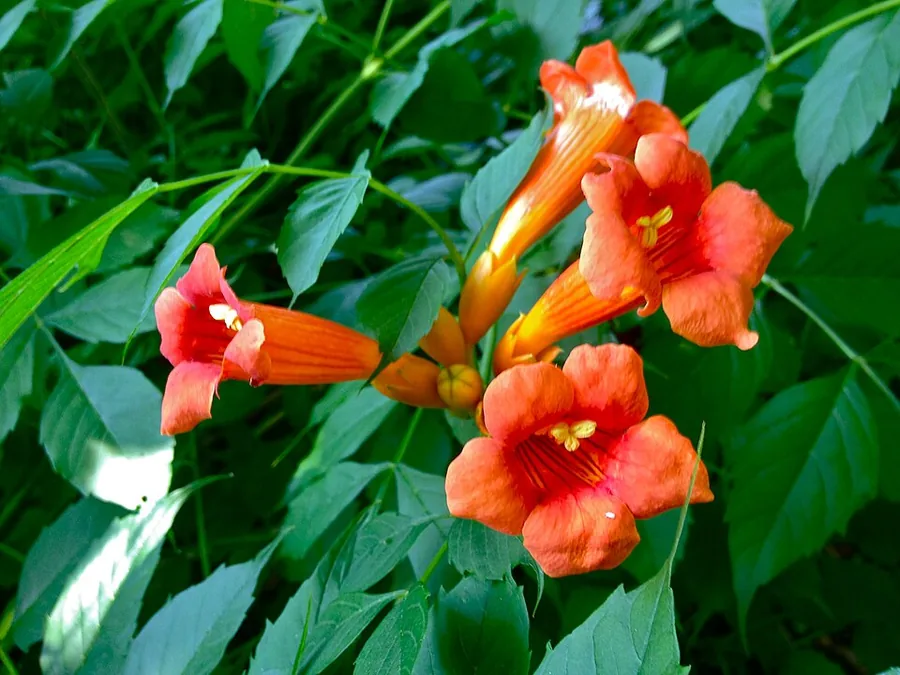
Campsis radicans is a fast, woody clinging vine native to the eastern United States, valued for the orange-red trumpets it opens from midsummer to fall to draw hummingbirds. It climbs by adventitious aerial rootlets, or holdfasts, that let it scale 25 to 40 feet (7.5 to 12 m) of arbor, fence, or wall without a twining habit. Rated for zones 4 to 9, it withstands cold, heat, drought, and poor ground, a resilience that travels with the same vigor that makes it hard to contain.
That vigor is the crux of growing it. It advances on two fronts, underground runners that throw up root suckers and bean-like capsules that self-sow, so an unmanaged plant forms dense colonies. The mass that lets it cover a structure also drives its weight and holdfasts against that structure, which is why placement matters more than any other decision here.
The whole management program reduces to placement and restraint. Grow it on a heavy freestanding support, keep it in lean soil so flowering is not lost to vegetative growth, and prune it hard each year on the new wood it flowers from. The sap behind the folk name cow itch vine is a contact irritant, so gloves are standard practice when handling or cutting it.
Care
The short version: full sun, lean soil, and a very sturdy freestanding support. Establish young plants with regular water, then rely on rainfall, withhold fertilizer to protect flowering, and prune hard in late winter to control the mass.
Light
Flowering is light-driven, so site it in full sun, six or more hours daily. It persists in partial sun or light shade, but reduced light shifts the balance toward foliage, and a shaded plant grows rampant and green with little bloom.
Water
Irrigate young plants through establishment, when the root system is still shallow, then reduce watering sharply. An established vine is drought tolerant across dry to moist soils and meets its needs from rainfall, so routine irrigation is unnecessary and can even feed excess growth.
Soil
Soil texture is largely immaterial: it grows in clay, sand, loam, or poor ground across a pH of 5.5 to 8.0. Fertility, however, is not immaterial, because lean soil restrains vegetative vigor and favors flowering, while rich soil does the reverse. It also tolerates conditions from dry to occasionally wet.
Temperature
Cold and heat hardiness are wide, spanning roughly -29°F to 100°F (-34°C to 38°C), which underpins its zone 4 through 9 rating. That range covers a severe winter and a high-summer heat load, which is why it succeeds across such varied climates.
Humidity
Ambient humidity is not a limiting factor for this species, so no target applies. It performs across a broad climatic range without regard to atmospheric moisture.
Feeding
Fertilizer is counterproductive. Rich soil and feeding drive foliage at the expense of flowers, because surplus nitrogen favors vegetative growth, so the plant flowers better lean and unfed, and lean ground also checks its aggressive spread.
Pruning
Prune hard in late winter or early spring, before growth resumes. Because it flowers on the current season's wood, this hard cut removes no flowering potential, and the annual thinning of woody stems plus removal of root suckers is the primary tool for keeping it off structures.
Repotting
As a ground-grown vine rather than a container subject, repotting rarely applies. Where a plant is containerized, the diagnostic signs are roots filling the pot and suckers emerging through the drainage holes.
Size & spacing
Scale the site to a large climber reaching 25 to 40 feet (7.5 to 12 m) in height and 5 to 10 feet (1.5 to 3 m) in spread. Provide a structure rated for that mass and set it well clear of anything it could overtake.
When to plant
Set plants out in spring after the last frost, or in fall within mild zones, so the roots establish before the growing season. Prune hard in late winter, before bud break, since flowers form on the current year's wood. The orange trumpets then run through summer, June into September.
Northern hemisphere
Southern hemisphere
Typical months for a temperate climate: start earlier in warm zones, later where spring frosts linger.
- Sow: Late winter to early spring; seed needs cold stratification, though the plant is usually propagated from root cuttings or suckers rather than seed.
- Plant: Spring after frost, or fall in mild zones
- Harvest: Summer (June to September)
Hardiness
USDA hardiness zones: 4–9
Temperature: down to -34°C
Troubleshooting
Nearly every problem with this vine traces to vigor rather than pest or pathogen. It colonizes ground you did not intend for it, loads its support with woody weight, and occasionally grows vegetatively at the expense of bloom. Identify the pattern below and correct the cause, not just the symptom.
Structural surfaces damaged by holdfasts and vine weight
Two mechanisms cause the damage: clinging adventitious rootlets that penetrate mortar, wood, and fine cracks, and the sheer woody mass of a mature plant, which can overload a fence or weak trellis. Detaching the vine from a wall typically takes the surface with it. Confine it to a heavy freestanding support such as a metal arbor or masonry, keep it off buildings, and reduce weight and reach by pruning hard each year.
Fix:
- Grow only on a very sturdy freestanding support such as a heavy metal arbor or masonry, not on house walls or wooden structures
- Keep the vine off buildings, gutters, and weak fences by pruning back hard
- Avoid clinging vines on wood, which can be damaged or rot from trapped moisture
Shoots emerging at a distance from the parent plant
The mechanism is aggressive suckering, the trait that defines the species. Underground runners extend laterally and the bean-like capsules disperse seed, so shoots and seedlings establish well away from the parent and can outcompete surrounding plants. Excise suckers as they emerge, taking as much root as possible, mow those that reach turf, and remove seed capsules before they split to limit self-sowing.
Fix:
- Dig or pull root suckers as soon as they appear, removing as much root as possible
- Mow suckers repeatedly where the plant adjoins lawn to exhaust them
- Remove spent flowers and seed capsules before they split to limit self-seeding
- Site it near concrete or mowable areas to make suckers easier to control
Rampant foliage with little or no flowering
Failure to flower has three common causes: insufficient light, immaturity, and excess fertility. Young plants may need several years to reach flowering age, while shade and nitrogen-rich soil both divert energy into foliage. Relocate to full sun, withhold nitrogen, grow it lean, and allow time, since flowering improves as the plant matures.
Fix:
- Site or relocate in full sun (6 or more hours)
- Be patient; allow the plant to mature, as blooming improves with age
- Avoid nitrogen-rich fertilizer and grow in leaner soil
- Root-prune or restrict the roots slightly to encourage flowering
Toxicity
The risk profile here is dermatological, not systemic. The leaves, flowers, and sap can provoke contact dermatitis in sensitive people, the reaction that gave the plant its cow itch vine name, while ingestion produces only mild irritation in animals. Handle it in gloves and discourage pets from chewing the foliage.
Toxic to
Cats · Dogs · Horses · Rabbits · Livestock · People
Safe for
Birds
Cats Mild
Ingestion by a cat generally produces no more than transient drooling or mild gastric upset, with possible oral or dermal irritation from the sap. Systemic poisoning is not a realistic concern.
Dogs Mild
In dogs, chewing the foliage typically results in mild, self-limiting drooling and gastrointestinal upset, sometimes with local mouth or skin irritation from contact with the sap.
Horses Mild
A horse that browses the vine may develop minor oral or dermal irritation and slight digestive upset, but the plant is not considered dangerous to equines.
Rabbits Caution
Documentation of rabbit sensitivity is sparse, so the prudent approach is exclusion rather than offering it as forage.
Livestock Caution
Livestock tend to avoid it, and any irritation from incidental browsing remains mild, but it is best fenced off from pasture rather than grazed.
People Caution
Direct contact with leaves, flowers, or sap can induce contact dermatitis, presenting as skin redness, itching, and blistering along with eye irritation. The cow itch vine name reflects this, so gloves and long sleeves are warranted during pruning.
Birds Safe
Birds face no ingestion hazard and interact with the flowers for nectar rather than the foliage, with hummingbirds the most frequent visitors to the blooms.
Not internally poisonous to pets, but the leaves, flowers, and sap can cause contact dermatitis with skin redness, itching, and eye irritation in sensitive people who handle the plant (hence the folk name cow itch vine). Wear gloves and long sleeves when pruning or handling.
Helpline numbers

United States
ASPCA Animal Poison Control: (888) 426-4435 (fee applies)
Poison Control: (800) 222-1222



Canada
Poison Centres: 1-844-764-7669
Varieties
Selection within the genus offers a range of flower color and a meaningful difference in aggressiveness. The forms and the near relative below are the ones worth knowing.
'Flava' (Yellow Trumpet, f. flava)
In this form the typical orange-red pigment gives way to clear yellow to orange-yellow trumpets.
'Madame Galen' (Campsis × tagliabuana)
A hybrid of C. radicans and C. grandiflora, it bears cantaloupe-orange to salmon-red flowers and still suckers and self-seeds, though with somewhat less vigor than the straight species.
Campsis grandiflora (Chinese trumpet creeper)
The East Asian species produces large orange-and-yellow flowers, climbs far less aggressively with fewer aerial rootlets, and therefore requires supplementary support to remain upright.
How to propagate
This vine propagates through nearly every available method, from cuttings and division to seed and self-layering, a reflection of the same regenerative vigor seen in the garden. In practice the challenge is restraint rather than increase.
Stem cuttingsEasy
Summer (softwood) cuttings · 4 to 8 weeks to root
Softwood cuttings taken in summer root readily, typically striking in 4 to 8 weeks, which makes this among the most easily propagated woody vines by cuttings.
DivisionEasy
Dormant season or early spring · One season
Since the plant produces its own rooted suckers, the most efficient increase is to lift one in the dormant season or early spring and transplant it, where it re-establishes within a single season.
SeedModerate
Spring after cold stratification · Several years to first bloom
Seed from the bean-like capsules germinates readily after cold stratification and is sown in spring, but expect a long juvenile phase, as seedlings can take several years to reach first bloom.
LayeringEasy
Spring to summer · One season
A stem left in contact with soil from spring through summer roots at its nodes and aerial rootlets without intervention, and the layered section can be severed within a season.
Myths
Trumpet vine is a systemic poison that will seriously harm a dog or cat that chews it.
The evidence does not support systemic toxicity. Campsis radicans is absent from ASPCA toxic-plant lists, and reported toxicity from ingestion is low, so a pet that chews it shows at most drooling or mild gastrointestinal upset. The actual hazard is contact dermatitis in people who handle the foliage or sap, an external reaction rather than internal poisoning.
It is a restrained, well-behaved climber suited to a house wall.
Its biology argues otherwise. It colonizes by root suckers and self-seeding, and its holdfasts and heavy woody growth can damage siding, mortar, wood, gutters, and any weak support. Site it on a strong independent structure and prune it hard annually, and keep it off the house entirely.