Shrub · Bignoniaceae
Crossvine
Bignonia capreolata
A vigorous southeastern native that carries a heavy spring flush of trumpets and reliably draws hummingbirds.
Full sun
Every 7–14 days
USDA 5–9
30–50 ft · 9.1–15.2 m
Overview
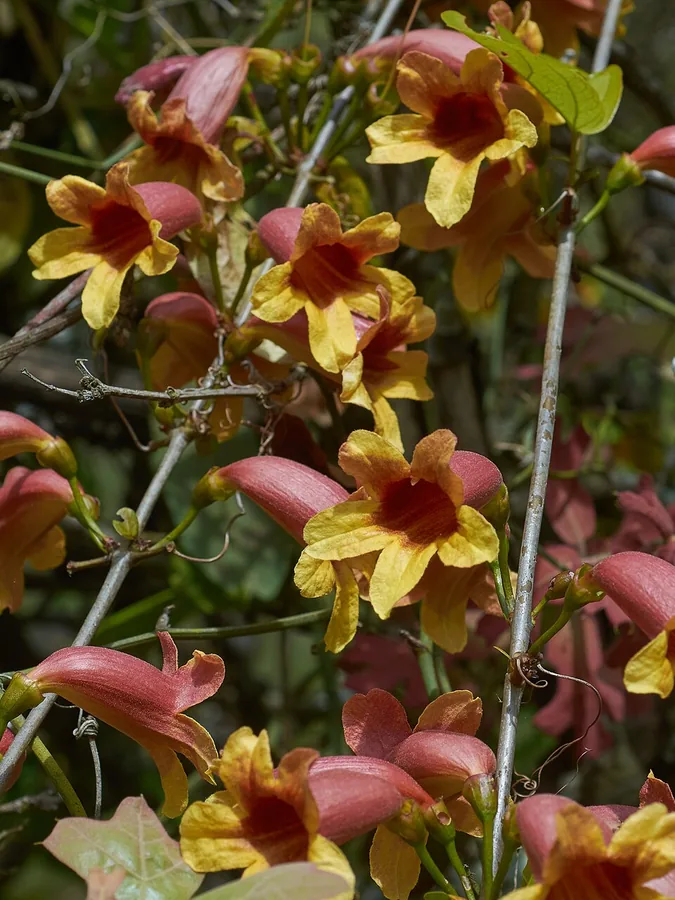
Bignonia capreolata is a fast, woody climber native to the southeastern United States, named for the cross-shaped pattern visible in the pith when an older stem is cut transversely. It is self-clinging, attaching to fences, walls, and arbors by tendrils tipped with adhesive disks rather than by twining, which is why it holds to flat surfaces. In early spring it produces an abundant flush of trumpet-shaped flowers whose nectar attracts hummingbirds.
Its adaptability is the practical headline. It performs across the light spectrum from full sun to deep shade, tolerates poor soils, withstands drought once established because a deep root system sustains it, and is cold hardy through zone 5 to zone 9. The cost of that vigor is management. Unchecked it ascends 30 to 50 feet and produces root suckers, so a substantial support and annual pruning are not optional.
It is routinely confused with the more aggressive trumpet creeper offered alongside it. Crossvine flowers earlier in the season, spreads less aggressively, and lacks the foliage and sap irritants that make its relative a skin concern.
Care
The short version: site it in full sun to maximize floral display, provide a structurally sound support for a large climber, water deeply only during establishment, and prune hard immediately after the spring bloom to control size without sacrificing the next year's flowers.
Light
Crossvine grows across the full range from full sun to full shade, which accounts for its reputation as undemanding. Sun drives the strongest performance, producing denser growth and a far heavier flush of spring trumpets, because higher light supports more photosynthate for flowering. In deep shade the plant etiolates, growing leggy and flowering sparsely.
Water
During establishment, maintain evenly moist soil so the developing root system can extend without check. Once established the plant is genuinely drought tolerant, and deep watering is warranted only during a prolonged dry spell. Under normal conditions rainfall meets its needs.
Soil
Soil requirements are minimal. It performs in average, well-drained loam or sandy ground and adapts across a wide range, tolerating a pH from 6.0 to 8.0. Organically rich ground yields the best growth, but the species persists in most conditions.
Temperature
This cold-hardy native tolerates approximately -20°F to 100°F (-29°C to 38°C), corresponding to zones 5 through 9. Neither winter low temperatures nor summer heat compromises it within that envelope.
Humidity
Average outdoor humidity suffices, so no target value applies. Air circulation is the more relevant factor, since stagnant, humid air around congested growth favors the occasional fungal leaf spot.
Feeding
Fertility demand is low. A light application of balanced fertilizer or compost in spring satisfies this vigorous native, and excess nitrogen is counterproductive because it promotes vegetative growth at the expense of flowering.
Pruning
Prune hard immediately after flowering finishes to manage size on the support, since cutting before bloom removes the flower buds carried on the previous season's wood. Remove root suckers as they emerge to limit the plant's lateral spread.
Repotting
As a landscape climber, crossvine is seldom maintained in a container for long. Where it is potted, pot up only when it has clearly outgrown the container, indicated by roots circling or escaping, rapid soil drying, and stalled top growth, all signs of a constrained root zone.
Size & spacing
Allow generous space. The vine ascends 30 to 50 feet (9 to 15 m) and spreads 6 to 9 feet (180 to 275 cm), so site it where a large, fast climber is appropriate and pair it with a structurally sound arbor or fence.
When to plant
Hardy from zone 5 to 9, crossvine is best planted in spring or fall, when moderate temperatures allow root establishment before the physiological stress of summer heat or winter cold. Flowering occurs from late winter to early spring, shifting later to May or June in the colder zones where spring warmth arrives more slowly.
Northern hemisphere
Southern hemisphere
Typical months for a temperate climate: start earlier in warm zones, later where spring frosts linger.
- Plant: spring or fall
- Harvest: late winter to early spring (May to June in colder zones)
Hardiness
USDA hardiness zones: 5–9
Temperature: down to -29°C
Troubleshooting
Crossvine carries almost no pest or pathogen pressure. The disorders it does present are physiological or cultural in origin, traceable to its inherent vigor, insufficient light, or mistimed pruning. Identify the symptom below and intervene early.
The vine outgrows its support and swallows nearby plants
The fast climbing reflects the species' inherent habit, with adhesive-disk tendrils that bond to any surface in reach. Shade compounds it, because low light drives elongation as the vine reaches for sun. Prune hard immediately after bloom and provide a sturdy arbor or fence engineered for a 30 to 50 foot climber.
Fix:
- Prune hard after flowering to reduce size
- Provide a sturdy, large support such as an arbor or fence
- Site in full sun for denser, more floriferous growth
New shoots popping up in the lawn away from the main plant
Those distant shoots are root suckers, the plant's natural mode of underground vegetative spread. Pull or dig them as soon as they appear, and mow over any arising in turf. Where containment is required, install a root barrier or site the plant in a bed where lateral spread is acceptable.
Fix:
- Pull or dig up root suckers as soon as they are spotted
- Mow or cut suckers in lawn areas
- Install a root barrier if confining the plant
A leafy, healthy vine that barely flowers
Vegetative vigor with poor bloom points to too much shade, since flowering depends on adequate light. Mistimed pruning contributes as well, because cutting before the spring bloom removes the buds. Relocate or train the vine into stronger light, withhold heavy nitrogen, and prune only after flowering concludes.
Fix:
- Move or train the vine into more sun
- Prune only after the spring bloom, not before
- Avoid excess nitrogen fertilizer
Dark spots scattered across the leaves
Discrete lesions are most often fungal leaf spot, a cosmetic issue on a species that otherwise resists pests and disease. Thin the canopy to improve air movement, remove the worst-affected leaves, and irrigate at the base rather than overhead to keep foliage dry. Crossvine has no serious insect or disease problems, so such spotting seldom progresses.
Fix:
- Improve air circulation by thinning growth
- Remove and dispose of badly affected leaves
- Avoid overhead watering
Toxicity
For households with pets or children, the verdict is straightforward: crossvine is not toxic. It does not appear on the ASPCA's list of poisonous plants and is regarded as safe for cats, dogs, and people. The one caveat is taxonomic, namely not confusing it with trumpet creeper, the related vine whose sap can irritate skin.
Safe for
People · Cats · Dogs · Horses · Rabbits · Livestock · Birds
Cats Safe
Crossvine is absent from the ASPCA toxic list, so a cat that samples a leaf is unaffected. A large quantity of any plant may cause transient drooling or loose stool, but nothing beyond that.
Dogs Safe
Dogs may chew the foliage without harm. The likely extent is mild gastrointestinal upset following ingestion of a large amount, which resolves without treatment.
Horses Safe
No constituent in this vine is toxic to horses. They can graze in its vicinity safely, although no animal should subsist on a single plant species.
Rabbits Safe
Rabbits may browse the foliage without risk. Introduce any new forage gradually, since an abrupt volume of fresh greens can disrupt a rabbit's digestion.
Livestock Safe
Cattle, goats, and sheep are unaffected by this vine. It contains none of the compounds that render certain pasture species hazardous.
Birds Safe
Crossvine presents no hazard to birds. Its spring trumpets in fact attract hummingbirds, which feed on the nectar without harm.
People Safe
This is the well-behaved crossvine rather than the irritant trumpet creeper, so handling it does not affect the skin. It is safe in proximity to children and pets.
No special handling required; as with any plant, large quantities of ingested foliage may cause mild, non-specific GI upset.
Varieties
Several named selections are distinguished chiefly by flower color and growth habit. These are the cultivars most often encountered in the nursery trade.
Tangerine Beauty
Tangerine Beauty is by a wide margin the most planted selection, clothing itself in warm tangerine to apricot-orange trumpets and flowering more freely than the species.
Atrosanguinea
Atrosanguinea is a more compact, restrained grower bearing darker purplish-red flowers on narrow, lance-shaped leaflets.
Dragon Lady
Dragon Lady is valued for its deep red-orange flowers.
How to propagate
Crossvine propagates readily, and in practice it often does so unaided, both by self-seeding and by adventitious rooting where low stems remain in contact with the soil.
SeedModerate
Fall or spring after pods mature · 1 to 2 growing seasons
Collect seed from the elongated, bean-like pods once they have ripened and sow in fall or spring. The species self-sows readily, so volunteer seedlings frequently establish without intervention. A sown plant requires a season or two to establish before vigorous growth begins.
Stem cuttingsModerate
Summer · Several weeks to root
Take softwood cuttings in summer, which root over several weeks. Root cuttings are also effective and are a documented method for this species, useful for clonally reproducing a particular selection.
LayeringEasy
Spring to summer · One season
Layering is the easiest method by a clear margin. Pin a low stem to the soil in spring or summer and it roots within one season, exploiting the same adventitious rooting by which the vine spreads as it sprawls.
Myths
Crossvine and trumpet vine are the same plant.
They are congeners within the same family but distinct species. Crossvine climbs by adhesive-disk tendrils, blooms in early spring, and remains comparatively restrained in growth. Trumpet creeper is the aggressive species, flowering in summer, with foliage and sap capable of irritating the skin.