Tree · Bignoniaceae
Northern Catalpa
Catalpa speciosa
A tough native shade tree that carries showy white flowers and lays on fast growth almost anywhere.
Full sun
Every 7–21 days
USDA 4–8
40–70 ft · 12.2–21.3 m
Overview
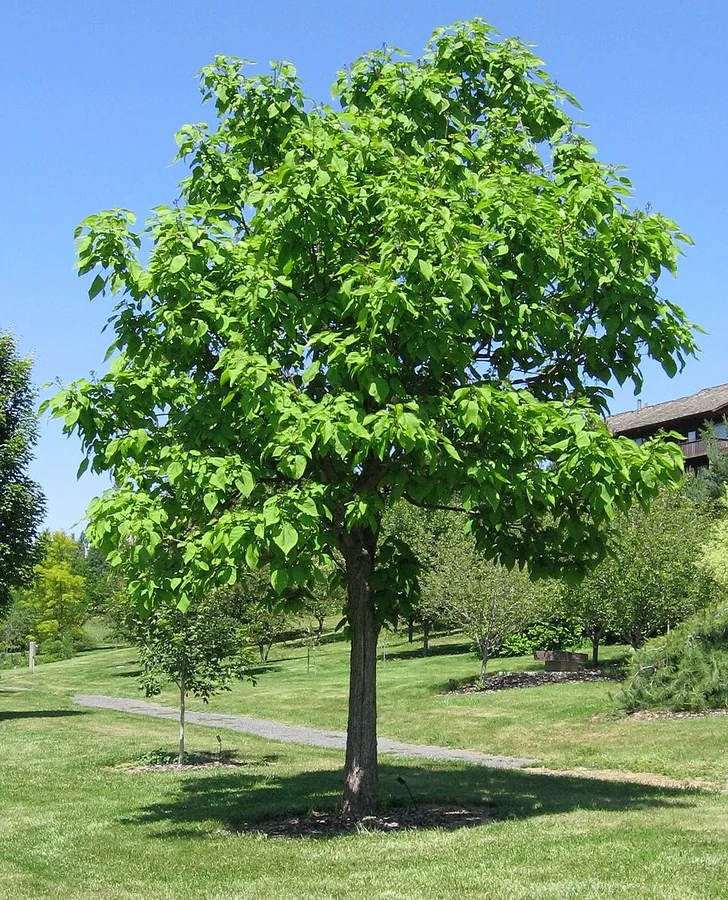
Northern catalpa is a fast-growing native valued as a shade tree, and its speed traces directly to its tolerance of poor sites. In late spring it produces showy white flowers in orchid-like panicles, and by fall those flowers set the long, slender seed pods behind the names cigar tree and Indian bean tree. The heart-shaped leaves run large, a habit that drives both its dense shade and its leaf litter.
Its defining trait is site adaptability. The species establishes on wet ground, dry ground, clay, poor soils, and polluted urban settings, and it holds through a span from -29°F to 100°F (-34°C to 38°C), which corresponds to USDA zones 4 to 8. Because that wide tolerance removes the limits that slow other trees, catalpa keeps adding growth where fussier species stall.
The cost of that fast, low-density growth is weak wood. Catalpa sheds large leaves, spent flowers, and long pods, and its brittle branches fail under wind and ice load. Siting it clear of patios and walks and pruning early to a sound central leader address both the litter and the structural risk, and in return it delivers decades of quick shade.
Care
The short version: full sun to part shade and nearly any soil, wet or dry, because broad tolerance is the species trait. Once roots establish it draws on flood and drought tolerance and rarely needs feeding or water, so management reduces to early structural pruning for sound form and siting that keeps falling limbs and litter out of the way.
Light
Catalpa performs best in full sun and tolerates partial shade. Higher light drives heavier flowering and a denser, mechanically sturdier crown, because the tree allocates more growth to a full canopy, while a shaded site still yields a healthy but looser specimen.
Water
An established tree tolerates both seasonal flooding and drought, so supplemental water is seldom required; the deep, adaptable root system buffers it against both extremes. Young trees lack that reach and need consistent moisture through the first year or two. Allow the top half of the soil to dry between waterings.
Soil
Few trees are less particular about soil. The species prefers a moist, fertile loam with organic matter, where growth is strongest, but it tolerates clay, saturated low spots, dry poor ground, and urban conditions, which is why it succeeds on difficult sites.
Temperature
This is a cold-hardy and heat-tolerant species, performing across USDA zones 4 to 8 and withstanding a range from -29°F to 100°F (-34°C to 38°C). Once established in the ground, temperature is rarely a limiting factor to manage.
Humidity
Ambient outdoor humidity is sufficient, so there is no target to meet. Air movement is the more important factor, because open airflow dries the foliage and denies leaf-spot and mildew fungi the moisture they need to establish.
Feeding
This adaptable native rarely needs feeding, since it grows well on poor soils without supplemental nutrients. Where growth is weak, a single balanced, general-purpose tree fertilizer in spring suffices, and in most years feeding can be omitted entirely.
Pruning
Prune in late winter to early spring to remove dead, weak, or crossing branches and to establish a strong central leader. Because the wood is brittle and fails readily, early structural pruning reduces the included bark and weak unions that lead to breakage over the tree's life.
Repotting
As a landscape tree rather than a container subject, catalpa rarely needs repotting. When a young tree is held in a pot, pot it up once roots circle the container, emerge from the drainage holes, or water passes straight through, all signs the medium can no longer hold moisture.
Size & spacing
This is a large tree, reaching 40 to 70 feet (12 to 21 meters) in height with a spread of 20 to 50 feet (6 to 15 meters). Allow generous open space, well clear of buildings, walks, and power lines, both for the canopy and for the brittle limbs it will drop.
When to plant
Timing is forgiving because the species establishes readily. Plant in spring after the last frost, when soils warm and roots can extend, or plant in fall, and expect the white flower panicles in May and June, with seed pods developing behind them through summer.
Northern hemisphere
Southern hemisphere
Typical months for a temperate climate: start earlier in warm zones, later where spring frosts linger.
- Sow: Late winter to early spring; seed needs no special pretreatment.
- Plant: Spring after the last frost, or in fall.
- Harvest: Showy white orchid-like flower panicles in late spring to early summer (May to June), followed by long bean-like seed pods.
Hardiness
USDA hardiness zones: 4–8
Temperature: down to -34°C
Troubleshooting
Catalpa is structurally hardy, and most of its problems are foliar and cosmetic rather than lethal. The exception is verticillium wilt, a vascular disease with no cure, so distinguishing it from the cosmetic issues matters most. Match the symptom below before applying any treatment.
Abrupt vascular wilt and one-sided branch decline
This is verticillium wilt, a soilborne fungus that colonizes and occludes the xylem, which produces the wilting and one-sided dieback and has no chemical cure. Confirm it by cutting a wilting branch and examining the wood beneath the bark for brown or greenish vascular streaking. Prune out affected limbs, maintain vigor through proper watering, and avoid replanting a susceptible species in the same soil if the tree dies.
Fix:
- Prune out and dispose of affected branches
- Keep the tree vigorous with proper watering, as there is no chemical cure
- Avoid replanting susceptible species in the same soil if a tree dies
Storm-broken limbs and wind-torn foliage
Catalpa wood is naturally brittle, so wind, ice, and hail load break limbs and shred the large leaves. Inspect for snapped or hanging branches after storms and prune them off with clean cuts to leave sound wood. Early structural training to a strong central leader builds better branch unions, and siting away from patios and walks keeps falling limbs from becoming a hazard.
Fix:
- Prune cleanly to remove broken or hanging limbs
- Develop a strong central leader and good branch structure with early structural pruning
Heavy summer defoliation from clustered leaf-feeders
The cause is the catalpa sphinx caterpillar, the catalpa worm, a host-specific defoliator that feeds only on catalpa. Feeding in gregarious clusters, it can strip a tree in mid to late summer, yet the tree re-leafs and sustains no lasting injury because the damage falls late in the season. Handpicking suits a small tree, though the larvae are often left in place, since anglers prize them as fish bait.
Fix:
- Handpick caterpillars from small trees, or simply tolerate them since trees easily re-leaf
- Harvest them as fish bait, for which catalpa worms are prized
- Apply a labeled caterpillar control such as Bt or a recommended insecticide only for heavy infestations on small or young trees
Powdery white fungal growth or foliar spotting
These are powdery mildew and leaf spot fungi, occasionally with twig blight that kills small shoots. Severe mildew yellows the foliage and forces early leaf drop, but the impact remains cosmetic and rarely warrants a fungicide, since the tree is not structurally harmed. Rake and dispose of fallen infected leaves to reduce inoculum, and open the canopy to improve air circulation.
Fix:
- Rake and dispose of fallen infected leaves
- Improve air circulation
- These foliar problems are largely cosmetic and rarely require fungicide
Toxicity
For pet-owning households the verdict is favorable: catalpa is not toxic. It is absent from the ASPCA poison-plant lists, and the long bean-like pods, though inedible, are not a recognized poisoning hazard. The single caution is the foliage, which can provoke minor contact dermatitis in sensitive skin, so gloves are sensible for a large cleanup.
Safe for
People · Cats · Dogs · Horses · Rabbits · Livestock · Birds
Cats Safe
Catalpa is absent from the ASPCA toxic list, so a cat that bats at a fallen pod is not at risk.
Dogs Safe
There is no poisoning hazard for dogs. One that chews a stray pod may show mild gastrointestinal upset from the bulk, but the tree contains no toxin.
Horses Safe
Catalpa carries no toxin recognized for horses and does not appear on poison-plant lists, so grazing nearby is safe.
Rabbits Safe
The foliage and pods contain nothing toxic to rabbits, so a nibbled leaf causes no harm.
Livestock Safe
Cattle, goats, and sheep can graze around a catalpa without risk, since the species is not a recognized poisoning hazard.
Birds Safe
Neither the foliage nor the long seed pods harm birds.
People Safe
The tree is safe to be near, though the pods are inedible and the foliage can cause minor contact dermatitis in sensitive skin, so gloves are advisable for a large cleanup.
The long seed pods and large leaves create heavy litter, and the foliage can cause minor contact dermatitis in sensitive people, so wear gloves when handling.
Varieties
A few catalpas appear in cultivation, ranging from the large northern and southern species to selections chosen for habit or foliage color. The taxa worth distinguishing are set out below.
Catalpa speciosa (Northern catalpa)
The larger and hardier of the two principal species, it grows tall and upright, carries green-scented foliage, and withstands cold down through zone 4.
Catalpa bignonioides (Southern catalpa)
A smaller, more rounded tree distinguished by fetid-scented foliage and more heavily purple-spotted flowers that open slightly later in the season.
Catalpa bignonioides 'Nana' (Umbrella catalpa)
A dwarf, non-flowering form grafted onto a standard trunk, which develops into a dense, rounded umbrella-shaped head.
Catalpa bignonioides 'Aurea'
A golden-leaved selection valued for its bright yellow to yellow-green foliage.
How to propagate
Catalpa propagates readily, whether by sowing seed collected from the pods or by striking cuttings from an existing tree.
SeedEasy
Collect seed from the long bean-like pods in fall and sow in late winter to spring. · 1 to 2 seasons
Seed is the most direct method. Collect it from the long pods in fall and sow from late winter into spring. No soaking or cold stratification is required, since the seed germinates without pretreatment. Germination is reliable, and given the tree's fast growth a seedling reaches landscape size within a season or two.
Stem cuttingsModerate
Softwood cuttings in early summer or hardwood cuttings in the dormant season. · 1 season to root
Cuttings are also viable. Take softwood in early summer or hardwood during dormancy, allowing about a season for them to root. Root cuttings succeed as well. Named selections such as 'Nana' are propagated by grafting rather than cuttings, because they do not come true on their own roots.
Myths
The catalpa worm consumes the entire canopy and ultimately kills its host.
The catalpa sphinx caterpillar can defoliate a tree completely, yet it re-foliates and recovers fully, even when defoliation recurs over several successive years, because the feeding occurs after the tree has banked its season's growth. The defoliation looks alarming but does no lasting harm, so intervention is rarely warranted.
The elongated seed pods are toxic to companion animals.
Catalpa is absent from the ASPCA toxic-plant lists and is classed as non-toxic. The long pods are inedible but not a poisoning hazard for cats or dogs.