Houseplant · Nepenthaceae
Tropical Pitcher Plant
Nepenthes
Supply warmth, high humidity, and rainwater, and this carnivore constructs its own insect-trapping cups.
Bright indirect
Every 2–4 days
64–84°F · 18–29°C
USDA 10–12
Overview
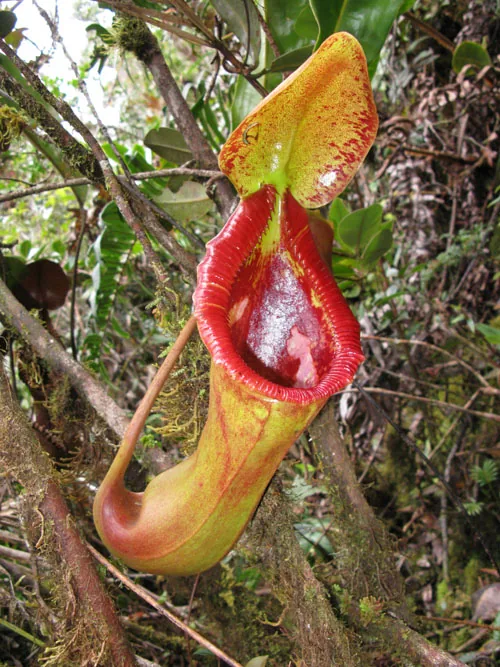
The tropical pitcher plant, genus Nepenthes, is a climbing carnivore of the warm, humid forests of Southeast Asia and adjacent tropics. Each leaf terminates in a tendril that inflates into a pendent cup, and that structure functions as the trap. Prey slips from the waxy rim, drops into the enzyme-bearing fluid, and the plant absorbs the released nutrients, an adaptation that compensates for the impoverished substrates it colonizes. The dangling cups gave rise to the common name monkey cups.
Successful indoor culture depends less on intervention than on reproducing the plant's native regime. It demands bright indirect light, sustained warmth, and high humidity, conditions that echo the forest margin of its origin. Meet all three and the vine continues to climb and initiate new pitchers; allow any one to drift and the plant reverts to producing bare leaves without traps.
This is not a species for the inexperienced windowsill grower. The limiting factors are water quality and atmospheric moisture rather than nutrition, because the roots are intolerant of tap-water salts and the medium must remain open and lean. Cultivate it as the bog plant it is, and it yields one of the most singular and arresting growth forms available to an indoor collection.
Care
The short version: provide bright indirect light, maintain warmth between 64°F and 84°F, and hold humidity near 60% to 80%. Establish it in an airy, nutrient-poor carnivorous medium, irrigate only with distilled or rainwater, and allow the pitchers to supply their own nutrition.
Light
Provide bright, indirect light for the greater part of the day, comparable to an east-facing window or a lightly shaded southern exposure. Some direct morning sun is acceptable, but intense midday radiation scorches the foliage, and insufficient light is the principal cause of arrested pitcher production.
Water
Maintain the medium damp but never waterlogged, irrigating every 2 to 4 days, and retain a small volume of fluid within each pitcher. Apply only low-mineral water such as distilled, reverse-osmosis, or rainwater, because tap-water salts accumulate in the open medium and progressively injure the roots.
Soil
Establish it in an airy, nutrient-poor carnivorous mix of long-fiber sphagnum moss with perlite and orchid bark. Avoid conventional potting soil, which retains more water and fertilizer than a species adapted to lean ground can tolerate. Target a slightly acidic pH between 5.0 and 6.5.
Temperature
Warmth sustains active growth, optimally between 64°F and 84°F (18°C to 29°C). The plant has no frost tolerance and responds poorly to cold drafts, so an interior position away from chilled windows serves it best.
Humidity
This factor is decisive. Hold humidity within the 60% to 80% range by means of a humid room, a tray, or an enclosure, since dry air is the most frequent reason pitchers fail to form.
Feeding
Withhold all root feeding, because the pitchers capture their own insect prey throughout spring and summer. A specimen isolated from prey will accept an occasional, very dilute foliar feed, and that represents the extent of its requirement.
Pruning
Remove browned or spent pitchers and dead leaves at the base to maintain condition. Shortening the excessively long vines additionally promotes branching and stimulates fresh pitcher production.
Repotting
Renew the medium every 1 to 2 years into a clean open mix, since aged sphagnum decomposes and begins retaining water without air. Roots emerging from the drainage holes, a soggy decomposed substrate, or diminished and fewer pitchers all indicate the interval has elapsed.
Size & spacing
Vine length ranges from 1 to 6 feet (30 to 180 cm) according to species and training, with a spread near 12 to 35 inches (30 to 90 cm). Allow sufficient clearance for the pitchers to hang unobstructed rather than pressing against a wall or neighboring specimen.
Troubleshooting
Most disorders in Nepenthes originate in water quality, light, or humidity rather than in pest pressure. The plant registers stress first in its pitchers and leaf tips, so learn to interpret those indicators promptly. Identify the symptom below and correct the underlying condition before the decline advances.
Browning, desiccated pitchers and leaf margins
Crisp brown margins point almost invariably to mineral toxicity from tap water, whose dissolved salts concentrate quickly in the low-nutrient carnivorous medium. Low humidity and any fertilizer reaching the roots compound the injury. Change over to distilled, reverse-osmosis, or rainwater, leach the accumulated salts by flushing the pot, and raise the humidity surrounding the plant.
Fix:
- Switch to distilled, RO, or rainwater
- Flush the mix with low-mineral water to leach salts
- Increase humidity and stop any root fertilizing
Wilting driven by root rot in a collapsed medium
Wilt paired with a saturated, compacted pot indicates root rot arising from an anaerobic medium. As sphagnum decomposes it retains water while excluding the air roots depend on, and conventional potting soil imposes the same condition from the outset. Lift the plant to assess the roots, excise the darkened, softened tissue, and re-establish it in fresh open sphagnum amended with perlite and bark.
Fix:
- Repot into fresh airy sphagnum and perlite/bark mix
- Trim mushy roots
- Keep the mix damp but never waterlogged
Leaf growth continues while pitcher production stalls
A Nepenthes that extends leaves without terminal traps is signaling that either atmospheric moisture or light intensity falls short of the threshold for pitcher initiation. Traps develop reliably only where humidity is sustained across the 60% to 80% band and the crown receives strong indirect light through most of the day. Stable warmth and low-mineral water then support the young pitchers as they mature and begin to catch.
Fix:
- Raise humidity around the plant
- Move to a brighter spot with strong indirect light
- Maintain stable warm temperatures and keep watering with low-mineral water
Toxicity
For pet owners the assessment is favorable: the tropical pitcher plant is not toxic to cats, dogs, or other household animals. The fluid within the pitchers is mild rather than harmful, and although it is not meant for ingestion, discouraging pets from chewing the traps mainly serves to preserve the plant.
Safe for
People · Cats · Dogs · Horses · Rabbits · Livestock · Birds
Cats None
Cats face no toxic exposure. Even a cat that swats a pitcher or samples the fluid comes to no harm, though positioning the traps beyond reach protects them from tearing.
Dogs None
No toxic constituents affect dogs. A dog that chews a leaf or laps the pitcher liquid may show a brief digestive upset attributable to novelty alone, and nothing further.
Horses Safe
Horses carry no poisoning risk from this species, and its modest stature keeps it well away from any pasture they would graze.
Rabbits Safe
Rabbits may browse it without consequence. The tissue contains no toxin, so an incidental bite is harmless, even though the plant seldom draws their attention.
Livestock Safe
Cattle, goats, and sheep are not at risk. Neither the foliage nor the trap fluid holds any compound capable of provoking a reaction.
Birds Safe
Pet birds remain unaffected. The plant presents no toxin, though a small bird is more plausibly captured as prey than harmed by any poison.
People Safe
People incur no toxic risk. The pitcher fluid is not intended for consumption, yet the plant contains no poison, so handling it or a child's incidental taste presents no genuine hazard.
The digestive fluid in the pitchers is mild but it is sensible to keep pets from drinking it or chewing the traps.
Varieties
The genus encompasses hundreds of species and hybrids, ranging from tolerant introductory plants to the giants sought by specialist collectors. The following are the selections most often encountered in cultivation.
Nepenthes ventricosa
A highland species that tolerates ordinary indoor conditions and produces characteristically hourglass-shaped pitchers, which accounts for its standing as a common introductory selection.
Nepenthes × ventrata
A robust cross between ventricosa and alata, ranked among the most forgiving tropical pitcher plants for indoor culture.
Nepenthes alata
A broadly adaptable species bearing slender winged pitchers, marketed as a houseplant more frequently than nearly any other in the genus.
Nepenthes rajah
A Bornean giant noted for producing some of the largest pitchers in Nepenthes, with a capacity exceeding a quart of fluid.
How to propagate
Nepenthes can be increased by the faster route of stem cuttings or the slower route of seed. Each method requires the same warm, humid environment that sustains the parent plant.
Stem cuttingsModerate
Active growth in spring to summer · 6 to 12 weeks to root in warm, humid conditions
Vegetative cuttings offer the most dependable means of increase, and they respond best when taken during active growth in spring and summer. Prepare a vine section carrying two or three nodes and root it in damp sphagnum under warmth and high humidity, where root initiation typically requires about 6 to 12 weeks.
SeedDemanding
Fresh seed sown any time under warm, humid conditions · Several months to germinate and a few years to reach mature size
Propagation by seed is protracted and demanding. It calls for fresh, viable seed held under consistent warmth and humidity, since germination alone can span several months and the seedlings need a few more years to attain mature size.
Myths
You have to feed pitcher plants meat or fertilizer to keep them alive.
These are modest feeders that secure their own nitrogen by trapping insects in the pitchers, so the roots require no supplementation. Light, humidity, and low-mineral water contribute far more to plant vigor than any deliberate feeding, whereas a regimen of meat scraps or houseplant fertilizer tends to induce trap rot.
Pitcher plants need rich, fertile potting soil like other houseplants.
Adapted to nutrient-depleted substrates, they require an open medium such as long-fiber sphagnum with perlite. Conventional potting soil retains excessive fertilizer and moisture and can prove lethal.