Houseplant · Commelinaceae
Tradescantia 'Nanouk'
Tradescantia albiflora 'Nanouk'
A compact variegated cultivar whose pink holds only under bright, filtered light, kept dense by routine pinching.
Bright indirect
50–81°F · 10–27°C
USDA 9–12
4 in · 10 cm
Overview
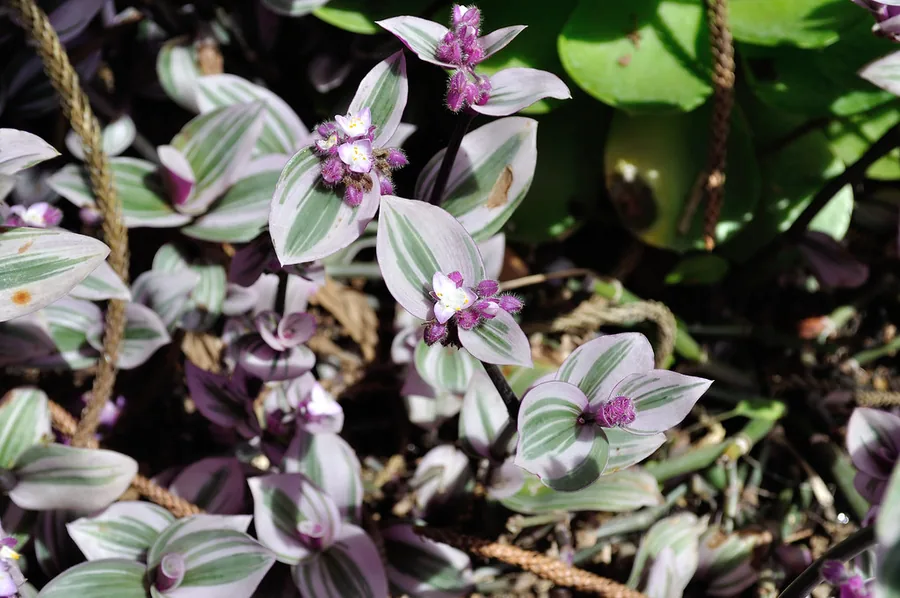
Tradescantia albiflora 'Nanouk' is a compact, variegated cultivar grown chiefly for foliage. The fleshy leaves carry longitudinal stripes of pink, green, and cream over a purple-flushed underside, and the habit stays low and mounded rather than long and pendent. It was selected within a Dutch breeding program and is now distributed internationally as an easy, quick-establishing pot plant.
The cultivar belongs to the Commelinaceae, the same family as the common inch plant, and that lineage explains much of its resilience. Nodes root readily, lateral buds break freely to branch the plant, and it recovers quickly from setbacks. Its principal cultural requirement is adequate light: because the pink and white leaf sectors lack chlorophyll, insufficient light forces the plant onto its green tissue and the variegation reverts toward plain green.
Grow it as a year-round indoor subject. It requires warmth, bright filtered light, and a free-draining medium, and it responds to periodic pinching with denser, more compact growth. The one serious failure mode is waterlogging, which rots the succulent stems; short of that, the plant is difficult to kill.
Care
The short version: supply bright, filtered light to sustain the variegation, water when the surface of the medium has dried and reduce the frequency in winter, hold it warm in a free-draining substrate, and pinch the tips regularly to maintain a compact habit.
Light
Provide bright, filtered light close to a window, because the coloration is light-dependent: only sufficient light lets the plant support the non-green pink and white sectors and retain them. In low light the variegation reverts to green and the internodes elongate. Exclude harsh midday sun, which scorches the foliage.
Water
During active growth, water thoroughly, then allow the top inch (3 cm) of the medium to dry before rewatering; reduce the frequency in winter as growth slows. The succulent stems are intolerant of saturation, so the medium must drain freely and the pot must never stand in water, since sustained wetness induces rot.
Soil
Use a free-draining, loam-based medium or a peat-free houseplant compost. Drainage is the governing requirement, because the fleshy stems decay in a substrate that remains wet. Amending a dense mix with perlite or grit improves aeration and water movement.
Temperature
Maintain temperatures of 50°F to 81°F (10°C to 27°C), the range of ordinary interior warmth. The cultivar has no frost hardiness, so in winter position it away from cold glazing and drafts to prevent chilling injury.
Humidity
Average indoor humidity is adequate, and no specific figure need be targeted. Very dry air desiccates the leaf tips and favors spider mites, whose populations increase under hot, dry conditions, so slightly elevated humidity is beneficial.
Feeding
Apply a liquid houseplant fertilizer monthly through spring and summer, coinciding with active growth. Suspend feeding in winter during dormancy, because nutrients applied to a resting plant are not taken up and accumulate as salts in the medium.
Pruning
Pinch the growing tips frequently to release lateral branching and preserve a dense, compact form rather than a leggy one. Excise any fully green reverted shoots as they emerge, because reverted tissue is more vigorous and will overgrow the variegated growth.
Repotting
Repot only when genuinely rootbound, as this compact cultivar occupies a container slowly. The diagnostic signs are roots emerging from the drainage holes, water passing through with little uptake, and stalled growth.
Size & spacing
Mature dimensions are modest: height near 4 inches (10 cm) with a spread of 4 to 20 inches (10 to 50 cm). The low, spreading habit suits a shelf, a windowsill, or the foreground of a grouped planting.
Troubleshooting
Nanouk signals cultural problems through predictable changes in its foliage and stems. Loss of color, elongated bare stems, and softened blackened bases each trace to a specific cause. Identify the disorder below by its diagnostic signs and correct the underlying condition promptly.
Softened, blackened stem bases
Persistent saturation produces root and stem rot, the cultivar's one lethal disorder. Cease watering and let the medium dry, then unpot, excise all soft brown tissue, and repot into fresh, free-draining substrate. Where decay is extensive, salvage the plant by rooting clean terminal cuttings.
Fix:
- Stop watering and let the soil dry out
- Remove rotted roots and stems and repot into fresh, free-draining mix
- Take healthy tip cuttings to start a fresh plant if rot is advanced
Webbing, stippling, or cottony deposits
These indicate spider mites, aphids, or mealybugs. Fine webbing with pinprick stippling denotes mites, clustered soft-bodied insects denote aphids, and cottony white masses at the nodes denote mealybugs. Dislodge and wipe the pests off, treat with insecticidal soap or horticultural oil, and isolate the plant until it is clear.
Fix:
- Rinse/wipe off pests and treat with insecticidal soap or horticultural oil
- Isolate the plant to prevent spread to other houseplants
- Repeat treatment as needed until clear
Reversion of pink variegation to green
This is light limitation, not disease. The pink and white leaf sectors contain little chlorophyll, so under insufficient light the plant compensates by favoring green tissue, and new growth emerges greener. Relocate it to bright, filtered light, and remove any wholly green shoots before their greater vigor overtakes the variegated growth.
Fix:
- Move to a spot with bright, filtered/indirect light
- Avoid harsh direct midday sun, which can scorch the leaves
- Remove any fully plain green reverted shoots so variegated growth is not overtaken
Elongated, sparsely leaved stems
Etiolation develops when the plant is not pinched, and inadequate light compounds it as the stems extend toward the source. Cut the tips back to force lateral branching and rebuild density. The removed sections root within a week, so return them to the same pot to thicken the display.
Fix:
- Pinch or cut back the growing tips to force branching and bushier growth
- Propagate the trimmed tip cuttings to fill in the pot
- Increase light if the plant is stretching
Marginal browning and scorched patches
Intense direct sun causes leaf scorch, most severe on the foliage nearest the glazing; low humidity and irregular watering also brown the tips. Shift the plant out of direct sun into bright, filtered light, remove the damaged leaves, and water on a consistent schedule.
Fix:
- Move out of harsh direct sun into bright filtered light
- Trim badly damaged foliage
- Keep watering consistent and maintain average humidity
Toxicity
Classify this as mildly toxic rather than benign. The sap is a contact irritant capable of provoking dermatitis in people and, in animals that chew the foliage, salivation or mild gastrointestinal upset. The risk is low rather than acute, but gloves during pruning and separation from foliage-chewing pets are sensible precautions.
Toxic to
Cats · Dogs · Horses · Rabbits · Livestock · Birds · People
Cats Mild
A cat that ingests the foliage may salivate or show mild gastric upset, and cutaneous contact with the sap can produce a localized red, itchy lesion. The response is minor in degree, but a cat inclined to chew leaves should be kept away from the plant.
Dogs Mild
Dogs respond similarly. The irritant sap can redden the muzzle or paws on contact, and a chewed stem elicits transient salivation or a brief episode of mild gastrointestinal upset.
Horses Mild
The ASPCA records this plant as toxic to horses, with dermal contact the principal concern. The sap irritates exposed skin, although a potted specimen seldom comes within reach of a horse.
Rabbits Caution
No rabbit-specific toxicological data are available, so caution is the appropriate classification. The same irritant sap that affects other animals argues for excluding it from the hutch.
Livestock Caution
Grazing species are poorly documented here, and the irritant sap alone warrants caution. As a container houseplant it rarely encounters cattle, goats, or sheep in any case.
Birds Caution
Evidence for birds is lacking, so the conservative course is to prevent pet birds from pecking the foliage. Sap that irritates skin may equally affect a probing beak.
People Caution
In people the sap is an established skin irritant capable of provoking contact dermatitis, an itchy rash, on those handling cut stems. Wear gloves when pruning or taking cuttings and wash the hands afterward.
Sap can irritate skin; the RHS advises wearing gloves when handling. The toxic principle is irritant sap (contact dermatitis / mild GI irritation), NOT calcium oxalate
Helpline numbers

United States
ASPCA Animal Poison Control: (888) 426-4435 (fee applies)
Poison Control: (800) 222-1222



Canada
Poison Centres: 1-844-764-7669
Varieties
Nanouk denotes the pink-variegated clone most growers intend, but one closely related selection is worth distinguishing.
Tradescantia 'Green Nanouk'
'Green Nanouk' is an RHS-recognized selection that retains the compact Nanouk habit while replacing the pink variegation with uniformly green foliage.
How to propagate
Few houseplants propagate more readily. Because the stems root at every node, a single terminal cutting establishes within days, and one specimen quickly yields many.
Stem cuttingsEasy
Spring to summer · Roots in about 1 week in summer (~21°C), 2 weeks in winter (~18°C) per the plant patent
This cultivar is among the simplest houseplants to increase. Take a terminal cutting in spring or summer, insert it in water or a moist medium, and expect rooting in roughly a week at 70°F (21°C) or about two weeks under cooler winter conditions near 64°F (18°C). Because the stems branch freely and root at every node, a small number of cuttings soon fills a container. Note a legal constraint: 'Nanouk' is a patented clone, so propagation for sale is restricted.
Myths
Nanouk is non-toxic to pets and people.
It is not. The ASPCA classifies the inch plant as toxic to dogs, cats, and horses, and both NC State and the RHS identify the sap as a skin irritant that induces contact dermatitis and mild gastrointestinal upset. The active agent is irritant sap rather than the calcium oxalate present in many other houseplants, so protective gloves address the hazard directly.
Nanouk retains its pink coloration in any indoor position.
It does not. In a dim location the variegation reverts and the pink is lost. Coloration is governed by light, so bright, filtered light is what preserves the pink, green, and white sectors. Site it near a well-lit window, just outside the range of harsh direct sun.