Ornamental · Commelinaceae
Spiderwort
Tradescantia virginiana
At ease in sun or shade, spiderwort renews its three-petaled flowers on a daily cycle.
Full sun
USDA 4–9
2–3 ft · 0.5–0.9 m
Overview
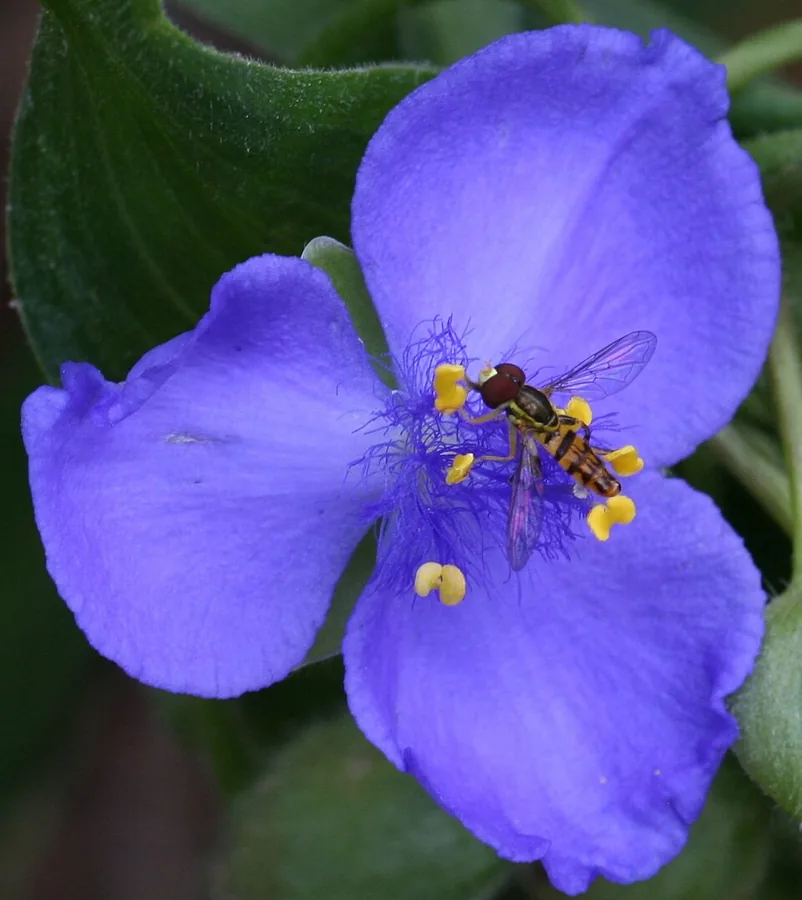
Spiderwort is a clump-forming herbaceous perennial from eastern North America, valued for a long succession of three-petaled flowers through late spring and summer. Each flower is short-lived, opening in the morning and closing by afternoon, but the plant keeps producing fresh buds, so bloom continues day after day. The grassy, arching foliage adapts to a wide range of sites, from open borders to the dappled shade of a woodland edge.
Its adaptability traces to a broad tolerance of light and soil. Flowering is heaviest in full sun, yet the plant persists in partial and even deep shade, and it grows across clay, sand, chalk, and saturated ground that limits less-tolerant species. Cold-hardy to zone 4, it regrows from the crown each spring and demands little maintenance once established.
The one predictable issue is a midsummer decline. After the primary flush, and especially under heat and moisture stress, the clump sprawls and browns as it shifts toward post-bloom dormancy. Cutting the plant back hard removes the exhausted top growth and stimulates fresh basal shoots, frequently producing a second flush in late summer.
Care
The short version: grow spiderwort in moist, fertile soil in sun to shade, irrigate through dry spells to sustain growth, and cut the clump back hard after the first flush to trigger renewed basal foliage.
Light
Flowering is most prolific in full sun, but spiderwort remains vigorous in partial and even deep shade. In hot-summer climates, afternoon shade reduces heat load on the foliage and moderates the midsummer decline.
Water
Spiderwort favors consistently moist to occasionally wet soil, reflecting its affinity for damp habitats. Supplemental irrigation during dry spells, particularly after cutting back, sustains the moisture the crown needs to push fresh basal growth.
Soil
The plant grows across clay, loam, sand, and chalk, and even tolerates wet ground and the juglone near black walnut. It performs best in fertile, moist but well-drained soil across a pH range of 6.0 to 8.0.
Temperature
Cold hardiness extends to roughly -29°F (-34°C), and the plant withstands heat to about 95°F (35°C). That upper heat is the trigger for the foliage sprawl and browning seen in midsummer, a heat-stress response rather than disease.
Humidity
Ambient outdoor humidity is adequate, so no specific level applies. Air circulation matters more than humidity itself, because still air in dense, damp clumps favors the rust and leaf-spot fungi.
Feeding
As a vigorous perennial, spiderwort has modest nutrient demands. A light application of balanced fertilizer or compost at the onset of spring growth suffices; excess nitrogen promotes weak, floppy stems.
Pruning
Deadheading removes spent flowers and encourages a second late-summer flush by redirecting energy from seed set. When the foliage sprawls or browns after the first flush, shear the stems back hard, and cut all growth to ground level at season's end.
Repotting
As a hardy border perennial it is not repotted but periodically divided. Lift and split the clump every 3 to 4 years to relieve congestion, restore vigor, and counter the central dieback and reduced flowering that follow crowding.
Size & spacing
Mature clumps stand 1.5 to 3 feet (46 to 91 cm) tall with a spread of 12 to 18 inches (30 to 46 cm). Spacing plants to that width maintains air movement through the foliage and limits fungal problems.
When to plant
In the temperate garden spiderwort keys its cycle to the seasons. Plant it in spring after the last frost, or set out container-grown stock in autumn; flowering then runs from late spring through early July, with many plants reblooming into late summer as conditions cool.
Northern hemisphere
Southern hemisphere
Typical months for a temperate climate: start earlier in warm zones, later where spring frosts linger.
- Plant: Spring after frost; container plants can also be set out in autumn
- Harvest: Late spring through early July (May-July), often reblooming into late summer; cultivars can flower June-September
Hardiness
USDA hardiness zones: 4–9
Temperature: down to -34°C
Troubleshooting
Spiderwort is largely trouble-free, and the few problems it shows are cosmetic rather than threats to the plant's survival. The midsummer decline, occasional slug feeding, and rust or leaf spot account for nearly all of them. Identify the symptom below and intervene early.
Midsummer sprawl and browning as the clump enters post-bloom decline
This is post-bloom decline compounded by heat and soil moisture stress, not a disease. Once the primary flush ends the clump loses turgor, opens at the center, and the foliage senesces. Shearing the top growth off, combined with irrigation through dry weather, prompts fresh basal shoots that reclothe the plant into fall.
Fix:
- Shear or cut the stems back hard after flowering
- Water during dry spells to encourage fresh basal regrowth
- Allow the plant to reflush in late summer and fall
Ragged feeding damage on emerging spring shoots
The soft new growth is grazed by slugs and snails, whose slime trails accompany the torn leaf margins. Feeding pressure is heaviest in damp, shaded positions where the mollusks shelter. Hand-collecting after dark, removing the moist debris that harbors them, and deploying traps or barriers reduces the population and protects the shoots.
Fix:
- Hand-pick slugs and snails, especially in the evening
- Reduce moist hiding spots and debris near the crown
- Use slug traps or barriers if damage is heavy
Rust pustules and fungal leaf spot in congested plantings
Orange-brown pustules or discrete lesions signal rust and fungal leaf spot, favored by the still, humid air of overcrowded clumps. Removing and destroying affected leaves lowers the inoculum, while thinning and cutting back restores airflow. Keeping irrigation off the foliage denies the fungi the leaf wetness they require to infect.
Fix:
- Remove and dispose of affected foliage
- Cut back and thin congested clumps to improve airflow
Toxicity
Spiderwort's risk is primarily dermatological rather than systemic. The sap acts as a contact allergen and can provoke an itchy rash on exposed skin, so gloves are warranted when cutting back or dividing, while ingestion by a pet tends to cause only mild irritation of the mouth and stomach. Prevent animals from grazing it, but a stray nibble carries little consequence.
Toxic to
Cats · Dogs · Horses · Rabbits · Livestock · Birds · People
Cats Mild
Ingestion of the leaves or stems produces mild gastrointestinal upset, and sap contact can irritate a cat's mouth or skin. Drooling and pawing at the face are the signs to watch.
Dogs Mild
A dog that ingests the foliage may drool or develop brief, mild gastrointestinal upset. Sap contact can redden the skin around the muzzle at the point of exposure.
Horses Caution
The ASPCA lists the genus as toxic to horses, with dermatitis the principal effect. Discourage grazing animals from feeding on the foliage repeatedly.
Rabbits Caution
The irritant sap can cause oral soreness and mild digestive upset in rabbits, so the foliage is not suitable forage.
Livestock Caution
Goats, sheep, and cattle seldom graze it, but ingesting the sappy stems can irritate the mouth and digestive tract. An incidental nibble poses little risk.
Birds Caution
The same irritant sap makes spiderwort unsuitable around pet birds, which may react to small quantities.
People Caution
The sap functions as a skin allergen capable of inducing an itchy dermatitis, so gloves are advisable before cutting back or dividing. Because no part is consumed, exposure risk is cutaneous rather than gastrointestinal.
Sap can cause contact dermatitis and is a skin allergen; wear gloves and protective equipment when cutting back or dividing.
Helpline numbers

United States
ASPCA Animal Poison Control: (888) 426-4435 (fee applies)
Poison Control: (800) 222-1222



Canada
Poison Centres: 1-844-764-7669
Varieties
Garden spiderwort is represented by a compact group of named selections, distinguished mainly by flower color and foliage brightness. The following are the most horticulturally useful.
'Sweet Kate' (syn. 'Blue and Gold')
Deep blue-purple flowers contrast sharply with golden-chartreuse foliage on a compact plant of 12 to 24 inches (30 to 60 cm).
'Concord Grape'
Rich grape-purple flowers are carried over cool blue-green foliage.
'Zwanenburg Blue'
A vigorous selection of the Andersoniana Group bearing large, deep blue-purple flowers.
'Satin Doll'
Soft pink flowers are produced on a compact, tidy habit.
'Billberry Ice' / white-flowered forms
Pure white, three-petaled flowers suit and illuminate a shaded position.
How to propagate
Spiderwort propagates readily, either by vegetative division of an established clump or from its own freely produced seed.
DivisionEasy
Spring, or in autumn after flowering · Reaches full size in 1-2 years
Division is the reliable vegetative method, performed in spring or in autumn after flowering ends. Lift a congested clump and separate it into sections, each retaining roots and shoots to re-establish quickly. Replanted divisions attain full size within 1 to 2 years, and dividing on a several-year cycle sustains the vigor of the parent clump.
SeedModerate
Sow seed in spring; plants also self-sow readily in the garden · 1-2 years to mature, flowering-size clumps
Spiderwort self-sows freely, so spring-sown seed germinates and grows on with minimal intervention, reaching flowering size in 1 to 2 years. Named cultivars, however, do not breed true from seed and are propagated by division to preserve their traits. Removing the spent flower stems limits self-seeding where volunteer seedlings are unwanted.
Myths
The hardy garden spiderwort is botanically the same as the trailing inch plant houseplant.
The two occupy different sections of the genus. Tradescantia virginiana and the x andersoniana garden hybrids are cold-hardy, clump-forming border perennials reliable to zone 4. The trailing houseplants, tender tropical species such as T. zebrina and T. fluminensis, cannot survive comparable cold. The hardy garden spiderworts remain contained clumps, whereas tropical T. fluminensis becomes invasive in the warm southern states and should be avoided.
Spiderwort requires full sun to grow well.
Full sun maximizes flowering, but the plant is well adapted to partial and even deep shade. In hot-summer regions, afternoon shade is a net benefit, lowering heat stress and delaying the midsummer sprawl.