Houseplant · Commelinaceae
Purple Heart
Tradescantia pallida
Strong light drives the pigment and dry-leaning soil protects the roots, so purple heart holds its deep violet with minimal intervention.
Full sun
USDA 10–11
8–12 in · 20–30 cm
Overview
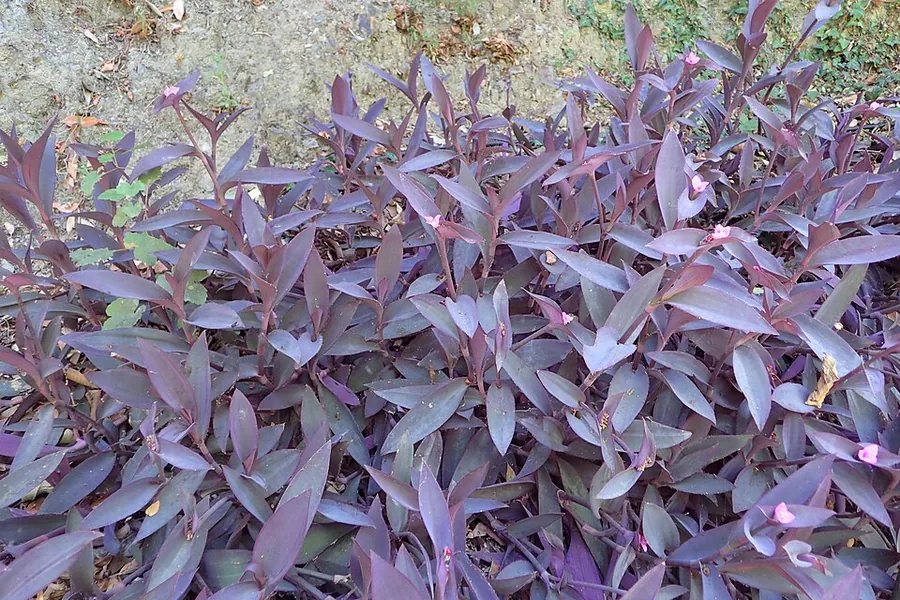
Tradescantia pallida, grown as purple heart, is prized chiefly for its pigmentation: the low, trailing stems and narrow, pointed leaves carry a deep violet-purple, set off by small pink flowers in the warmer months. Native to Mexico and a member of the spiderwort family, Commelinaceae, it stands close to the inch plants.
Its reputation for toughness is earned. Growth is fast, the plant tolerates drought once established, and detached stem segments root without effort. Light, though, is the controlling factor: full sun develops and holds the violet pigment, whereas in shade the foliage reverts toward green and the stems etiolate, elongating with widely spaced leaves.
Indoors, treat it as a container specimen in the brightest available window, where the trailing habit fills the pot quickly. The cell sap is a mild skin irritant that can provoke contact dermatitis, so gloves are sensible during handling, and placement should keep foliage away from pets and young children inclined to chew it.
Care
The short version: supply the strongest light available to drive the purple pigment, use well-drained soil kept on the dry side between waterings, hold temperatures above 50°F (10°C), and pinch periodically to force branching.
Light
Light governs everything here. Full sun, or the brightest position available, is what develops and holds the pigment behind the violet color; deprived of it the foliage greens over and the stems draw out long and thin. Indoors, a south-facing window supplies the intensity the plant requires.
Water
This species is highly drought-tolerant once established, adapted to drying out, so allow the surface to dry before rewetting. Constantly saturated soil is the principal danger: it induces root and stem rot, the one condition capable of killing an otherwise durable plant. Err toward underwatering.
Soil
Drainage is the non-negotiable requirement. The plant performs best in a rich, organic, free-draining medium, yet it accepts clay, loam, or sand and a pH span from acid to alkaline. What it will not endure is a substrate that holds water, since saturation feeds rot.
Temperature
As a tender perennial, purple heart has no frost tolerance; exposure to cold below 50°F (10°C) blackens the soft top growth outright. Ordinary indoor temperatures satisfy it throughout the year. Where winters fall under that threshold, grow it as a houseplant or move containers inside before the cold sets in.
Humidity
Ambient household humidity meets its needs, so no adjustment is warranted. The plant withstands dry indoor air without any decline in health.
Feeding
Apply a balanced general-purpose fertilizer once a month across spring and summer, the plant's active season, when the nutrients are actually taken up. As growth slows through the cooler months, suspend feeding.
Pruning
Pinching removes the growing tip and releases the lower buds, which is why it produces a compact, well-branched plant and fresh growth. Pinch as often as the form requires, and cut spent flower stems after bloom. Because the tips root so readily, they double as propagation material.
Repotting
Repot every 1 to 2 years, or sooner once the plant becomes crowded. Roots protruding from the drainage holes, thin or stalled new growth, and soil that drains almost immediately after watering all indicate the root system has outgrown its container.
Size & spacing
Mature dimensions are modest: roughly 8 to 12 inches (20 to 30 cm) in height with a spread of 12 to 18 inches (30 to 45 cm). The low, spreading habit suits a hanging container or the front edge of a mixed planting, where the stems can cascade.
Troubleshooting
Most disorders of purple heart resolve to two variables: light and moisture. Insufficient light degrades color and form, while excess moisture threatens the roots. The symptoms below identify which is at fault and what corrective step it calls for.
Basal stems softening, blackening, and collapsing
Soft, blackened, collapsing tissue at the base is root and stem rot, driven by soil held too wet, and it is the single disorder that reliably kills this otherwise hardy plant. Affected roots turn brown and slimy rather than firm and pale. Withhold water, excise all rotted tissue, and set healthy firm cuttings into fresh, free-draining medium to regrow.
Fix:
- Stop watering and allow soil to dry out
- Cut away rotted tissue and re-root healthy firm stem cuttings in fresh well-drained mix
- Discard severely rotted plants and soil
Top growth blackening after cold or frost
Blackened, collapsed top growth after a cold event reflects this plant's lack of hardiness; it tolerates no cold below 50°F (10°C) or frost. Remove the damaged tissue and return the plant to warmth. In frost-prone areas, overwinter containers indoors or hold rooted cuttings rather than rely on basal survival.
Fix:
- Remove damaged top growth
- Bring containers indoors or take cuttings to overwinter where frost occurs
- Where roots survive in mild climates, allow the plant to resprout from the base
Stippling, sticky residue, or webbing from sap-feeders
Stippled, distorted foliage with sticky residue or webbing points to sap-feeding pests: spider mites, mealybugs, aphids, or scale, each identifiable by its trace. Look for fine webbing, cottony masses, insect clusters, or fixed bumps on stems and the undersides of leaves. Rinse and wipe the plant, apply insecticidal soap or horticultural oil on a repeating schedule, and isolate it until the infestation clears.
Fix:
- Rinse plant and wipe off pests
- Treat with insecticidal soap or horticultural oil, repeating as needed
- Isolate affected plants to prevent spread
Greening foliage with elongated, sparse stems
Loss of violet color with drawn-out growth signals inadequate light. The pigment behind the purple only develops under strong sun; below that threshold the leaves green and the stems etiolate, spacing their foliage widely. Relocate the plant to full sun or the brightest window available, then pinch the elongated stems to restore density and color.
Fix:
- Move to a spot with full sun or as much bright direct light as possible
- Pinch back leggy stems to encourage compact, well-colored regrowth
Elongated bare stems bearing leaves only at the tips
The trailing, sprawling habit of this species leaves stems elongated and leafless except at the growing tips once pinching is neglected; low light compounds the stretching. Regular pinching removes the terminal growth and forces lateral branching, which restores density. The severed tips root readily and can refill the same pot.
Fix:
- Pinch or cut stems back to encourage branching and bushier growth
- Root the removed tips as cuttings to fill in the plant or start new ones
Skin reddening after contact with cut sap
The cell sap released by cut or crushed tissue is a skin irritant and can produce contact dermatitis, presenting as redness and itching. The response is minor and self-limiting, and a rinse of soap and water settles it. Wearing gloves during pinching, pruning, or cutting prevents any recurrence.
Fix:
- Wash the affected skin with soap and water
- Avoid further bare-handed contact with cut stems
Toxicity
Purple heart is not lethal, but it is not inert either. Its sap is a mild irritant capable of reddening skin, and ingestion irritates the mouth and stomach of a browsing animal. Handle cut stems with gloves, and site the plant beyond the reach of pets and children.
Toxic to
Cats · Dogs · Horses · Rabbits · Livestock · Birds · People
Cats Mild
Ingestion by a cat produces salivation and mild gastrointestinal upset, and sap contact can redden and irritate the skin. The effect is minor, though a persistent chewer is best denied access.
Dogs Mild
Dogs present the same picture as cats: some salivation and transient stomach upset following ingestion, with dermal irritation where the sap makes contact.
Horses Caution
In horses this irritant sap affects the mouth and skin, so browsing should be prevented rather than permitted.
Rabbits Caution
Reliable feeding data for rabbits is lacking, and the sap's irritancy alone is grounds to exclude the plant from their diet. It should not be provided as forage.
Livestock Caution
Grazing livestock are subject to the same oral and gastric irritation once they ingest the sap, making exclusion by fencing the prudent measure wherever they can reach the plant.
Birds Caution
Pet birds, small and physiologically sensitive, are poorly suited to proximity with an irritant-sapped plant. Position it outside cages and away from perches.
People Caution
In people, working with broken stems can induce contact dermatitis, with localized redness and itching at the point of sap contact. Use gloves for pruning and cutting, and prevent children from mouthing the foliage.
Cell sap is a skin irritant (contact dermatitis); wear gloves when pruning, pinching, or taking cuttings
Helpline numbers

United States
ASPCA Animal Poison Control: (888) 426-4435 (fee applies)
Poison Control: (800) 222-1222



Canada
Poison Centres: 1-844-764-7669
Varieties
In commerce purple heart is represented almost entirely by one named clone, the form responsible for its characteristic depth of color.
'Purpurea'
This clone accounts for virtually all material sold under the name Purple Heart, distinguished by stems and leaves of a deeper, more uniform violet-purple than the species type.
How to propagate
Vegetative increase is nearly effortless in purple heart, whose stems root from the nodes with little encouragement.
Stem cuttingsEasy
Any time during active growth · Roots in 1-2 weeks
Propagation by cutting is close to guaranteed. The stems form roots freely from every node, so a shoot tip or a stem segment set into soil, or suspended in water, establishes within a week or two. Take cuttings at any point during active growth.
Myths
Purple heart requires constant moisture and cannot survive a dry period.
The physiology runs the other way. Once it is established the plant is drought-adapted, and overwatering, not drought, is the genuine risk, because saturated soil rots the roots and stems. Allow the medium to dry between waterings.
The purple coloration is fixed regardless of growing conditions.
Light intensity determines the color. Strong sun develops the deepest violet, whereas a shaded plant loses pigment, greens, and stretches toward the available light.