Ornamental · Liliaceae
Toad Lily
Tricyrtis hirta
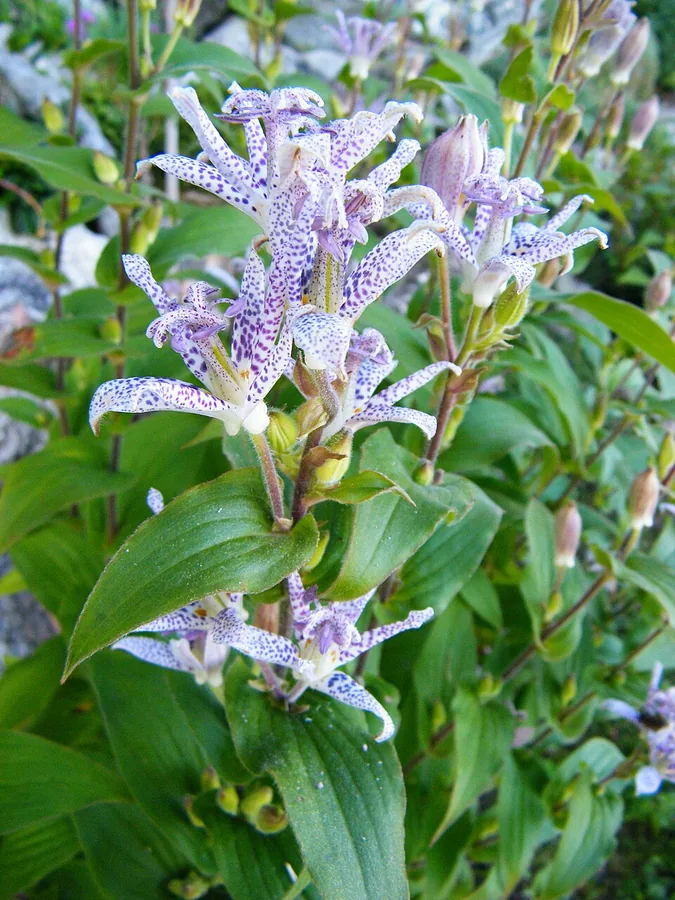
Rooted in shade and steady moisture, the toad lily holds its orchid-like, purple-speckled flowers back until the quiet close of the season.
Partial shade
Every 3–7 days
USDA 4–8
2–3 ft · 0.6–0.9 m
Overview
The toad lily holds real value in the late shade border, opening orchid-like flowers speckled in purple as the surrounding planting declines. A woodland perennial from Japan, it is hardy across USDA zones 4 to 8 and carries its bloom on arching, leafy stems through dappled light. The individual flowers are small, waxy, and freckled along the upper stem, rewarding a close look.
Its niche is the cool, shaded, moisture-retentive ground where few other perennials will flower. The plant depends on rich, humusy soil that stays evenly damp, and it fails fastest under drought, which is the single most common way to lose it. Growth is slow and clump-forming, so a stand needs several seasons to knit together, after which it reappears dependably each spring.
Once the site suits it, the plant is close to self-managing. Held cool, shaded, and moist, its only routine demands are periodic division and vigilance against slugs. Site it wrong, in excess sun or dry soil, and the same plant answers with spotted leaves and an early dieback in place of its late flowers.
Care
The short version: part to full shade, organically rich soil held evenly moist, and shelter from hot afternoon sun. Feed once in spring, cut spent stems to the ground at season's end, and divide the clump every few years to renew its vigor.
Light
Grow it in part to full shade, conditions that keep the foliage cool and slow evaporation from the root zone. A little morning sun is tolerated, but hot afternoon light scorches the leaves and drives the premature dieback, because the plant cannot replace the moisture it loses under that load.
Water
Hold the soil consistently moist, since it is drought at the root that triggers the leaf spotting and early dormancy. Watering every 3 to 7 days meets that need in most weather, and directing water to the base keeps the foliage dry, which denies leaf fungi the film of moisture they need to establish.
Soil
Provide moist, humusy, well-drained soil high in organic matter, mirroring the woodland floor it evolved on. A slightly acidic to neutral pH of 5.5 to 7.0 is the working range, and an annual compost top-dressing sustains both the organic content and the moisture-holding structure the roots rely on.
Temperature
The species is fully cold-hardy, enduring winter minima near -29°F (-34°C) and summer maxima around 86°F (30°C). Because the crown and roots survive hard frost intact, no lifting or winter protection is warranted in its hardiness range.
Humidity
Ambient outdoor humidity is adequate, so no target figure applies. Air movement is the limiting factor here, since stagnant, damp air held among crowded leaves is precisely the condition under which anthracnose develops.
Feeding
A single feed in spring, either a balanced fertilizer or a compost top-dressing applied as growth resumes, supplies what this plant uses in a season. Its slow growth rate means demand is modest, and heavier feeding returns little.
Pruning
Formative pruning is unnecessary. Cut the dead foliage and stems to the ground once they have browned at the close of the season, which removes overwintering inoculum and tidies the crown, and leave the plant undisturbed otherwise.
Repotting
Grown in open ground rather than containers, the clumps still decline as they age and crowd. Lift and divide them every few years in early spring, prompted by a congested center, thinning bloom, or reduced leaf size, all of which signal that competition within the clump has begun to limit performance.
Size & spacing
Mature plants stand 2 to 3 feet (58 to 91 cm) tall with a spread of about 18 to 23 inches (46 to 58 cm). Spacing that allows the stems to arch and admits air between clumps lowers leaf wetness and, with it, the incidence of foliar disease.
When to plant
The toad lily follows a late phenology. Plant it out in spring once frost has passed so the roots establish through the warm months, and the plant reserves its bloom for the end of the cycle, flowering from August into September.
Northern hemisphere
Southern hemisphere
Typical months for a temperate climate: start earlier in warm zones, later where spring frosts linger.
- Sow: Late winter to early spring (seed; may require cold stratification)
- Plant: Spring after frost danger has passed
- Harvest: August to September (late summer to early fall)
Hardiness
USDA hardiness zones: 4–8
Temperature: down to -34°C
Troubleshooting
Nearly every toad lily disorder resolves to one of two moisture problems: soil that ran too dry at the root, or foliage that stayed too wet in still air. Read the symptom for which extreme is at work, then correct the cause rather than the symptom.
Mottled leaves and color-broken flowers turning purple
Irregular color-breaking in the flowers with mottled foliage that finally goes purple indicates Tricyrtis floral virus, an aphid-transmitted infection with no chemical cure. Because the virus moves in sap, rogue out and destroy affected plants, suppress the aphid vectors, and disinfect tools between plants to break the transmission chain.
Fix:
- Remove and destroy infected plants to limit spread
- Control aphid vectors
Small orange spots on the leaves and stems
Small orange spots on leaves and stems are anthracnose, a fungal leaf spot that establishes on foliage left wet in still air. Control follows from denying it that moisture: remove the spotted leaves to cut inoculum, open the planting to improve air circulation, and water at the base so the foliage dries quickly.
Fix:
- Remove and discard symptomatic leaves
- Improve air circulation
- Water at the base to keep foliage dry
Spotted leaves and premature summer dormancy
Leaf spotting followed by early dormancy is the plant's protective response to drought stress, typically from excess sun or soil that dries between waterings faster than the roots can compensate. Water deeply and on a consistent schedule, mulch to buffer soil moisture, and relocate to shadier, moister ground if the symptom recurs.
Fix:
- Water deeply and consistently
- Add organic mulch to retain moisture
- Site in shadier, moister conditions
Ragged holes in the leaves with slime trails nearby
The ragged holes in soft new growth, with slime trails alongside, identify slugs and snails, which thrive in the shaded, damp bed the plant itself prefers. Inspect after dark or at first light by torch and remove them by hand. Clearing the mulch and debris that shelter them reduces the population, and iron-phosphate bait checks persistent feeding.
Fix:
- Hand-pick slugs and snails in the evening
- Remove garden debris and mulch harboring them
- Use iron-phosphate slug bait if needed
Toxicity
For households with pets or children, the record is clear: the toad lily is not toxic. The common name misleads, because this is not a true lily and none of the nephrotoxic compounds that endanger cats are present. It can be planted wherever animals and children pass.
Safe for
People · Cats · Dogs · Horses · Rabbits · Livestock · Birds
Cats None
Safe around cats. Despite the lily in its name, it is not a true lily and lacks the nephrotoxin responsible for the kidney injury Easter and Asiatic lilies cause, so an exploratory nibble poses no real hazard.
Dogs None
No toxicity is on record for dogs, and chewing a leaf or stem should have no consequence. As with any plant, a large quantity may transiently upset a sensitive digestive system.
Horses Safe
Regarded as safe for horses, with no report on record of the plant causing them harm.
Rabbits Safe
Rabbits graze toad lily without ill effect and often crop it hard, so a wire guard is worthwhile where flowering is the goal.
Livestock Safe
No poisoning is documented in cattle, sheep, or goats. As a small shade perennial, it seldom occupies grazing ground in any case.
Birds Safe
Safe for birds, with no toxic constituents recorded in the foliage, flowers, or seed.
People Safe
Not known to be toxic to people. It is not a culinary plant, so treat it strictly as ornamental and wash your hands after handling, a sensible habit with any garden species.
Generally considered safe; no toxicity reported. Wash hands after handling as a routine precaution.
Varieties
The named toad lilies differ chiefly in stature, habit, and the density of their flower freckling rather than in culture. Two forms account for most of what is grown.
Miyazaki
Miyazaki is the more compact selection, its arching stems reaching only about 2 feet and bearing white to pale lilac flowers densely freckled with purple.
Hairy toad lily (species form)
The upright species form grows taller, to 2 to 3 feet, on stems clothed in hairs over their whole length, the character that gives the hairy toad lily its common name.
Companions
Toad lilies pair best with the other plants of the moist woodland floor, which share their love of shade and damp, rich soil.
How to propagate
Toad lilies increase readily, and vegetative division is the dependable method because it renews the clump and reproduces a cultivar exactly. Cuttings and seed are both workable where more plants or the true species are wanted.
DivisionEasy
Early spring while dormant · One growing season
Division is the most reliable technique and the correct one for named cultivars, since it reproduces the parent exactly rather than segregating as seed does. Lift the dormant clump in early spring and separate it into rooted divisions. Each reestablishes over a single growing season.
Stem cuttingsModerate
Late spring to early summer · Several weeks to root
Stem cuttings root readily, succeeding even in plain water, which reflects the tissue's willingness to form adventitious roots. Take them from late spring into early summer and allow several weeks for a root system to form before potting on.
SeedModerate
Late winter to spring · Multiple seasons to flowering size
Seed suits raising the species rather than cultivars, which do not come true, and in favorable ground the plant self-sows. Sow from late winter into spring, accepting that seedlings need several seasons to reach flowering size.
Myths
The toad lily is a true lily and therefore poses the same fatal kidney risk to cats as Easter and Asiatic lilies.
The name places it in the lily family, but its genus is Tricyrtis, not Lilium, so it is not a true lily in the toxicological sense that matters. No botanical or extension source records it as toxic, and it is absent from the ASPCA toxic plant list. It carries none of the severe kidney danger that true lilies pose to cats.