Bulb · Liliaceae
Oriental Lily
Lilium
Tall, richly scented summer blooms that perfume a whole garden, governed by one firm rule: keep them away from cats.
Full sun
Every 3–7 days
USDA 3–9
1–6 ft · 0.3–1.8 m
Overview
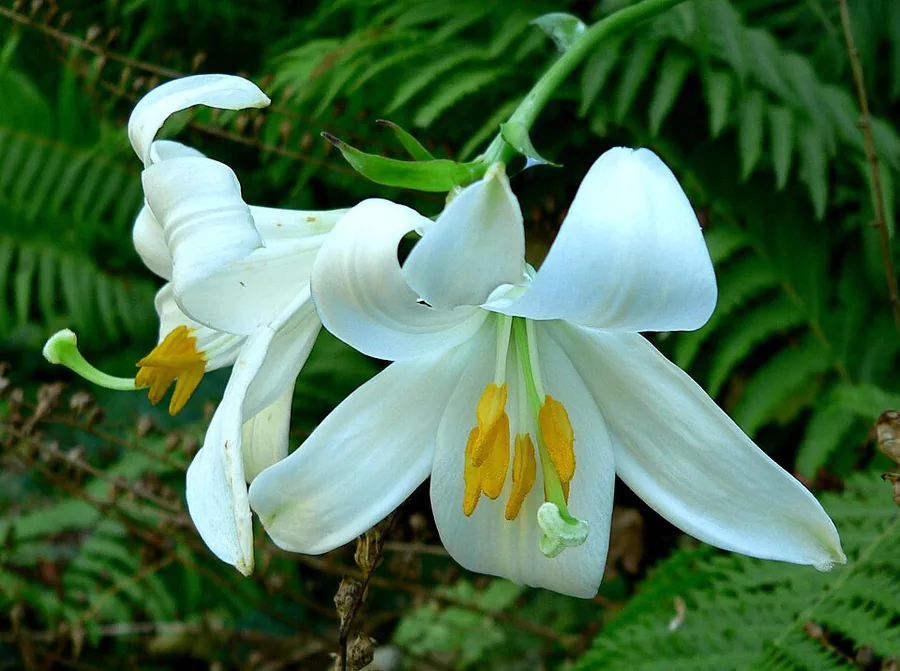
Oriental lilies are the large, fragrant lilies that define high summer, and the fragrance registers well before the plant is in view. They are bulbous perennials in the genus Lilium, derived from Japanese species that breeders crossed to produce the showy garden hybrids grown now. Stargazer is the reference point most people hold, though the whole group shares the upright stems and large, heavily perfumed flowers that define the class.
As hardy perennials, they persist from the same bulb over successive years and increase slowly into clumps. Given a favorable site the stems reach 6 feet (183 cm), presenting their flowers above the surrounding border through mid to late summer. Two seasons of establishment precede full performance, after which a settled clump delivers its strongest display.
One fact governs every planting decision where a cat is present. Oriental lilies are deadly to cats, to a degree no other animal on the roster approaches, and that risk alone is enough to exclude them from certain homes. Sited with that constraint respected, they are otherwise an undemanding, productive plant whose requirements come down to sun and free-draining soil.
Care
The short version: full sun with tolerance for light afternoon shade, deep planting in rich free-draining soil, even moisture held by mulch that also keeps the roots cool, and a light feed as growth emerges in early spring.
Light
Site Oriental lilies in full sun for the strongest flowering, though they accept some partial shade during the hottest part of the day. The working principle is sun on the flowers and shade on the roots, and a mulch layer is what delivers the cool root zone that principle depends on.
Water
Hold the soil evenly moist but never waterlogged, because saturated conditions are what drive bulb rot. Irrigate every 3 to 7 days according to the weather, and mulch to conserve that moisture and buffer the root zone against summer heat.
Soil
Use fertile, humus-rich soil that drains freely, on the acidic to neutral side at a pH of 5.5 to 7.0. They will not tolerate alkaline ground, so test the pH where it is uncertain and incorporate ample organic matter before planting.
Temperature
They perform across a broad range, from about 30°F to 84°F (-1°C to 29°C), and the bulbs are hardy enough to overwinter in situ throughout their zones. Summer heat is tolerated provided the root zone is kept cool and moist.
Humidity
Average outdoor humidity is sufficient, so no target figure applies. Air movement matters more than atmospheric moisture, because a crowded, damp canopy is precisely the condition that allows botrytis to establish.
Feeding
Fertilize sparingly. A single balanced feed in early spring, timed to emerging growth, supplies what the season requires, and additional applications confer no benefit.
Pruning
Deadhead spent flowers, and on cut stems remove the anthers to prevent pollen staining. Allow the foliage to senesce naturally, since it returns reserves to the bulb for the next year, then cut the stems down in fall.
Repotting
Divide a clump every 3 to 4 years in fall once it is dormant, which counters the decline in bloom size that comes with congestion. Container bulbs benefit from a refresh every few years; reduced flowering, crowded clumps, and bulbs heaving to the surface are the diagnostic signs.
Size & spacing
Stem height ranges from 1 to 6 feet (30 to 183 cm) by cultivar, with a spread of 1 to 3 feet (30 to 91 cm). Space each plant so air circulates freely, and provide support for the tallest stems where their height warrants it.
When to plant
The schedule follows the bulb's dormancy cycle. Set the bulbs in fall or early spring, about 6 inches deep, allow them to root and produce stems through spring, and expect flowers from mid to late summer, with some cultivars extending into fall.
Northern hemisphere
Southern hemisphere
Typical months for a temperate climate: start earlier in warm zones, later where spring frosts linger.
- Plant: Plant bulbs in fall or early spring, about 6 inches deep
- Harvest: Mid to late summer, some cultivars into fall
Hardiness
USDA hardiness zones: 3–9
Temperature: down to -40°C
Troubleshooting
Most disorders originate below ground or surface during wet weather, so the bulb and the lower foliage are where diagnosis should begin. Rot and fungal disease take hold there first, ahead of any symptom higher on the plant. Match the sign described below and intervene before it advances upward.
Soft, decaying bulbs and shoots that fail to emerge
The disorder here is bulb rot, and its origin lies in drainage rather than the bulb itself. When soil holds water around the scales, the tissue stays anaerobic and fungal pathogens colonize the weakened bulb, which is why heavy or waterlogged ground is the common thread. Discard any bulb that has gone mushy, amend the bed with organic matter to open its structure, and reset the sound bulbs where water cannot pool.
Fix:
- Improve drainage by amending soil with organic matter
- Remove and discard rotted bulbs
- Replant healthy bulbs in raised or better-drained sites
Brown or gray lesions and gray mold in prolonged wet weather
Spotted foliage and rotting stems in a damp, crowded stand point to botrytis, a fungal disease whose spores establish readily on wet tissue. Prolonged humidity and standing moisture on the leaves give the pathogen the film of water it needs to germinate, so the two levers that matter are drier leaves and faster drying. Remove and destroy the infected material, widen the spacing to move air through the planting, and water at the base so the canopy is not left wet.
Fix:
- Remove and destroy affected foliage
- Improve air circulation and spacing
- Avoid overhead watering
Skeletonized leaves and buds with bright red beetles feeding
Foliage stripped to the veins alongside a vivid red insect indicates the lily leaf beetle, whose larvae do the heaviest feeding on leaves and buds. Because the beetle overwinters and emerges to feed early, hand removal of adults and larvae on sight keeps the population from compounding across the season. Aphids concentrate on the buds in the same window, so dislodge them with a water jet or treat with insecticidal soap, and scout through spring and early summer while numbers are still low enough to manage.
Fix:
- Handpick beetles and larvae
- Spray aphids off with water or treat with insecticidal soap
- Monitor regularly through the growing season
Toxicity
This entry carries a serious warning. Oriental lilies are catastrophically toxic to cats, since even a trace of pollen or a mouthful of vase water can precipitate fatal kidney failure, which rules them out of any household with cats. Their effect on dogs and horses is far milder and they present no meaningful hazard to people, but the feline risk is the determining factor.
Toxic to
Cats · Dogs · Horses · Rabbits · Livestock · Birds
Safe for
People
Cats Severe
This species is specifically nephrotoxic to cats, and that is what makes it lethal. Any part of the plant, pollen groomed from the coat, or a mouthful of vase water can injure the kidneys, and the presenting signs are deceptively mild at first: vomiting, a sudden loss of appetite, and lethargy. Over the following day or two the injury progresses to acute kidney failure, which becomes fatal quickly without intervention, so emergency care is not optional.
Dogs Caution
The toxicity that endangers cats does not extend to the kidneys in dogs. Ingestion tends to produce drooling and vomiting, the kidneys are not implicated, and most dogs recover once the material clears the gut.
Horses Caution
A horse that samples the foliage may show a mild digestive upset and some drooling. The reaction is uncomfortable rather than dangerous, though grazing on the plant is still worth preventing.
Rabbits Caution
Extension sources classify lilies as unsafe for rabbits, so the leaves, stems, and flowers should not be offered. Keep container plants and cut stems out of range of any rabbit with access to the house or garden.
Livestock Caution
Cattle, goats, and sheep are best excluded from lily plantings, since grazing the foliage can bring on digestive disturbance. Fence off any bed where the bulbs are established.
Birds Caution
Pet birds should not be permitted to sample the leaves or blooms. Regard the entire plant, pollen included, as off limits in the vicinity of a cage.
People Safe
For people, Oriental lilies present no poisoning hazard, and no part must be eaten or avoided on safety grounds. The pollen does stain skin and fabric, so remove the anthers from cut stems, and wash your hands after handling where a cat shares the home.
Keep all parts of the plant and any cut stems, fallen pollen, and vase water completely out of reach of cats; even brushing against pollen and grooming it off the fur can poison a cat. Wash hands after handling.
Helpline numbers

United States
ASPCA Animal Poison Control: (888) 426-4435 (fee applies)

United Kingdom
Animal PoisonLine: 01202 509000 (fee applies)

Australia
Animal Poisons Helpline: 1300 869 738
Varieties
The Oriental class includes many named hybrids, but several recur consistently in gardens and trade. These are the ones a grower should be able to identify by name.
Stargazer
The best-known selection carries sky-facing crimson-pink blooms edged in white and dusted with orange pollen, and it comes into flower ahead of most other Oriental lilies.
Rubrum (Lilium speciosum var. rubrum)
A fragrant Japanese show lily identified by white-and-pink spotted petals that recurve strongly back on themselves.
Casa Blanca
Valued for large, pure white, outward-facing flowers and a powerful fragrance that carries well across a garden.
How to propagate
Vegetative increase from the bulb is so dependable that seed is rarely the chosen route. The methods below differ mainly in how soon they return flowers, trading speed against effort.
Bulbs & cormsEasy
Fall when dormant · 1-2 growing seasons to flowering size
The most reliable method is scaling: lift a dormant bulb in fall and detach a few of the fleshy outer scales for potting. Each scale carries the reserves to form its own bulblet, and those reach flowering size in one to two seasons.
Offsets & pupsEasy
Fall · 1-2 seasons
Established bulbs produce their own offset bulblets around the base as a natural increase. Detach them from the parent in fall and reset each at roughly three times its own height deep, and they bulk up to size over one to two seasons.
DivisionEasy
Fall when dormant · 1 season to reestablish
Once a clump grows congested, lift it in fall during dormancy and separate it into smaller sections. The divisions reestablish and return to bloom the following season.
SeedDemanding
Fall or spring · Several years to flowering
Seed is the slowest route, sown in fall or spring for the grower willing to wait. Seedlings need several years to reach blooming size, which is why vegetative bulb increase is the standard practice.
Myths
A cat has to eat the leaves to be poisoned, so pollen and vase water are harmless.
In a true lily the toxic principle is present throughout the plant, not confined to the leaves. A cat can be poisoned simply by grooming a few grains of pollen from its coat or by drinking the vase water, and even a tiny, indirect exposure can trigger fatal kidney failure.
Lilies are equally dangerous to cats and dogs.
The two risks differ by species, not by degree. True lilies cause severe, often fatal kidney failure in cats specifically, whereas a dog that ingests one typically experiences no more than a brief gastrointestinal upset with no renal involvement.