Herb · Lamiaceae
Thyme
Thymus vulgaris
Grown in full sun and lean, sharp-draining soil, thyme yields aromatic sprigs season after season.
Full sun
Every 7–14 days
USDA 5–9
6–12 in · 15–30 cm
Overview
Thyme (Thymus vulgaris) is a low, woody subshrub of the Mediterranean and a member of the mint family, Lamiaceae. It performs as a cold-hardy perennial, resuming growth from its crown each spring once established. Its resilience traces to its origin on dry, sun-baked ground, where poor soil and sharp drainage are the rule.
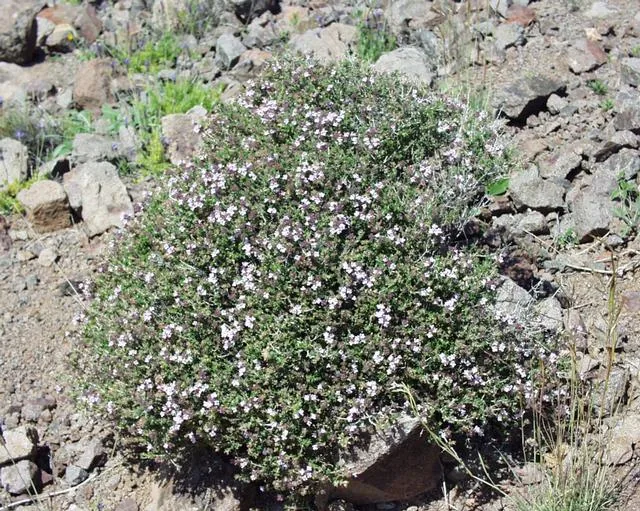
Mature plants stay compact at 6 to 12 inches (15 to 30 cm), forming a slow-spreading, aromatic mound. Small pink to lilac flowers open in early summer and draw bees strongly. The aromatic oils that carry thyme's flavor are richest just before flowering, which is why sprigs cut at that stage taste strongest.
Thyme's cultural needs invert the usual herb-garden assumptions. It requires lean, gritty soil and a dry interval between waterings rather than rich beds and steady moisture, because saturated ground suffocates the roots and induces rot. Kept lean, the plant stays fragrant and full-flavored, while overwatering or over-feeding produces soft, watery, poorly flavored growth.
Care
The short version: site thyme in full sun with lean, fast-draining soil, and water only once the upper half of the soil has dried, because the plant is drought-adapted and intolerant of saturation. It feeds lightly and needs an annual shearing to remain bushy.
Light
Thyme requires full sun, a minimum of six hours of direct light daily, because that intensity drives the buildup of the aromatic oils responsible for its flavor. It tolerates partial sun, but reduced light produces leggy, weakly flavored growth.
Water
Allow the upper half of the soil to dry before rewatering, which typically falls every 7 to 14 days. Once established the plant is genuinely drought-tolerant, and saturated soil is its principal threat, since waterlogging excludes oxygen from the roots and leads to root rot.
Soil
Grow thyme in well-draining sandy or gravelly loam, the leaner the better. It accepts a broad pH range of 6.0 to 8.0, so drainage rather than fertility governs success, and sharp drainage is what prevents the saturated conditions its roots cannot tolerate.
Temperature
The plant withstands a wide thermal range, from 0°F to 95°F (-18°C to 35°C), tolerating both winter cold within its hardiness range and summer heat. Prolonged hot, dry conditions, however, favor spider mites, which colonize drought-stressed foliage.
Humidity
Thyme prefers low humidity of 30% to 50%, consistent with its dry Mediterranean habitat. Damp, stagnant air promotes fungal disease, so adequate spacing and air movement matter for keeping the foliage dry.
Feeding
Fertilize sparingly, since thyme is a light feeder and over-feeding dulls its flavor. A single spring application of balanced fertilizer or compost supplies all the nutrition it needs for the season.
Pruning
Shear lightly after flowering and again in early spring to maintain bushy growth and delay woodiness. Avoid cutting into the old bare wood, because thyme resprouts poorly from mature, leafless stems.
Repotting
Repot container specimens every 2 to 3 years, or sooner if roots circle the container, emerge from the drainage holes, or growth stalls. Thyme accepts a snug root zone, but a fully rootbound plant loses access to water and nutrients and weakens.
Size & spacing
Expect a compact habit, 6 to 12 inches (15 to 30 cm) tall and 8 to 16 inches (20 to 40 cm) wide. Space plants to allow free air movement between the mounds, which keeps foliage dry and reduces disease pressure.
When to plant
Thyme is cold-hardy to 0°F (-18°C) and overwinters outdoors across zones 5 to 9. To raise your own plants, sow indoors 6 to 10 weeks before the last expected frost and transplant in spring once frost danger has passed, with flowering following in early summer.
Northern hemisphere
Southern hemisphere
Typical months for a temperate climate: start earlier in warm zones, later where spring frosts linger.
- Sow: 6-10 weeks before last frost
- Plant: spring after danger of frost has passed
- Harvest: Tiny pink to lilac flowers in early summer, attractive to bees; harvest sprigs anytime, best just before flowering for peak flavor.
Hardiness
USDA hardiness zones: 5–9
Temperature: down to -29°C
Troubleshooting
Thyme is undemanding, and the disorders that do arise trace almost entirely to excess moisture or insufficient pruning. Recognizing the early signs below lets you correct the underlying cause before the plant declines.
Collapse with blackened, softened stems
This pattern indicates root rot, a condition driven by saturated, poorly drained soil rather than any airborne pathogen. Persistent waterlogging deprives the roots of oxygen until they soften and brown. Reduce irrigation, transplant into a gritty, fast-draining medium, and cut away all tissue that has already broken down.
Fix:
- Reduce watering
- Improve drainage or repot into gritty, well-draining soil
- Remove affected growth
Stippled, yellowing foliage with webbing
Hot, dry air favors spider mites, which feed on the small leaves and leave them stippled and pale. Fine webbing on the leaf undersides confirms their presence. A forceful water rinse dislodges most of the population, and insecticidal soap addresses any survivors.
Fix:
- Rinse foliage with water
- Apply insecticidal soap if needed
Bare, woody stems bearing foliage only at the tips
Thyme becomes woody and leggy with age, a natural process that accelerates without regular pruning. The lower stems harden and lose their leaves while growth concentrates at the tips. Annual shearing after flowering and in spring sustains a bushy form, but once the wood is bare and unproductive the plant is best propagated or replaced.
Fix:
- Trim lightly each spring and after flowering
- Replace or propagate new plants every 3-4 years
Toxicity
For households with pets or children, thyme presents no toxic risk. The ASPCA classifies common thyme as non-toxic to cats and dogs, and the culinary foliage is harmless to people and animals. The exception is concentrated thyme essential oil, a far more potent extract that can mildly irritate a pet's digestive system.
Safe for
People · Cats · Dogs · Horses · Rabbits · Livestock · Birds
Cats Safe
The ASPCA classifies thyme as non-toxic, so a cat that samples the foliage is not at risk. Only concentrated thyme essential oil warrants caution, since it may cause mild gastric upset.
Dogs Safe
Dogs can consume the leaves without adverse effect. The concentrated essential oil is the exception and may cause transient nausea if a large quantity is ingested, so it should be stored securely.
Horses Safe
Thyme is safe for equine browsing, and the foliage causes no harm at the quantities a horse would realistically consume.
Rabbits Safe
Rabbits tolerate fresh thyme well, and modest amounts are a suitable supplement to their forage.
Livestock Safe
Ruminants such as goats and sheep can graze thyme without ill effect, since it is an aromatic culinary herb rather than a toxic species.
Birds Safe
The plant presents no hazard to pet or wild birds that feed on the foliage.
People Safe
Thyme is a common culinary herb, safe to prepare and consume in ordinary amounts. Only the concentrated essential oil requires care and should never be ingested undiluted.
Concentrated thyme essential oil is a different product and can be irritating; the plant and its leaves are non-toxic.
Varieties
Several culinary thymes recur in herb gardens, distinguished mainly by leaf form and flavor. The following are the ones worth identifying.
'English' thyme
This is the broad-leaved selection most cooks default to, valued for its classic, full thyme flavor.
'French' thyme
This one has narrower, grayer foliage and a sweeter, more refined flavor than English thyme.
Lemon thyme (Thymus × citriodorus)
This related hybrid, grouped with the culinary thymes, is notable for the distinct lemon fragrance carried in its foliage.
How to propagate
Thyme propagates readily, and vegetative methods outperform seed for both speed and reliability.
Stem cuttingsEasy
Late spring to early summer · 4-6 weeks to root
Stem cuttings are the most dependable method for reproducing a selected plant true to type. In late spring or early summer, remove soft, non-flowering shoots and insert them in a gritty, free-draining medium, where they root over roughly 4 to 6 weeks.
DivisionEasy
Spring or early fall · A few weeks
An established clump can be divided directly. Lift it in spring or early fall, separate it into sections while keeping intact roots on each, and replant them to re-establish over a few weeks.
SeedModerate
Spring · Several weeks to germinate, slow to establish
Seed sowing in spring is workable but slower and less predictable. Germination extends over several weeks and the seedlings establish slowly, so most growers favor cuttings or division.
Myths
Thyme requires frequent irrigation and rich soil to thrive.
The record shows the reverse. As a Mediterranean species, thyme is adapted to lean, dry ground and tolerates drought well once established. Frequent watering or rich, moisture-retentive soil predisposes it to root rot and yields soft, watery growth with diminished flavor. Thyme performs best when kept somewhat lean and somewhat dry.