Ornamental · Asteraceae
Sunflower
Helianthus annuus
Set it in full sun with wind protection, and the sunflower carries its bloom from summer into fall.
Full sun
70–100 days
USDA 2–11
2–10 ft · 0.5–3 m
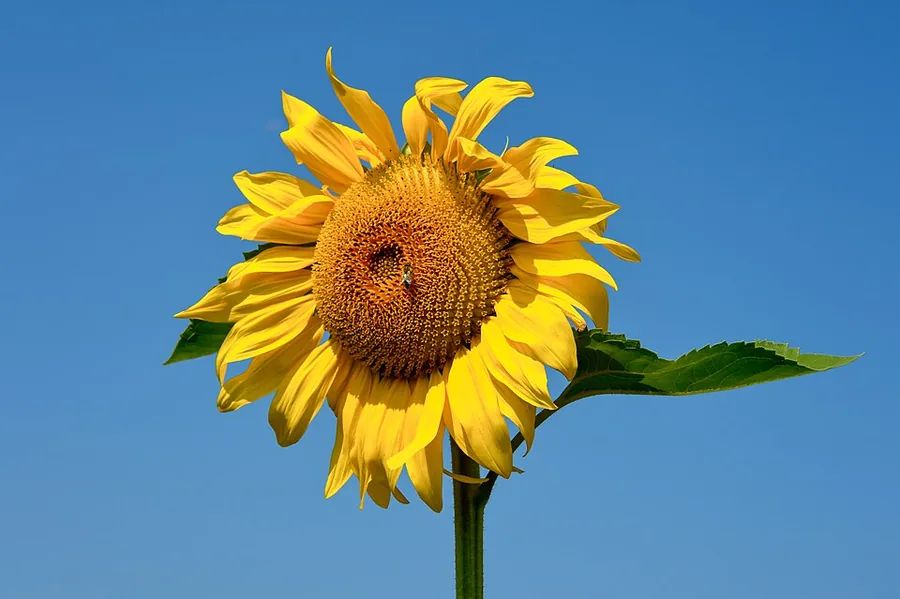
Overview
The sunflower ranks among the most recognizable members of the Asteraceae, the daisy family, and it grows wild through much of North America. A fast grower, it can build a stem topping 10 feet (3 m) from a single seed in one season, provided it sits in full sun, its ideal exposure.
Cultivated forms span a wide range. The single-stem giants concentrate their energy into one large head and a heavy set of seed, while branching selections spread bloom across many smaller heads over an extended period. Growers who cut for the vase favor pollenless single-stem forms because they shed no pollen to soil the flowers, and dwarf selections stay compact enough for a window box.
Few ornamentals demand less. Given sun, warm soil, and adequate spacing, the sunflower establishes quickly and, once its deep taproot is set, tolerates drought with little intervention. The main constraint is scale, as the tallest cultivars grow top-heavy and need staking and a sheltered site before the heads reach full weight.
Care
The short version: full sun, a deep and well-drained soil of average fertility, and consistent moisture through establishment and again around bloom, tapering off once the root system matures and the plant becomes drought tolerant.
Light
The sunflower requires full sun, the single most important factor in its performance. Direct light fuels the thick stems and large heads it is known for, so the most open position available serves it best. In shade the stems weaken and lean, and flowering drops off sharply.
Water
Keep the soil evenly moist during germination and establishment, when the shallow young roots cannot yet reach reserves. Then water deeply and regularly for roughly 20 days before and after flowering, the demand peak when the developing heads draw the most. After establishment the plant is markedly drought tolerant and needs little supplemental water.
Soil
Provide deep, loose, well-drained soil of average fertility. The species produces a strong taproot that must penetrate freely, so loosening any compacted pan before sowing pays off in anchorage and drought access. High fertility is unnecessary, and ordinary garden soil is sufficient.
Humidity
Ambient outdoor humidity suits the plant, so no specific level applies. Air movement is the variable that counts, because still, damp foliage creates the conditions downy mildew needs to establish.
Feeding
Nutrient demand is modest. A single side-dressing of slow-release all-purpose fertilizer once several true leaves have formed covers the season. Hold nitrogen in check, since a surplus pushes vegetative growth and disease susceptibility at the expense of flowering.
Pruning
Pruning is minimal. Deadheading spent flowers on branching types redirects energy into further bloom, and removing damaged or diseased tissue limits the spread of problems.
Size & spacing
Mature height ranges from 18 inches to 1.5 to 10 feet (0.5 to 3 m) by cultivar, with a spread of 1.5 to 3 feet (46 to 91 cm). Select a form scaled to the site and space plants so air passes freely, which also lowers disease pressure.
When to plant
As a warm-season annual, the sunflower has no frost tolerance, so timing follows soil temperature rather than the calendar alone. Direct-sow after the last spring frost, once the soil holds at least 60°F (16°C), and expect bloom from mid summer into fall. The seed heads are ready in early fall, when the reverse of each head turns yellow-brown and nods.
Northern hemisphere
Southern hemisphere
Typical months for a temperate climate: start earlier in warm zones, later where spring frosts linger.
- Sow: Usually unnecessary; sunflowers resent transplanting, so indoor starting is generally not recommended
- Plant: After the last spring frost, once soil has warmed to at least 60°F (16°C)
- Harvest: Blooms mid to late summer into fall; harvest seed heads in early fall when the back of the head turns from green to yellow-brown and nods downward
Hardiness
USDA hardiness zones: 2–11
Temperature: down to -46°C
Troubleshooting
Sunflower disorders concentrate in three areas: the foliage, the flower heads, and the tall stems. Early detection keeps most of them minor, since the causal agent is easiest to check before it establishes. Identify the symptom below, then apply the matching measure while it remains effective.
Tunneling and webbing among the developing seeds
The damage points to caterpillars, commonly sunflower moth larvae, which enter the head and consume buds, petals, and immature seed. Opening an affected head reveals the tunneling, webbing, and frass they leave among the seeds. Handpick where feasible, cut out heavily infested heads, and time a labeled control to early flowering, when the young larvae are most exposed.
Fix:
- Handpick caterpillars where practical
- Remove and destroy heavily infested heads
- Apply a labeled biological or insecticidal control at early flowering if needed
Chlorotic blotches above with gray sporulation beneath
These signs indicate downy mildew, a fungal pathogen that advances in cool, wet conditions and produces pale upper-surface blotches over gray growth on the underside. It distorts and stunts new growth as the infection moves through the tissue. Remove and destroy affected plants, widen spacing to improve airflow, and keep irrigation off the foliage to deny the pathogen the surface moisture it requires.
Fix:
- Remove and destroy affected plants and debris
- Improve air circulation and avoid overhead watering
- Plant resistant cultivars where available
Maturing seed removed from the head before harvest
The losses come from birds, which detect ripening seed and strip the heads as they fill. Covering each head with mesh or row cover once the seed begins to plump forms a physical barrier. Scare devices such as spinners, reflective tape, or an owl decoy help temporarily, and cutting near-mature heads to finish drying indoors removes the seed from reach entirely.
Fix:
- Cover maturing heads with mesh or row cover
- Use scare devices such as spinners, reflective tape, or owl decoys
- Cut and dry nearly mature heads indoors to finish ripening
Tall stems bending or breaking in wind and rain
This is lodging, the failure of top-heavy single-stem giants whose head weight overcomes stem and root support in wind or rain. Staking the tall cultivars before the heads fill provides the missing support. Deep, even watering develops a stronger, more anchoring root mass, and a sheltered site reduces the mechanical load altogether.
Fix:
- Stake tall and giant cultivars
- Provide deep, even watering to encourage strong rooting
- Site plants where they are sheltered from strong wind
Sticky honeydew and colonies of small insects on the stems
The culprit is an aphid colony, soft-bodied insects that congregate on stems and leaf undersides and excrete the sticky honeydew you see. A firm jet of water dislodges them physically, after which resident lady beetles and lacewings suppress the survivors. Reserve insecticidal soap for heavy infestations, since routine spraying also removes those beneficial predators.
Fix:
- Dislodge aphids with a strong jet of water
- Encourage natural predators such as lady beetles and lacewings
- Apply insecticidal soap if populations are heavy
Toxicity
Toxicity is not a concern with this species. The ASPCA classifies the sunflower as non-toxic to cats, dogs, and horses, and the seed is a standard food for both people and birds. Incidental browsing of a leaf or petal carries no risk.
Safe for
People · Cats · Dogs · Horses · Rabbits · Livestock · Birds
Cats None
Cats are unaffected by sunflowers, and a bite of leaf or petal produces no meaningful harm.
Dogs None
Dogs tolerate sunflowers without issue, and the seed is a sound treat in measured amounts.
Horses None
Horses are safe grazing near sunflowers, which the ASPCA records as non-toxic to the species.
Rabbits Safe
Rabbits can consume the leaves and flowers without adverse effect, so an eaten stem is inconsequential.
Livestock Safe
Cattle, goats, and sheep are unharmed by sunflowers, and the seed serves as a recognized feed component.
Birds Safe
Birds consume sunflower seed without harm, and a ripened head functions as a natural feeding station.
People Safe
The seed is widely eaten raw or roasted, and no part of the plant poses a hazard to people.
Varieties
Named sunflowers number in the thousands, yet a small set of forms accounts for most garden use, ranging from the tallest giants to purpose-bred cut flowers. The following are the ones worth recognizing.
Mammoth (Russian Giant)
This is the tall single-stem giant selected for its outsized heads and a heavy yield of edible seed.
Autumn Beauty
A branching selection that produces numerous smaller flowers in warm autumn tones across a long season.
ProCut and Sunrich series
These pollenless single-stem series are bred specifically for clean, durable cut stems.
Teddy Bear
A dwarf bearing dense double flowers, well suited to confined beds and container culture.
How to propagate
Propagation is by seed alone, which places the sunflower among the most straightforward plants to raise from the start.
SeedEasy
Direct-sow after the last spring frost once soil has warmed to at least 60°F (16°C) · Germinates in about 7 to 10 days
Direct-sow into the final position after the last spring frost, once the soil reaches at least 60°F (16°C), since the species does not transplant well. Place seed 1 to 2 inches deep, and germination follows in about 7 to 10 days. Because the taproot resents disturbance, avoid indoor starting and sow where the plants are to grow.
Myths
The mature sunflower rotates its head to follow the sun across the sky throughout the day.
Sun-tracking belongs to the vegetative stage: young shoots swing from east to west by day and return east overnight. As the head opens at anthesis, the oscillation ceases permanently. At maturity the heads settle facing east rather than following the sun.