Vegetable · Asteraceae
Sunchoke
Helianthus tuberosus
A hardy perennial sunflower grown for its tubers, productive for years once its spread is contained.
Full sun
Every 7–10 days
120–150 days
USDA 3–9
Overview
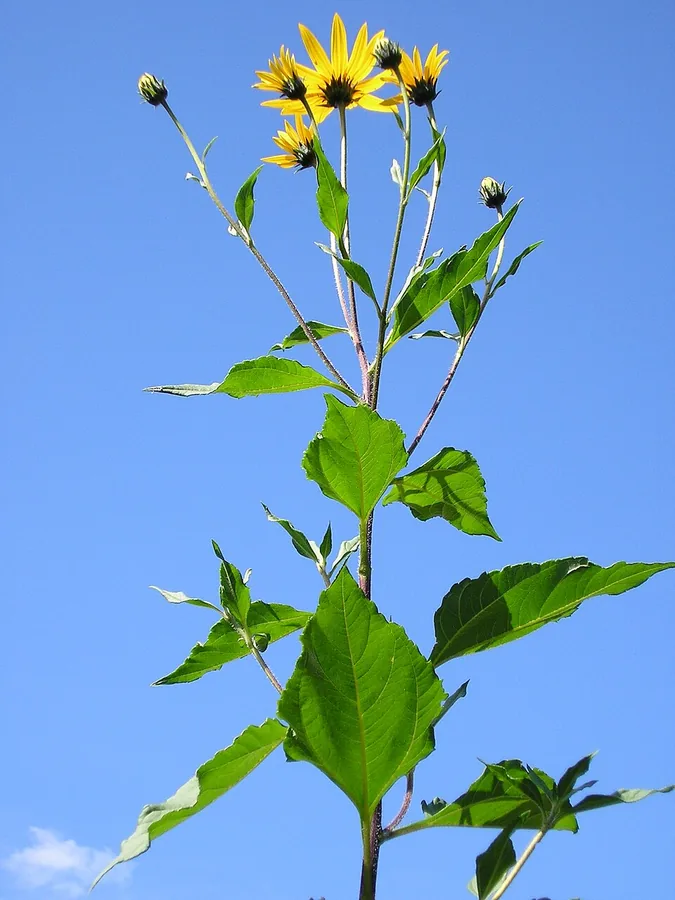
Helianthus tuberosus is a North American sunflower cultivated for its tubers rather than its inflorescence. The Jerusalem artichoke name misleads on both counts, as the species is unrelated to true artichokes and has no geographic tie to Jerusalem. It is a tall herbaceous perennial that produces yellow, sunflower-like flower heads in late summer above starchy tubers with a faintly nutty, sweet flavor.
The species owes its reputation for ease to a wide tolerance for cold and marginal soil. It withstands winter lows near -22°F (-30°C) and crops on poor ground with minimal input. That same vigor accounts for its weediness, since any tuber left in the soil overwinters and resprouts to found a new stand the following spring.
Manage it as a permanent bed rather than a rotated annual. Site it where lateral spread is acceptable, or restrict the root zone with a buried barrier or a large container, and it returns a substantial tuber yield that stores in place through winter. The tubers hold better in the ground than in most root cellars until the soil freezes hard.
Care
The short version: site in full sun on well-drained loam, water deeply through drought so the tubers size up, and enclose the planting within a bordered bed or buried barrier to limit rhizomatous spread.
Light
Full sun drives the strongest performance, yielding the tallest stalks and the heaviest tuber set. The plant still crops under partial sun or light shade, but production falls, so reserve full sun for this crop.
Water
Water deeply every 7 to 10 days during dry weather, and give closer attention in late summer and fall while the tubers are bulking, the phase when moisture most directly limits yield. Established stands tolerate drought, yet consistent moisture is what fills the crop out.
Soil
The species accepts most soils but performs best in loose, loamy ground with free drainage. Hold the pH between 5.8 to 6.8, and avoid waterlogged sites, since saturated soil predisposes the tubers to rot.
Temperature
Cold hardiness is exceptional. The plant survives winter lows of -22°F (-30°C) and continues active growth through summer highs near 86°F (30°C), a range that suits a broad band of temperate regions.
Humidity
Ambient humidity of 40% to 60% is adequate and rarely a limiting factor outdoors. Airflow matters more than any figure, because still, humid air within crowded stands favors powdery mildew late in the season.
Feeding
Nutrient demand is low. A single balanced feed in spring suffices, and excess nitrogen only promotes leggy, top-heavy stalks that are more prone to lodging.
Pruning
Routine pruning is unnecessary, but cutting the tall flowering stalks back in late summer limits reseeding and reduces lodging in top-heavy stems. Remove dead stems after frost, and mow colonies where containment is the priority.
Repotting
Container culture is atypical for this crop. Where it is grown in a contained bed or large pot, lift and divide the tubers each season to renew the planting and relieve congestion.
Size & spacing
Allow generous space, as mature stalks reach 6 to 10 feet (1.8 to 3 m) and each clump occupies 2 to 4 feet (60 to 120 cm) of width. The stand casts significant shade, so position it where it will not overshadow lower crops.
When to plant
Cultivation follows a predictable annual sequence tied to soil temperature and frost. Tuber pieces go in during early to mid spring once the ground is workable, flowering follows in late summer, and tuber harvest begins after the first hard frost and continues through winter into early spring whenever the soil is not frozen.
Northern hemisphere
Southern hemisphere
Typical months for a temperate climate: start earlier in warm zones, later where spring frosts linger.
- Plant: Early to mid spring, once soil can be worked, by planting tuber pieces 10-15 cm deep
- Harvest: Yellow sunflower-like blooms in late summer to fall; harvest tubers after the first hard frost and through winter into early spring
Hardiness
USDA hardiness zones: 3–9
Temperature: down to -40°C
Troubleshooting
Problems with sunchoke are few and generally concern containment rather than plant health. Monitor the tubers, the tall stalks, and the perimeter where volunteer shoots appear. Identify the disorder below and intervene early, before it becomes established.
Volunteer shoots emerging well beyond the original planting
The cause is the species' aggressive spread, sustained by tuber fragments left at harvest and by rhizomes advancing from established clumps. A single overlooked fragment overwinters and resprouts the next spring to establish a new colony. Excavate every fragment you locate, confine plantings within a bordered bed or buried barrier, and mow volunteer shoots before they translocate energy into fresh tubers.
Fix:
- Dig and remove every tuber fragment repeatedly over several seasons
- Confine plantings to a bed bordered by buried barriers or grow in large containers
- Mow or cut emerging shoots before they store energy in new tubers
Watery, decaying tubers bearing cottony white growth
The agent is sclerotinia soft rot, a fungus that establishes in soggy, poorly drained soil and at wound sites where tubers were bruised during digging. Infection renders the tubers watery and discolored and advances fastest in saturated ground. Discard affected tubers, correct the drainage, and cure and store sound tubers cool and slightly moist rather than wet.
Fix:
- Discard affected tubers
- Improve soil drainage and avoid waterlogging
- Cure and store harvested tubers cool and slightly moist, not wet
Powdery white film across the upper foliage
Late in the season, crowded and humid stands are colonized by powdery mildew. The fungus spreads white patches over the leaf surface and drives premature yellowing and drying, though the injury is largely cosmetic at that stage. Thin the stems to improve air circulation and remove any heavily infected foliage.
Fix:
- Improve air circulation by thinning stems
- Remove and dispose of heavily infected foliage
Tall stalks leaning or collapsing after wind or rain
At a mature 6 to 10 feet (1.8 to 3 m), the stalks are predisposed to lodging on exposed sites and in rich soil. Top-heavy stems tip from the base or fracture mid-stalk once wind and rain load them. Provide staking or a wind-sheltered fence, and cutting the stalks back partway in midsummer limits the top-heavy growth that causes it.
Fix:
- Provide staking or grow against a wind-sheltered fence
- Cut stalks back partway in midsummer to reduce height
Toxicity
The safety profile is straightforward. All tissues of the sunchoke are safe for people and pets, with no toxic compounds documented in the leaves, stems, or tubers. The one caveat concerns inulin, a fermentable fiber concentrated in the tubers that can provoke gas when consumed in quantity by a person or animal, an effect of digestion rather than toxicity.
Safe for
People · Cats · Dogs · Horses · Rabbits · Livestock · Birds
Cats None
Safe for cats, with no toxic constituents in the leaves, stems, or tubers. A cat that nibbles a stalk may experience mild, transient gastrointestinal upset, but nothing hazardous.
Dogs None
No poisoning risk to dogs. A dog that unearths and eats a tuber may pass additional gas from the inulin, which resolves without intervention.
Horses Safe
Horses graze the foliage without harm, and the tubers make a wholesome, starchy supplement in moderate amounts.
Rabbits Safe
Rabbits tolerate the leaves and tubers well. Introduce any new food gradually, as with any fresh green, to maintain gut stability.
Livestock Safe
Cattle, goats, sheep, and pigs all consume sunchoke tops and tubers, and the crop is sometimes grown deliberately as livestock forage.
Birds Safe
Backyard poultry and wild birds feed on the plant without trouble, and the spent seed heads attract them once flowering ends.
People Safe
The tubers are a long-established food, eaten raw or cooked. Their high inulin content, a fiber humans do not fully digest, can produce gas after a large serving, a digestive response and not poisoning.
No special handling precautions for toxicity; tubers are high in inulin, which can cause gas and digestive upset if eaten in quantity by people, but this is a dietary effect and not poisoning.
Varieties
Several named selections merit consideration, chosen largely for smoother tuber form that eases cleaning and preparation. The following are the most widely available.
Stampede
An early selection bearing large, white-fleshed tubers that yields reliably even in regions with a short season.
Red Fuseau
Produces long, smooth, red-skinned tubers that clean far more readily than the knobbier types.
Mammoth French White
A vigorous, tall selection that yields abundant large, knobby white tubers.
Fuseau
Valued for smooth, elongated tubers with few knobs, which streamlines washing and preparation.
How to propagate
Propagation is vegetative and effortless, since the tubers themselves are the planting stock and the species multiplies whether or not it is encouraged.
Bulbs & cormsEasy
Early to mid spring · One growing season to a harvestable colony
Set whole tubers or divisions, each bearing at least one bud or eye, at a depth of 4 to 6 inches (10 to 15 cm) in early to mid spring, treating them as you would a bulb or corm. They establish rapidly and form a harvestable colony within a single growing season, after which spread is vigorous, so select a site where a permanent stand is acceptable.
Myths
Jerusalem artichokes are a form of artichoke originating in Jerusalem.
Neither part of the claim holds. The plant is a North American sunflower, Helianthus tuberosus, unrelated to the true artichoke, and the common name most plausibly derives from girasole, the Italian term for sunflower.
The tubers can be eaten in any quantity without consequence.
The tubers are rich in inulin, a fermentable fiber the human digestive tract cannot fully break down, so a large portion produces pronounced gas and flatulence. The effect is digestive rather than an indication of toxicity.