Vegetable · Asteraceae
Cardoon
Cynara cardunculus
Supplied with a long season, rich soil, and several weeks of blanching, the cardoon yields tender stalks the trade rarely offers.
Full sun
Every 3–7 days
120–150 days
USDA 7–10
Overview
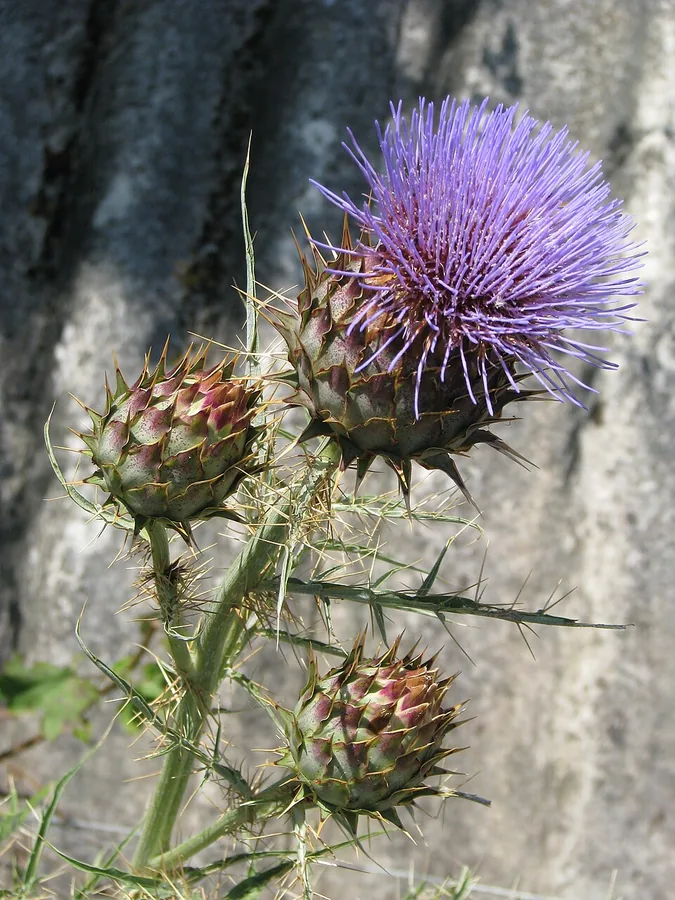
Cardoon is a large silver thistle in the Asteraceae, conspecific with the globe artichoke but selected for a different edible part. Rather than the immature flower buds, the harvested organs are the blanched leaf stalks and midribs, which cook tender and carry a faint artichoke flavor. The plant is Mediterranean in origin, where it has held a place in the kitchen garden for centuries.
Its scale follows from a fast growth rate paired with heavy feeding. A mature specimen reaches 4 to nearly 4 to 6.5 feet (119 to 201 cm) and produces arching, deeply divided leaves on spiny stalks, which gives it ornamental value well before harvest. Full sun and steady fertility drive that vigor, so the plant sizes up quickly when both are supplied.
The limiting factors are season length and blanching. Cardoon needs 120 to 150 days to reach harvestable size, and the stalks remain palatable only when excluded from light for a few weeks before cutting. Light exposure keeps the tissue green, fibrous, and bitter, which is the mechanism that turns an unblanched stalk into a tough, woody disappointment.
Care
The short version: full sun, deep and consistent moisture, and rich, well-drained soil, supported by heavy feeding through the season and a multi-week blanching period before the stalks are cut.
Light
Cardoon performs best in full sun, where direct light for most of the day drives the vigorous growth a heavy feeder requires. It will accept light partial shade, but reduced irradiance yields leaner stalks and a less vigorous plant, since the canopy cannot fix the carbon the large frame needs.
Water
Supply deep, consistent moisture throughout active growth, because water stress drives lignification and the stalks turn fibrous. Irrigation on roughly a 3 to 7 day interval suits most conditions, more under heat, yet the soil must not stay saturated, as waterlogging around the crown promotes the rot that follows.
Soil
Use deep, fertile, well-drained loam amended generously with compost or aged manure. A pH of 6.0 to 7.0 keeps nutrients available, and the open, organic-rich structure both lets the substantial root system extend and sustains the heavy top growth above it.
Temperature
The plant grows over a wide thermal range, about 32°F to 86°F (0°C to 30°C), and tolerates real heat without check. Hard frost, however, kills the stalk tissue, which is why the harvest is timed to precede deep cold rather than to follow it.
Humidity
Average outdoor humidity near 40% to 70% meets its needs, so the absolute figure is rarely limiting. Air movement is the more important variable, because still, damp air within a crowded stand favors aphid colonization and powdery mildew.
Feeding
Cardoon is a heavy feeder, and its fast growth must be matched by fertility. Incorporate ample compost or aged manure at planting to build the reserve, then apply a balanced fertilizer about monthly through spring and summer so nutrient supply keeps pace with demand.
Pruning
Remove old, damaged, or yellowing outer leaves through the season to maintain a clean, productive canopy. Roughly 3 to 4 weeks before harvest, gather the stalks and blanch them with cardboard, paper, or soil, excluding light to tenderize the tissue and suppress the bitterness that light promotes. Cut flower stalks if stalk production rather than ornament is the aim.
Repotting
Cardoon is not a container subject; it is grown in the ground and usually re-established from seed each year. The only potting involved is moving seedlings into larger cells before transplanting, which prevents root circling that would later restrict establishment.
Size & spacing
Allow for a large plant, 4 to nearly 4 to 6.5 feet (119 to 201 cm) tall with a spread of 3 to 4 feet (90 to 120 cm). Spacing at that distance maintains air movement through the canopy, which is the practical defense against the foliar problems that crowding invites.
When to plant
Cardoon is intolerant of frost and depends on a long warm season to complete growth. Sow indoors in late winter to bank that season, transplant after the cold has passed, then blanch for 3 to 4 weeks and harvest in fall before a hard frost ends the crop.
Northern hemisphere
Southern hemisphere
Typical months for a temperate climate: start earlier in warm zones, later where spring frosts linger.
- Sow: 8-10 weeks before the last spring frost
- Plant: After danger of frost has passed in spring
- Harvest: Blanch stalks for about 3-4 weeks, then harvest leaf stalks/midribs in fall before hard frost
Hardiness
USDA hardiness zones: 7–10
Temperature: down to -18°C
Troubleshooting
The stalks and the crown are where cardoon disorders concentrate, because both reflect the plant's response to water and light management. Reading the early signs lets you correct a cause before it costs the harvest. Match the symptom below, then address the underlying condition.
The plant wilts and collapses with a soft, dark crown
Brown, mushy, foul-smelling crown or root tissue following a wet period is diagnostic of crown or root rot in poorly drained soil. A plant at this stage is not recoverable and should be lifted and destroyed. Because saturation around the crown is the initiating condition, correcting drainage and reducing watering frequency before replanting is what prevents recurrence.
Fix:
- Remove and destroy severely affected plants
- Improve drainage and reduce watering frequency
Tough, stringy, or hollow leaf stalks
Fibrous, bitter stalks result from failure to blanch or from harvest delayed past maturity, with inconsistent moisture compounding the lignification. The corrective sequence is to tie and wrap the stalks 3 to 4 weeks before cutting, hold even soil moisture through that interval, and harvest as soon as the tissue tenderizes. A crosswise cut confirms the diagnosis, since an overmature stalk is hollow at the core.
Fix:
- Blanch stalks for 3-4 weeks before harvest by tying and wrapping them
- Harvest at proper maturity before stalks toughen
- Maintain even soil moisture during stalk development
Sticky residue and curled new growth on the leaves
Curled tips and a sticky honeydew film indicate aphids colonizing the undersides and growing points, whereas a white powdery coating under crowded, humid conditions indicates powdery mildew. Dislodge the aphids with a strong water jet and apply insecticidal soap only if the colony persists. Improving air circulation and removing the worst mildewed leaves addresses the fungal side by reducing the humidity that sustains it.
Fix:
- Dislodge aphids with a strong spray of water
- Apply insecticidal soap if infestation is heavy
- Improve air circulation and remove badly mildewed leaves
Toxicity
From a safety standpoint cardoon is reassuring: it is an edible vegetable and carries no toxic principle for pets, livestock, or people. The only hazard is mechanical, since the leaves and stalks are armed with sharp spines. Gloves are warranted whenever the plant is handled or harvested.
Safe for
People · Cats · Dogs · Horses · Rabbits · Livestock · Birds
Cats None
There is no poisoning risk, as cardoon is absent from the ASPCA toxic list. The only concern is mechanical, since the sharp spines can prick an investigating nose.
Dogs None
A dog can ingest the foliage without toxic consequence, because the plant contains no poisonous principle. In practice the prickly leaves deter most dogs before ingestion occurs.
Horses Safe
Cardoon presents no toxic hazard to horses. The spiny habit alone is usually enough to keep them away from the stand.
Rabbits Safe
The plant is non-toxic to rabbits and may be grazed without concern. The bristly foliage is the only effective deterrent.
Livestock Safe
Cattle, goats, and sheep may graze it without risk of poisoning. The dense spines, rather than any toxin, are what limit feeding.
Birds Safe
Birds are exposed to no toxic compound from cardoon. Backyard flocks can peck at the plant without harm.
People Safe
The blanched stalks and midribs are a traditional vegetable, eaten cooked with no adverse effect. Gloves remain advisable at harvest, because the spines abrade the skin.
The leaves and stalks bear sharp spines and prickles that can scratch or prick skin; wear gloves when handling and harvesting. This is a physical hazard, not a poisoning risk.
Varieties
The cardoons in commerce are largely Italian heirlooms selected for thick, tender stalks. The following are the cultivars worth recognizing by name.
Gigante di Romagna
A large Italian heirloom selected for its thick, fleshy leaf stalks.
Bianco Avorio
An ivory-white stalk type valued for tender, mild midribs once blanched.
Gobbo di Nizza Monferrato
The Piedmontese 'hunchback' cardoon, whose stalks curve down into the soil and self-blanch as a result.
How to propagate
Cardoon is most often raised from seed each season, the reliable method for an annual crop. In mild climates the crown of an established plant can also be divided, which preserves a chosen clone.
SeedModerate
Sow indoors 8-10 weeks before the last frost, then transplant out after frost · 120-150 days to reach harvestable maturity
Seed is the standard method. Sow indoors 8 to 10 weeks before the last frost and transplant after the cold has passed, because the crop requires a long 120 to 150 days to reach harvestable maturity and an early start banks that season.
DivisionModerate
Spring, lifting offsets/suckers from the crown of an established plant · One growing season to establish
Where winters are mild, offsets can be lifted from the crown of an established plant in spring and replanted. This vegetative route preserves a selected clone and allows the new plant a full growing season to establish.
Myths
Cardoon and the globe artichoke are entirely distinct species.
Both are forms of the single species Cynara cardunculus. Cardoon is grown for its blanched leaf stalks, while the globe artichoke is the same species selected and managed for its immature flower buds.
Cardoon is a harmless garden ornamental in every region.
In California and parts of Australia and Argentina it has escaped cultivation and become an invasive noxious weed, forming dense spiny stands across rangeland. Verify its regulatory status in your region before planting, since it can naturalize aggressively.