Vegetable · Asteraceae
Endive
Cichorium endivia
Grown cool, evenly watered, and well-spaced, endive yields crisp salad leaves across spring and fall.
Full sun
Every 3–5 days
39–75°F · 4–24°C
85–100 days
Overview
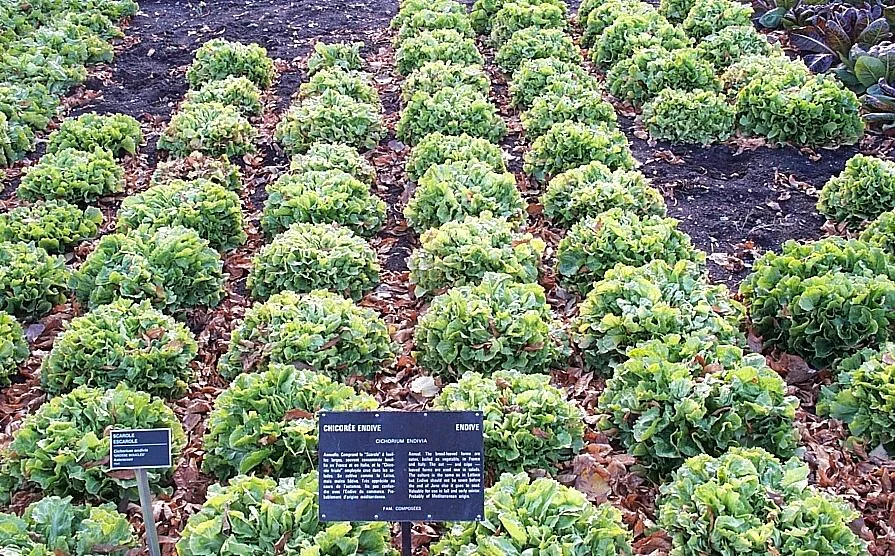
Endive is a leafy salad green in the Asteraceae, closely allied to chicory and cultivated for its frilly or broad foliage rather than for any inflorescence. Two principal forms exist: the curly, finely cut frisee and the broad, flat escarole. Both express a characteristic bitterness that diminishes once the leaves reach the table.
The species behaves as a cool-season crop. Growth peaks in spring and fall, when mild days and retained soil moisture favor leaf expansion, and the plant stalls or bolts as summer heat builds. Scheduling the crop into the cool periods of the year is what makes it one of the more straightforward greens to manage.
Blanching is the second technique central to its quality. Tying the outer leaves over the heart or covering the plant for roughly two weeks excludes light, which slows chlorophyll formation and softens the bitterness toward a sweeter, paler product. Omit the step and the result is still a sound salad green, simply a sharper one.
Care
The short version: site it in full sun to light shade, hold the soil evenly moist so the foliage never desiccates, plant into fertile ground during cool weather, apply a balanced feed, and space the plants to limit bolting and tipburn.
Light
Endive performs best in full sun, though it accepts partial shade, and some afternoon shade is in fact useful during warm spells when it reduces heat stress. Under insufficient light the leaves develop thin and loosely formed.
Water
Maintain evenly moist soil throughout, irrigating every 3 to 5 days and more frequently in dry heat. Drought stress is the trigger for bitterness, tipburn, and premature bolting, so consistent moisture is the controlling factor in quality.
Soil
Use fertile, moisture-retentive loam that nonetheless drains freely, amended with ample organic matter. A pH of 5.5 to 7.0 is suitable, and the soil's water-holding capacity is what sustains the turgor that keeps leaves crisp and sweet.
Temperature
As a cool-season green it grows well between 39°F and 75°F (4°C to 24°C) and withstands light frost. Above that range, heat induces bolting and the associated rise in bitterness.
Humidity
Average humidity of 50% to 70% is adequate, and outdoors it seldom warrants attention. Soil moisture exerts far greater influence on the plant than ambient humidity does.
Feeding
Incorporate a balanced N-P-K at planting, then side-dress with nitrogen during active leaf expansion. Restrain the nitrogen, since an excess promotes the soft, succulent growth that favors both tipburn and aphids.
Pruning
No structural pruning is required beyond removing damaged outer leaves. The pertinent operation is blanching: tying the outer leaves over the heart or covering the plant for 2 to 3 weeks before harvest to lower bitterness by excluding light.
Size & spacing
Mature plants reach 10 to 24 inches (25 to 61 cm) in height and 10 to 18 inches (25 to 46 cm) in spread. Allot each that full width, because close spacing intensifies competition and humidity, which in turn promote bolting, rot, and weak airflow.
When to plant
Because endive is governed by temperature and bolts under heat, scheduling determines success. Sow in early spring once hard frost has cleared, and again in midsummer for a fall crop, harvesting while the days remain cool. The autumn planting commonly carries the sweetest flavor, a response to the first light chill.
Northern hemisphere
Southern hemisphere
Typical months for a temperate climate: start earlier in warm zones, later where spring frosts linger.
- Sow: 4-6 weeks before the last spring frost, or in midsummer for a fall crop
- Plant: Early spring after hard-frost danger passes, or late summer for fall harvest
- Harvest: Harvest leaves/heads in cool weather before heat triggers bolting
Hardiness
USDA hardiness zones: 4–9
Temperature: down to -34°C
Troubleshooting
Most disorders of endive present on the foliage, whether from pests feeding on the leaves or from environmental cues driving the plant to bolt. Early recognition usually saves the crop. Match the symptom below, then intervene before it advances.
Stem elongation signaling the shift to reproduction
An elongating central stalk marks bolting, the plant's reproductive switch tripped by heat, lengthening photoperiod, or crowding stress. Once it commits, vegetative leaf production halts and the tissue accumulates the bitter compounds that flowering brings, a transition that cannot be reversed. Harvest the remaining usable leaves at once, and prevent recurrence by growing in spring or fall, spacing plants to ease competition, and avoiding the summer heat that triggers the response.
Fix:
- Harvest promptly once bolting begins
- Plant cool-season-timed successions instead
Marginal necrosis confined to the rapidly expanding heart
Browning at the inner-leaf margins is tipburn, a localized calcium deficiency in the fastest-growing tissue rather than a whole-plant shortage. Calcium moves with the transpiration stream, so the enclosed young heart leaves receive too little even when roots and outer leaves remain sound, and both heat and excess nitrogen sharpen the demand. Even soil moisture keeps that uptake steady, restrained nitrogen slows the surge of soft growth, and harvesting in cool weather sidesteps the worst of it.
Fix:
- Maintain even soil moisture
- Avoid over-fertilizing with nitrogen
- Harvest during cooler conditions
Curled foliage colonized by clustering small insects
The soft-bodied colonists are aphids, sap feeders whose excreted honeydew accounts for the sticky sheen on the leaves. A forceful water spray dislodges the colony mechanically, and removing the most heavily infested foliage takes out the densest feeding sites. Where pressure persists, insecticidal soap suppresses them, and reducing nitrogen matters because the lush, soft tissue it drives is exactly what aphids exploit.
Fix:
- Hose aphids off with a strong water spray
- Pinch out and discard heavily infested foliage
- Use insecticidal soap if populations persist
Irregular feeding holes accompanied by mucous trails
Slugs and snails rasp these irregular holes, feeding nocturnally and favoring the cool, damp conditions that keep their bodies from drying, with the dried mucus trail confirming the culprit. A shallow vessel of stale beer set flush to the soil exploits their attraction to fermentation volatiles and drowns them, while hand-collection after dark removes the active feeders. Clearing mulch and debris denies them the moist daytime refuge they depend on.
Fix:
- Trap with a shallow saucer of stale beer set flush to the soil
- Hand-pick at night
- Remove mulch and debris that shelter slugs
Toxicity
For households with pets or children, endive presents no toxic concern. It is an edible salad green, and no part of the plant is toxic to people or animals. It may be grown wherever curious mouths could reach it.
Safe for
People · Cats · Dogs · Horses · Rabbits · Livestock · Birds
Cats None
No toxic principle is present for cats. A leaf taken in passing might cause a brief, self-limiting digestive upset, no different from any unaccustomed green.
Dogs None
The plant poses no toxic risk to dogs, and a few leaves serve as a benign treat. Quantity is the only variable, since a large volume of any vegetable can loosen the stool, though the tissue itself contains no toxin.
Horses Safe
Horses can graze the foliage without consequence. The species carries no compounds known to affect them.
Rabbits Safe
Endive suits rabbits as one component of a varied leafy diet. Phase it in gradually, as with any new forage, to let the gut adjust.
Livestock Safe
Cattle, goats, and sheep tolerate the foliage fully, as no part of the plant holds a toxin.
Birds Safe
Backyard poultry and pet birds take the leaves readily and without hazard. It registers as a sound green in their diet.
People Safe
Cultivated expressly as food and eaten raw or cooked, endive is safe for all consumers, children included.
No special handling precautions; leaves are eaten raw or cooked by people.
Varieties
Endive resolves into a few recognized types, and the choice largely determines how sharp or mild the harvested leaves prove to be. The following are the ones most worth knowing.
Curly endive (frisee, var. crispum)
Recognizable by narrow, finely divided, curled dark-green outer leaves, it registers the most pronounced bitterness of the group.
Escarole (Batavian, var. latifolium)
Its broad, flat, smoother leaf form correlates with a distinctly milder, less bitter flavor than curly endive.
'Clodia'
A compact, self-blanching escarole, it develops tender, pale, mild hearts without manual blanching.
How to propagate
Endive is raised from seed alone, but germination is rapid and growth quick, so a fresh sowing keeps the supply close at hand.
SeedEasy
Sow in early spring or late summer for fall harvest, in cool soil · 7-14 days to germinate, with transplants set out 4-6 weeks after sowing
Endive propagates exclusively by seed. Direct-sow into cool soil in early spring or late summer, or raise transplants indoors and set them out 4 to 6 weeks after sowing. Germination occurs in 7 to 14 days, and early thinning to adequate spacing reduces the competition and humidity that drive crowding, bolting, and rot.
Myths
Belgian endive and curly endive or escarole are the same plant.
The distinction is taxonomic, not merely varietal. Belgian endive, or witloof, is forced chicory, Cichorium intybus, whereas curly endive and escarole belong to Cichorium endivia, a separate species. The overlapping common name is what produces most of the confusion at market.
Blanching turns endive into a different, sweeter variety.
Blanching alters the phenotype, not the variety. Excluding light from the heart slows chlorophyll synthesis, and that reduction in the associated bitter character is what moderates the flavor. The identical plant grown in full light simply expresses a sharper taste.