Vegetable · Asteraceae
Globe Artichoke
Cynara cardunculus var. scolymus
An architectural thistle grown for the bud you eat before it flowers.
Full sun
Every 3–7 days
45–84°F · 7–29°C
85–110 days
Overview
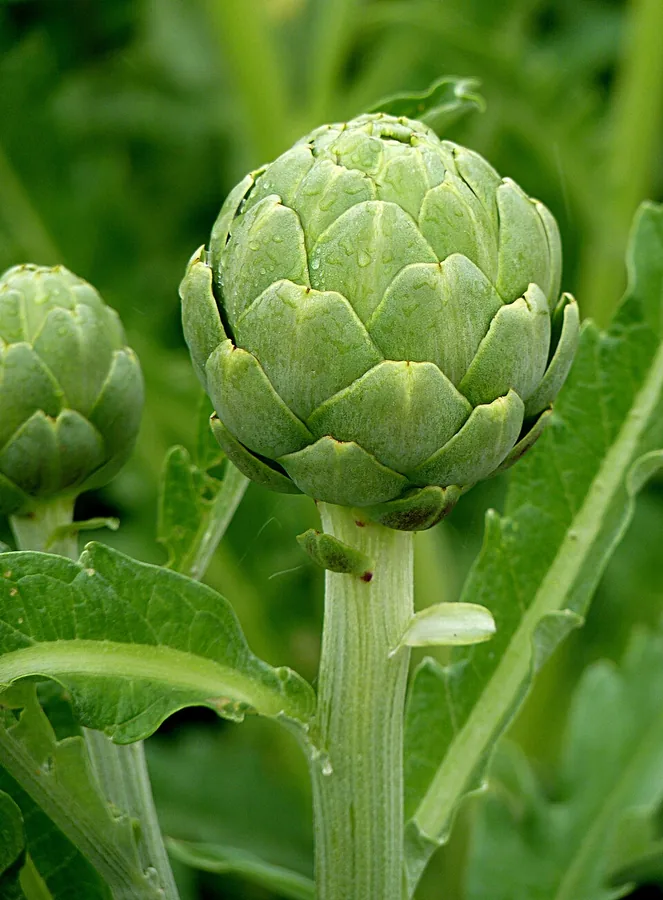
Globe artichoke is a large thistle in the Asteraceae, the same family as daisies and sunflowers, and the part you harvest is the immature flower bud, cut while the bracts are still closed. Leave a bud on the plant and it opens into a striking purple flower, which is exactly what the closed bud is on its way to becoming. The silver-green, deeply cut leaves spread several feet across, so a single plant reads as much as a sculptural shrub as a vegetable.
How long the plant lives for you depends on your climate. Where winters stay mild the crown persists in the ground and crops for years as a true perennial; where winters are hard it is grown as an annual from seed and lifted each season. The catch with annual culture is that a first-year plant only switches into bud formation after it has felt a cold spell, a response known as vernalization.
This is a heavy feeder that rewards rich, deep, well-drained ground and steady moisture, and it returns buds from summer into fall. The one failure that ends a planting outright is poor drainage, which rots the crown, so the whole approach to the soil is built around keeping water moving away from the base of the plant.
Care
The short version: give globe artichoke full sun, deep well-drained soil kept evenly moist, and monthly feeding through the growing season, because it is a large, hungry plant building big edible buds. Cut buds while tight, divide crowns every few years, and remember it needs a cold cue to bud in its first year.
Light
Site artichoke in full sun with no shade; it tolerates none. The plant gets large, and that leaf area has to be fully lit to drive the photosynthesis that fills out the buds, so a shaded plant trades crop for foliage.
Water
Keep the soil evenly moist the whole season. Deep, regular watering is what keeps the buds tender and succulent, since steady moisture lets the bud tissue swell rather than toughen. Water at the base, and never let the crown sit wet, because saturation invites rot.
Soil
Work in a rich, deep, well-drained loam high in organic matter and aim for a pH between 6.5 and 7.5. Where the ground holds water, raise the bed; the point of good drainage is to keep water from pooling around the crown, which is where rot begins.
Temperature
The working range runs from 45°F to 84°F (7°C to 29°C). A cool spell near 50°F (10°C) is not just tolerated but needed, because that chilling is what flips the plant from leaf growth into bud production.
Humidity
Ordinary outdoor humidity is fine; no special level is required. Airflow matters far more, since damp, crowded foliage is what favors the pests and rots that trouble this plant, so space and ventilation do more good than any humidity target.
Feeding
Treat it as a heavy feeder. Work compost into the bed at planting and feed monthly through spring and summer with a nitrogen-rich balanced fertilizer, supplying the nutrients a fast-growing, bud-heavy plant pulls from the soil.
Pruning
Cut buds while they are still tight, before they open. After harvest, take the spent flowering stalks off at the base. In cold zones cut the foliage to the ground and mulch the crown to carry it through winter; in mild zones cut back old growth in late winter to push fresh shoots.
Repotting
This is not a container plant. To keep a planting vigorous, divide established crowns every 3-4 years, since an aging crown loses productivity and division renews it.
Size & spacing
Expect 3 to 6 feet (90 to 180 cm) in height with a spread about as wide. Allow roughly 3 feet (90 cm) per plant; that spacing is what gives each crown the airflow it needs to stay free of rot and pests.
When to plant
Artichoke has a split requirement: it needs warmth to grow but a cold period to bud. The calendar below works with that, starting seed indoors in late winter, chilling the young plants, moving them out after the last frost, and harvesting tight buds from summer into fall.
Northern hemisphere
Southern hemisphere
Typical months for a temperate climate: start earlier in warm zones, later where spring frosts linger.
- Sow: Start seed indoors 8-10 weeks before the last spring frost, then chill/vernalize the seedlings (expose to roughly 50°F / 10°C for 10 or more days) so they will form buds the first year.
- Plant: Transplant after the last frost once soil has warmed, in spring.
- Harvest: Harvest the immature flower buds in summer (and into fall) before the bracts begin to open.
Hardiness
USDA hardiness zones: 7–11
Temperature: down to -18°C
Troubleshooting
Most problems on artichoke trace back to two things: insects drawn to soft new growth or hidden in the bud, and water sitting where it should not. The entries below pair each symptom with the mechanism behind it so the fix addresses the cause, not just the surface damage.
Crown rot from saturated soil
When ground stays waterlogged the roots are starved of oxygen and soil fungi move in, decaying the crown so the plant wilts even though water is plentiful.
Fix:
- Remove and destroy affected plants
- Improve soil drainage before replanting
- Avoid replanting artichokes in the same wet site
Aphids massing on tender shoots
Soft new tissue is the easiest feeding site for aphids, and the sugary honeydew they excrete recruits ants that defend the colony, so populations climb fast unless you break the cycle early.
Fix:
- Dislodge with a strong jet of water
- Apply insecticidal soap
- Remove and destroy heavily infested leaves
No buds without a cold trigger
Bud initiation depends on a chilling cue, so a plant grown from seed without vernalization will keep building leaf and stem and never switch into flowering its first year.
Fix:
- Vernalize transplants for 10 or more days near 50°F / 10°C before setting out
- Overwinter plants as perennials in mild zones to bud the following year
Aphids sheltering inside the bud
A tightening flower head makes an ideal hiding place, so aphids that worked their way between the bracts often go unseen until the bud is split open in the kitchen.
Fix:
- Soak cut buds in cold salted water to flush out insects
- Harvest buds promptly while still tight
- Control aphids on plants before they enter the bud
Slugs and snails grazing at night
These pests feed after dark and retreat by day, so the silvery slime trails are usually the first clue that mollusks, sometimes alongside earwigs, are rasping holes in the foliage.
Fix:
- Handpick at night
- Set out traps or iron-phosphate slug bait
- Remove damp hiding places near plants
Toxicity
Globe artichoke is a food crop, not a poison plant, and it is not on the ASPCA's toxic list for cats or dogs. The only thing to manage is physical, the sharp spine tips on some bracts and the bristly foliage, so the notes below sort the genuine non-issue of toxicity from the real hazard of handling.
Safe for
People · Cats · Dogs · Horses · Rabbits · Livestock · Birds
Cats None
No toxin is present, so the plant poses no poisoning risk; the bristly foliage tends to deter a curious cat more than it harms one.
Dogs None
There is nothing poisonous here, though a dog that eats a large quantity of the fibrous leaf may pass looser stool, as it would with any rich plant matter.
Horses Safe
No poison is involved, and the coarse, prickly leaves are unpalatable enough that horses rarely bother with them.
Rabbits Safe
The tender leaves are harmless; introduce them gradually, since any sudden flush of fresh greens can loosen a rabbit's gut.
Livestock Safe
Cattle, goats, and sheep graze artichoke and the related cardoon without harm; the only thing to watch is the sharp bracts on spiny types.
Birds Safe
No toxin affects birds, and chickens will peck at leaf and stem scraps with no ill effect.
People Safe
The cooked buds are eaten worldwide and carry no toxic risk; the only real hazard is physical, the sharp bract tips, so wear gloves when handling.
The bracts of some varieties have sharp spine tips and the foliage is bristly, which can prick or irritate skin during handling and harvest. This is a physical hazard, not poisoning.
Varieties
Choice of variety comes down to your climate and the bud you want. Some types are bred for perennial culture in mild regions, others to crop from seed in their first year, and a few simply for unusual color, as the entries below explain.
Green Globe
The most widely grown green-budded type and the standard choice for perennial culture in mild-winter regions.
Imperial Star
An annual-type cultivar bred to set buds in its first year from seed with little chilling, which makes it the pick where winters are too cold for perennial growing.
Violetto di Romagna
An Italian heirloom that bears long, elongated purple buds rather than green ones.
Green Globe Improved
A selected strain of Green Globe that yields more uniform, more productive plants.
How to propagate
There are two routes, and they answer different needs: seed gets you many plants but with variation, while division copies a parent crown exactly. The notes below cover why each behaves as it does and when to reach for it.
SeedModerate
Start indoors 8-10 weeks before last frost, then vernalize seedlings before transplanting · First buds in roughly 85-110 days from transplant when seedlings are vernalized
Because seedlings carry the chilling cue forward, a vernalized transplant can flower its first year; expect variation among seed-grown plants and lean on an annual-type cultivar like Imperial Star for a dependable first-season crop.
DivisionEasy
Late winter to early spring · Rooted offshoots establish within one growing season
Division is the reliable way to copy a plant exactly: detach a rooted sucker from the parent crown and pot it, and the rooted piece settles in within one season and comes true to the parent.
Myths
Artichokes are poisonous to pets
This is an everyday edible vegetable, not listed by the ASPCA among plants toxic to cats or dogs; the only genuine danger is physical, the sharp spines on some bracts.
Artichokes grow true to type from seed like most vegetables
Seed-grown plants vary considerably, which is why dividing rooted offshoots from a parent crown is the way to get uniform stock; only a few cultivars such as Imperial Star reliably bud the first year from seed.